
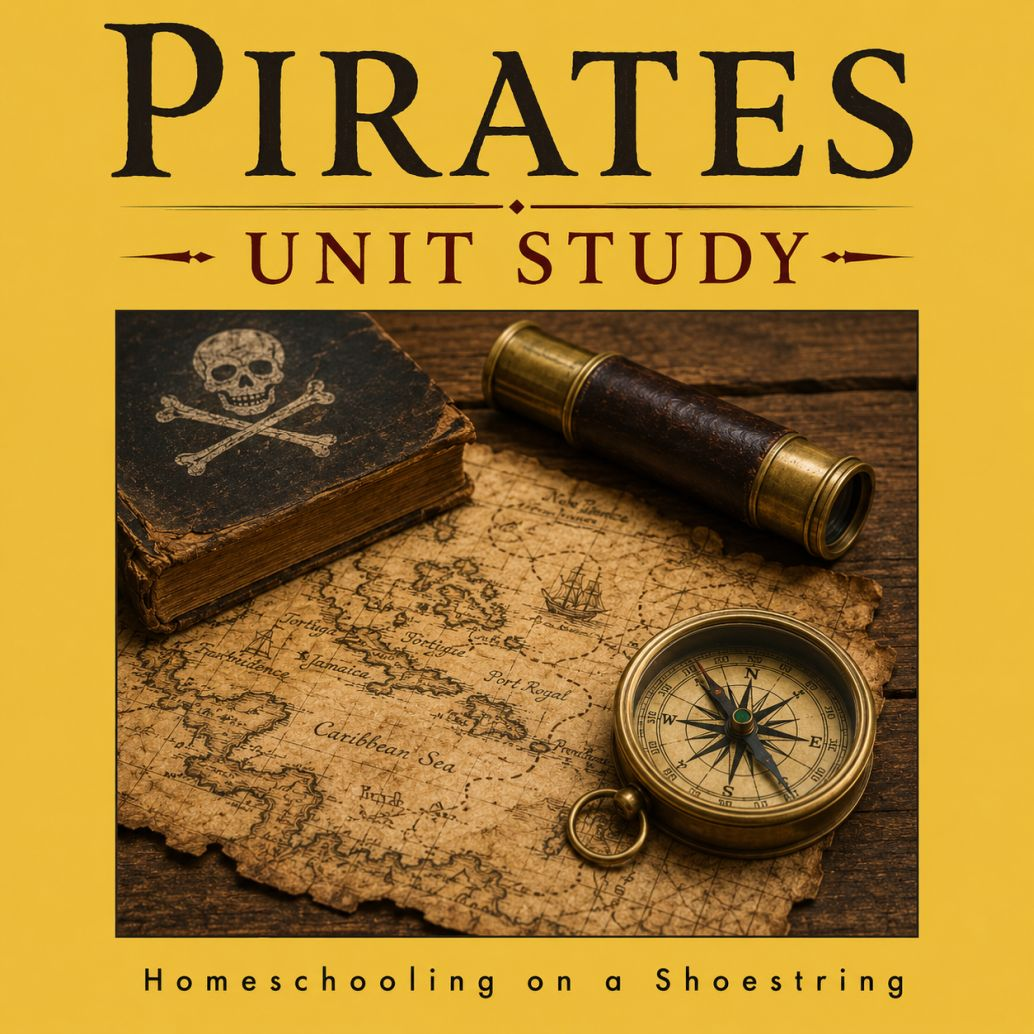
Pirates Unit Study
Set sail for adventure! This Pirates unit study covers the Golden Age of Piracy, famous pirates, navigation, ship life, and the difference between pirates and privateers. It weaves together history, science, math, language arts, music, and the arts for a hands-on, budget-friendly exploration of the high seas. Nearly everything here can be done free or very low cost.
The unit is suitable for grades K–12, with flexibility to adapt based on your learners’ ages and abilities. Please preview links and activities to ensure they are appropriate for your family. New resources will be added as time allows.
Many of the links below lead to printable resources that can be added to a notebook or lapbook for this study.
Learning Objectives
Many parents and teachers will need to create their own goals. You can compare the goals at these sites to create your own goals depending on how stringent your requirements need to be. All links have several suggested activities for different ages.
Suggested Curriculum Standards:
- World Book Scope Basic Course structure https://www.worldbook.com/free-educational-resources#tcos
- Michigan Department of Education https://www.michigan.gov/mde/services/academic-standards
- Maine as an example of state level requirements https://www.maine.gov/doe/ela/standards/index.html
- California state level requirements https://www.cde.ca.gov/be/st/ss/
- McREL Compendium National Level https://www2.mcrel.org/compendium/
- Ontario Canada K-8 Expectations https://www.dcp.edu.gov.on.ca/en/curriculum#elementary
- Abeka Scope and Sequence https://www.abeka.com/HomeSchool/ScopeAndSequence.aspx
- The series of books called “What your nth Grader needs to know” May also be helpful nth representing the grade your child is in. This series only Goes to grade 8
- Explain the difference between a pirate, privateer, buccaneer, and corsair
- Identify key figures from the Golden Age of Piracy and discuss their real history
- Locate major pirate trade routes and regions on a world map
- Understand basic navigation concepts including compass use, latitude, and longitude
- Apply math skills through treasure-map coordinates, measurement, and trading scenarios
- Recognize the science behind wind, weather, and ocean currents that affected sailing
- Read, analyze, and write in a variety of genres connected to the pirate theme
- Create artwork, music, and media inspired by maritime and pirate history
Timeline
- Ancient piracy – 3000 BCE: Aegean and Mediterranean Sea pirates raided early trade routes
- Viking Age – 793-1066 CE: Norse raiders terrorized European coastlines
- Barbary Corsairs – 1500s-1800s: North African pirates raided Mediterranean and Atlantic shipping
- Golden Age of Piracy – approximately 1650-1730: Peak of Caribbean and Atlantic piracy
- 1668: Henry Morgan sacks Portobelo, Panama
- 1696-1701: William Kidd sails as privateer, later hanged as pirate
- 1717-1718: Blackbeard (Edward Teach) at height of his power
- 1718: Blackbeard killed off North Carolina coast
- 1720: Anne Bonny and Mary Read captured near Jamaica
- 1724: A General History of the Pyrates published by Captain Charles Johnson
- 1883: Treasure Island by Robert Louis Stevenson published
- 1984: Whydah Gansway shipwreck discovered off Cape Cod
Vocabulary
| Ahoy | Crew | Loot | Raid |
| Anchor | Crow’s Nest | Map | Rudder |
| Avast | Cutlass | Marooned | Sail |
| Bow | Deck | Mast | Ship |
| Brigantine | Eye Patch | Matey | Shiver Me Timbers |
| Buccaneer | Flag | Mutiny | Smuggler |
| Cannon | Galley | Navigation | Spyglass |
| Captain | Galleon | Parrot | Starboard |
| Captain’s Quarters | Hook Hand | Peg Leg | Stern |
| Cargo Hold | Island | Pirate | Treasure |
| Castaway | Jolly Roger | Plunder | Treasure Map |
| Compass | Landlubber | Port | Voyage |
| Corsair | Longboat | Privateer |
WordWeb Dictionary – Free downloadable dictionary software for looking up definitions without needing an internet connection.
Dictionary.com – Look up definitions and hear correct pronunciation for any vocabulary word in this unit.
Copy each word and its definition onto a sheet of paper for your portfolio.
Make Flash Cards – Print the vocabulary words on the front and have kids hand write the definition in their own words on the back. It helps them remember the definitions better.
Word Puzzles
Word searches boost visual recognition and spelling through repetition. Word scrambles build memory and problem-solving as kids piece words together. Both improve focus and keep learning low-pressure and engaging. Have kids use the words in a sentence or drawing afterward to reinforce meaning.
Below are word puzzles I created for this unit.
Word Search Maker – Type in your pirate vocabulary list and print a custom word search for free.
Word Scramble Maker – Turn your vocabulary list into a printable word scramble activity.
Book Resources
Picture Books and Early Readers
Treasure Hunts! Treasure Hunts! – by Lenny Hort
Red Rackham’s Treasure (Adventures of Tintin) – by Hergé
Middle Grade and Up
Holes – by Louis Sachar (treasure, buried secrets, and consequences)
The Treasure Hunter – by William Boniface
The Treasure Hunt Book – by Klutz
Reference and Nonfiction
Atlas of Shipwrecks and Treasure – by Nigel Pickford
Lost Treasure Ships of the Twentieth Century – by Nigel Pickford
Magic Tree House
Pirates Past Noon (Magic Tree House #4) – Jack and Annie land in the middle of a pirate adventure. A great entry point for younger students and a natural read-aloud to open the unit.
Free Books – Project Gutenberg
Parents are encouraged to preview these titles before sharing with children, as they contain historical accounts of piracy and violence.
Treasure Island by Robert Louis Stevenson
The Pirates Own Book by Charles Ellms
The Complete Plays of Gilbert and Sullivan (includes The Pirates of Penzance)
Among Malay Pirates by G. A. Henty
Howard Pyle’s Book of Pirates
Buccaneers and Pirates of Our Coasts by Frank Richard Stockton
The Pirates of Malabar
Free Audiobooks – LibriVox
LibriVox Pirate Audiobooks – Free volunteer-recorded audiobooks related to this unit. A great option for audio learners or long car rides. Parents should listen first, as these titles involve violence by natur
Activities and Lesson Plans
Social Studies and History
- Research a real pirate such as Blackbeard, Anne Bonny, Mary Read, Calico Jack, or Bartholomew Roberts. Write up what you find or add it to your lapbook.
- Compare pirate fact vs. fiction. Watch a pirate film clip (with parental guidance) and look for things that were historically accurate and things that were made up.
- Discuss the difference between a pirate and a privateer. Why did governments issue Letters of Marque? Was that practice fair?
- Plot famous pirate voyages and raid locations on a world map using an atlas or free printable map.
- Create a simple Venn diagram comparing life for a pirate crew member vs. a merchant sailor in the 1700s.
- Study the Pirate Code. Many ships had actual written codes of conduct. Try drafting your own family or crew code of conduct using that as inspiration.
- For older students: Research the connection between piracy, colonial trade routes, and the transatlantic slave trade. Some formerly enslaved people found freedom by joining pirate crews.
Free Printable World Maps – Print a blank world map for plotting pirate voyages, trade routes, and raid locations. Works well alongside the coordinate and geography activities in the math section.
Overview of Piracy – Wikipedia – A solid starting point for understanding the full history of piracy across different time periods and regions of the world.
Famous Pirates Facts and Information – Student-friendly profiles of well-known pirates with key facts, dates, and context. Good for research and reading comprehension.
English Language Arts
- Write a first-person pirate journal entry from the perspective of a crew member on a three-week voyage. What did you eat? What did you see? How did you feel?
- Create a coded message using a simple substitution cipher. Trade with a sibling or friend to decode.
- Write a newspaper front page announcing the capture of a famous pirate. Include a headline, dateline, quotes, and illustration.
- Read a passage from Treasure Island (free at Project Gutenberg) and retell it in your own words. Look up any unfamiliar words.
- Compare two accounts of the same pirate – one historical, one fictional. How do they differ and why?
- Write a persuasive paragraph: Should governments have used privateers? Pick a side and argue it.
- Make an illustrated glossary of pirate slang terms from your vocabulary list.
Pirate Reading Comprehension from EdHelper – A printable passage with questions covering pirate history and vocabulary. Good for independent work or discussion.
Famous Pirates Reading Comprehension – Student-friendly profiles and fact sheets on well-known pirates. Use as a research starting point or a standalone reading comprehension activity.
Poetry and Writing Extensions
How to Write an Onomatopoeia Poem – A kid-friendly lesson on writing poems using sound words. Try it with pirate sounds: creak, crash, splash, boom, clang.
Poetry Worksheet Template – A simple printable template for writing and illustrating original poems. Use it for ballads, acrostics, or any poetry activity in this unit.
Write a ballad about a pirate’s last voyage. A ballad tells a story in verse, usually with 4-line stanzas and a repeating refrain.
Write an acrostic poem using the word PIRATE. Each letter starts a line that describes something from the unit.
Treasure Island
Treasure Island by Robert Louis Stevenson is the cornerstone novel of pirate fiction and worth its own mini-study.
Treasure Island – Wikipedia – Background on the novel, its characters, and its place in literary history. Good context before or after reading.
Treasure Island – Free Full Text at Project Gutenberg – Read the complete novel for free online or download it to any device.
Treasure Island Study Guide at SparkNotes – Chapter summaries, character analysis, and discussion questions for older students working through the novel independently.
Treasure Island – Free Audiobook at LibriVox – Listen to the full novel read aloud for free. Great for younger students or as a family listening experience.
Peter Pan
Captain Hook is one of literature’s most famous pirate characters. Pair Peter Pan with a discussion of how pirates are portrayed in fiction vs. history.
Peter Pan – Wikipedia – Overview of the story, characters, and the many adaptations of J. M. Barrie’s classic.
Peter Pan (Peter and Wendy) – Free at Project Gutenberg – The original novel by J. M. Barrie, free to read online or download.
Peter Pan in Kensington Gardens – Free at Project Gutenberg – Barrie’s earlier version of the Peter Pan story, also free to read or download.
Science
- Wind and Sails: Study how wind direction affects a sailing ship. Use a simple pinwheel or fan to demonstrate. Discuss port tack vs. starboard tack. Talk about how hurricanes and sudden storms made ocean travel so dangerous.
- Ocean Currents: Learn about trade winds and ocean currents that pirates relied on. Draw and label major currents on a map. Discuss how currents shaped which trade routes were most valuable – and most worth raiding.
- Navigation Science: Study how a compass works. Make a simple homemade compass using a needle, magnet, cork, and a bowl of water. This NOAA tutorial walks through the whole process step by step.
- Scurvy and Vitamin C: Sailors historically suffered from scurvy on long voyages. Learn what causes it and how citrus fruit solved the problem. This connects naturally to nutrition science. Finding the Cure for Scurvy from the U.S. Naval Institute tells the real historical story. Cleveland Clinic overview of scurvy covers causes, symptoms, and treatment in plain language.
- Buoyancy: Explore why ships float. Test which objects sink or float in a tub of water. Build a simple foil boat and see how much weight it holds before sinking. A cereal box, a piece of aluminum foil, and some pennies is all you need.
- Marine Ecosystems: Sailors depended on the ocean for food and survival. Study what lives beneath the surface – fish, whales, sea turtles, and the creatures pirates would have encountered on long voyages.
- Stars and Navigation: Before GPS, sailors used stars. Learn to identify the North Star (Polaris) using this step-by-step activity from Teach Engineering and explain how it helped sailors know which direction they were heading.
- Knot Science: Study the physics of knots. Learn to tie three basic sailing knots (square knot, bowline, cleat hitch) and discuss why the right knot matters on a ship. Time yourself tying and untying them – then try to beat your own time.
Parrots
Parrots were real companions on some ships and were also traded as valuable cargo. Their colorful feathers, ability to mimic human speech, and long lifespans helped make them a lasting part of pirate lore. Study parrot species, care, communication, and behavior. Discuss the difference between how parrots are portrayed in pirate stories and their role in real maritime trade.
Mickaboo Companion Bird Rescue – A bird rescue and adoption organization with information on parrot care and behavior. A good starting point for learning about parrots as living animals rather than props.
Visit a local pet store, bird rescue, aviary, or zoo to observe parrots and discuss their care, intelligence, communication, and unique adaptations.
Math
- Coordinate Mapping: Draw a treasure map on graph paper. Use ordered pairs to mark the treasure location and give directions to find it (go 3 units east, 2 units north). Free coordinate treasure map activities on TPT are a good starting point if you want something ready to print.
- Latitude and Longitude: Practice reading coordinates on a world map. Find five pirate-related locations using their coordinates. Use a printed map and mark each one.
- Map Scales and Distance: Draw a ship to scale. If a real galleon was 150 feet long, what scale would make it fit on your paper? Use the same idea to measure distances between ports on a map.
- Pirate Trade Math: If a ship seized 500 gold coins and the captain gets 1/4, the quartermaster gets 1/8, and the remaining crew shares the rest equally among 20 sailors, how much does each sailor get?
- Estimation and Weight: A cannonball weighed about 12 pounds. If a ship carried 40 cannonballs, how much weight was that? What other supplies would you need to account for on a long voyage?
- Time and Distance: A ship travels at 7 knots (roughly 8 mph). How long would it take to travel 200 miles? 500 miles? Try making up your own word problems using pirate scenarios.
- Graphing: Research how many years each famous pirate was active. Create a bar graph comparing them.
Physical Education
- Pirate Obstacle Course: Set up a course using what you have on hand. Crawl under a table (cargo hold), balance on a strip of painter’s tape on the floor (walking the plank), jump over rolled towels (waves), and toss a beanbag into a bucket (cannon fire).
- Treasure Hunt Race: Hide small objects or clues around the house or yard. Give each player or team a simple map to follow. First to collect all pieces wins.
- Sea Shanty Movement: Sea shanties had a strong beat because sailors pulled ropes in rhythm. Find a shanty on YouTube, clap or stomp along, and talk about why that rhythm mattered for physical labor at sea.
- Walk the Plank Challenge: Place a strip of painter’s tape on the floor. Walk heel-to-toe without stepping off. Try carrying a beanbag as your “treasure chest” while balancing. Time yourself or count successful crossings.
Fine Arts
- Design a Jolly Roger: Study real historical pirate flags – each captain had a distinct design with personal symbols. Research what those symbols meant (skull = death, hourglass = your time is running out) and design your own. Black and white paper, a marker, and a stick are all you need.
- Draw a Ship: Find a diagram of a galleon or brigantine, study the parts, then draw one from memory and label it.
- Pirate Portrait: Draw or paint a portrait of a real or imaginary pirate captain. Include their clothing, weapons, flag, and ship in the background.
- Treasure Map Art: Tear the edges off a brown paper bag, crumple it, smooth it out, and brush it with a tea bag for an aged look. Add a compass rose, sea creatures in the margins, and an X to mark the spot.
- Pirate Coloring Pages – Free printable pirate coloring pages covering ships, flags, treasure, and characters. Good for younger students or as a quiet activity alongside read-alouds.
- DLTK Pirate Crafts – A collection of free printable pirate craft projects for kids, including hats, telescopes, and ship models.
- Build a Model Pirate Ship: Cardboard boxes, paper towel rolls, and fabric scraps for sails work great. No special supplies needed.
Music
- Sea Shanties: Sailors sang shanties to coordinate heavy labor – the beat matched the work. Listen to Drunken Sailor, Blow the Man Down, or Haul Away Joe on YouTube and talk about the call-and-response structure.
- The Pirates of Penzance: Gilbert and Sullivan’s comic opera is a family-friendly introduction to musical theater. Listen to I Am the Very Model of a Modern Major-General on YouTube. Read the full libretto free at Project Gutenberg.
- Compose a Sea Shanty: Write a two-verse shanty using a call-and-response format. Base it on a real task – hoisting sails, scrubbing the deck, loading cargo.
- Rhythm and Work Songs: Clap or drum along to a shanty recording and notice where the heavy beats fall. How does that connect to the physical work being done?
- Make Your Own Audiobook: Record yourself reading a passage from Treasure Island or your own pirate story. Audacity is a free recording tool that works on Windows and Mac. dBpoweramp converts your recording to MP3 for a smaller, shareable file.
Media Arts
- Create a Pirate Newscast: Script and record a short video news report announcing the capture of a famous pirate. One student can be the anchor, another the field reporter, another the captured captain. A phone or tablet works perfectly.
- Design a Book Cover: Choose a book from the reading list and design a new cover using drawing, collage, or digital tools.
- Digital Treasure Map: Use Google My Maps (free) to create a real-world pirate voyage map. Mark key ports, raid locations, and the final fate of your chosen pirate.
- Stop-Motion Animation: Use a phone camera and a free app to create a short stop-motion scene of a ship sailing toward a treasure island. Build your ship and island from clay, paper, or LEGO.
- Podcast Episode: Record a short 5 to 10 minute episode about one pirate from history. Include an introduction, key facts, and a conclusion. Save it as a keepsake or post it to a private family account.
- Photo Essay: Stage and photograph a series of images that tell the story of a treasure hunt. Write a caption for each photo.
Games
Use these ideas to turn key concepts from this unit into creative, engaging games your learners will love.
Game Board Blanks
Create your own themed games for this unit using printable templates and inspiration from the sites below:
- Games . . . Tools for Learning by Mark and Janice Vreeland
- Games for Learning ideas from Mary Peterson
- Board Game Templates – Tim’s Printables – free blank game boards
- JustFamilyFun – Board Game Paths
- Educational Board Games – Cardboard Cognition – printable game boards and pieces
More Game Ideas
Pirate Bingo Create bingo cards using vocabulary words from the unit. Call out definitions instead of the word itself.
Treasure Map Challenge Hide a small object and create a simple treasure map with clues, coordinates, or landmarks.
Pirate Vocabulary Charades Act out vocabulary words such as:
- Mutiny
- Spyglass
- Crow’s Nest
- Captain
- Parrot
- Marooned
Sink or Float Collect household objects and predict whether they will float or sink before testing them.
Pirate Memory Game Make matching cards using:
- pirate terms and definitions
- famous pirates and descriptions
- ship parts and names
Compass Treasure Hunt
Use a compass and directional clues:
- Walk 10 steps north.
- Turn east.
- Walk 5 steps south.
Hide a treasure at the end.
Roll-a-Pirate
Use a die to determine which pirate feature to draw:
- hat
- eye patch
- peg leg
- parrot
- beard
- treasure chest
Pirate Trivia
Create questions from the unit:
- Who was Blackbeard?
- What is a privateer?
- What is a Jolly Roger?
- What caused scurvy?
GeoSafari Cards
Using the GeoSafari Instruction Guide, you can create a wide variety of custom cards for this unit. GeoSafari is especially great for independent learning and long car trips!
Donna Young shows you how to make GeoSafari Cards
DIY Card Ideas
- Timeline event ↔ date matching cards
- True or false review questions
- Vocabulary words ↔ real-life images
- Chapter-based quizzes or review sets
More GeoSafari Card Ideas
Use these ideas to create trivia cards, quiz games, or interactive review tools based on the Golden Age of Piracy. Great for laminated decks, co-op centers, or DIY board games.
Categories You Might Include:
- Famous Pirates: Blackbeard, Anne Bonny, William Kidd, Mary Read, Calico Jack, Bartholomew Roberts
- Ships and Sailing: Galleon, brigantine, crow’s nest, port, starboard, bow, stern, rudder
- Navigation: Compass, latitude, longitude, North Star, trade winds, sextant, astrolabe
- Pirate Life: Jolly Roger, privateer, buccaneer, corsair, Letters of Marque, Pirate Code
- Locations: Port Royal, Tortuga, Caribbean Sea, Spanish Main, Cape Cod, Nassau
- Science and Health: Scurvy, vitamin C, buoyancy, ocean currents, hurricanes
- Fiction and Legend: Treasure Island, Captain Hook, Long John Silver, Peter Pan
- You could use True/False to compare pirate vs. privateer, or two famous pirates
Example Prompts:
- “What was Blackbeard’s real name?” (Edward Teach)
- “What disease did sailors get from lack of vitamin C?” (Scurvy)
- “What flag did pirates fly to strike fear into their enemies?” (The Jolly Roger)
- “What tool helped sailors find north before GPS existed?” (Compass)
- “What made a privateer legal and a pirate not?” (A privateer had government permission called a Letter of Marque)
- “Which Caribbean island was a famous pirate hideout?” (Tortuga)
- “Who wrote Treasure Island?” (Robert Louis Stevenson)
- “What lines on a map measure how far north or south you are from the equator?” (Lines of latitude)
Art and Craft Ideas
Buccaneers Coloring Pages – Free printable pirate coloring pages for a variety of ages.
DLTK Pirate Themed Crafts – Free printable craft projects including hats, maps, and ship-building templates.
Design a Jolly Roger flag using black and white paper, a marker, and a stick.
Build a pirate ship from recycled materials – cardboard boxes, paper towel rolls, and fabric scraps make a great crew project.
Recipes
Discussion Questions
- Which foods would last the longest at sea?
- Which foods provide the most vitamin C?
- Why did sailors develop scurvy?
- What challenges did sailors face before refrigeration?
Hardtack (Ship’s Biscuit)
Sailors ate hardtack because it lasted for months at sea without spoiling. It is not delicious – and that is the point. Many sailors softened it in water, soup, or stew before eating.
Ingredients
- 2 cups flour
- 1/2 teaspoon salt
- 1/2 cup water
Instructions: Mix flour and salt. Add water a little at a time until a stiff dough forms. Roll flat to about 1/3 inch thick. Cut into 3-inch squares. Poke rows of holes with a fork or skewer. Bake at 375 degrees for 30 minutes, flip, and bake another 30 minutes until very hard and dry. Compare it to a regular cracker and talk about what a long voyage on this diet would feel like.
Dietary Adaptations: Families following gluten-free, vegan, or raw food diets may want to observe the recipe rather than make it, or substitute a cracker of their choice for comparison. The goal is to understand the limited food options sailors had at sea.
Citrus Agua Fresca
Fresh citrus was a welcome source of flavor on long sea voyages – and sailors eventually learned it also prevented scurvy.
Ingredients
- 4 limes, juiced
- 2 oranges, juiced
- 4 cups cold water
- Ice (optional)
Instructions
- Squeeze the juice from the limes and oranges into a pitcher.
- Add the water and stir well.
- Serve over ice if desired.
Science Connection: Why did sailors who spent months at sea sometimes become sick? How did citrus fruits help? Research why British sailors were nicknamed “Limeys.”
Pirate Snack Mix
- Goldfish crackers (Treasure)
- Pretzel sticks (Ship Masts)
- Chocolate coins (Loot)
- Dried cranberries (Sailor’s Rations)
- Peanuts or sunflower seeds (Pieces of Eight)
Raw Vegan Pirate Snack Mix
- Pumpkin seeds (Pirate Doubloons)
- Sunflower seeds (Pieces of Eight)
- Sliced almonds (Silver Coins)
- Unsweetened coconut flakes (Ocean Waves)
- Freeze-dried strawberries (Rubies)
- Freeze-dried raspberries (Garnets)
- Freeze-dried blueberries (Sapphires)
- Freeze-dried bananas (Gold Coins)
Field Trips
The New England Pirate Museum in Salem, Massachusetts is dedicated entirely to the Golden Age of Piracy, with exhibits on famous pirates, ships, and the history of the era.
The Whydah Pirate Museum in Provincetown, Massachusetts is built around the real pirate ship Whydah Gansway, discovered off Cape Cod in 1984. It includes actual recovered artifacts and is one of the most significant pirate shipwreck discoveries in history.
Michigan has its own pirate history. Read about the Great Lakes pirates before you go, then plan a visit to the Great Lakes Shipwreck Museum at Whitefish Point, which tells the stories of ships and sailors lost to Lake Superior’s storms. Open May through October.
The Dossin Great Lakes Museum on Belle Isle in Detroit explores Detroit’s maritime history and is a great local option for Michigan families. Features one of the largest collections of model ships in the world and the anchor of the SS Edmund Fitzgerald.
The Michigan Maritime Museum in South Haven offers hands-on maritime history including the tall ship Friends Good Will. Check their schedule for on-water experiences.
Lake Shore Sail in Michigan offers sailing experiences on the Great Lakes that bring nautical history to life.
6 Historical Pirate Strongholds You Can Visit Today – A good starting point for families planning a history-focused trip to real pirate locations around the world.
Your local aquarium is a great tie-in to the marine science parts of this unit. Many offer free or reduced admission days. Look for exhibits on ocean ecosystems, navigation, and sea life that pirates would have encountered.
Check for a harbor or marina near you. Seeing real boats up close makes the vocabulary and ship-parts activities much more meaningful, and many marinas welcome visitors at no cost.
A pet store visit to observe parrots connects naturally to both the science and history sections of this unit.
Pirate Lapbook Ideas
A Pirates lapbook could include:
- Mini-book for each famous pirate (drawing, bio, claim to fame)
- Timeline of the Golden Age of Piracy
- Vocabulary flip book
- Flag identification fold-out
- Map of pirate trade routes
- Parts of a ship labeled diagram
- Pocket holding original pirate journal entries
- Mini-book on navigation tools (compass, sextant, astrolabe, stars)
Worksheets
Make your own worksheets with these worksheet creation tools:
- SchoolHouseTech https://www.schoolhousetech.com/ This company gives away two free software worksheet factories one for Basic math and one for wordsearch utility that will make wonderful complements to this unit when you include the clipart listed in the clipart section.
- Start Write – This program makes nice reports and handwriting worksheets for the unit. https://www.startwrite.com/
- TeachNology has several online worksheet makers and a ton of Rubric makers. Rubrics work great with Homeschool Tracker because they give you total points and you count up exactly how many points your child gets. https://www.teach-nology.com/worksheets/
- Online Crossword Puzzle Maker to use with your vocabulary words or locations or even dates from the timeline. https://www.happychild.org.uk/wks/english/ssm/crosswords01.htm
Video Games
Interactive Games – these are pirate-themed and may contain mild cartoon violence. Parental preview recommended before sharing with younger students.
Neopets Pirate Game 1
Neopets Pirate Game 2
Neopets Pirate Game 3
Neopets Pirate Game 4
Evaluation Ideas
Assemble a three ring binder and please include:
- A copy of this unit
- Course Description (Highschool Students)
- Write a summary about books read for the unit
- Write an essay on the various topics discussed
- Your Lapbook created for the unit (K-8 Students)
- Any worksheets or activity books created with SchoolhouseTech Software https://www.schoolhousetech.com/
- Your journal and its contents
- Your Log of activities from Homeschool Tracker https://www.homeschooltracker.com/free-homeschool-tracker-basic-edition Its Free!
- Your Timeline
Some ideas for wrapping up the unit:
- A written pirate biography in the student’s own words
- A completed treasure map with coordinates and compass rose
- A pirate journal with entries written throughout the unit
- An oral presentation about a chosen pirate shared with the family
- Notebooking pages for vocabulary, timeline, and ship parts
- A completed lapbook
- A science demonstration showing how the homemade compass works
- A creative project of the student’s choice – recipe, craft, recording, map, or drawing
Affiliate Links
| Amazon | NotebookingPages.com |
|---|---|
 The Mystery of Blackbeard the Pirate by Carole Marsh The Mystery of Blackbeard the Pirate by Carole Marsh |
 Continental Maps Notebooking Pages Continental Maps Notebooking Pages |
 Treasure Island by Robert Louis Stevenson Treasure Island by Robert Louis Stevenson |
 World Maps Notebooking Pages World Maps Notebooking Pages |
Last Updated on June 14, 2026 by Jodi