
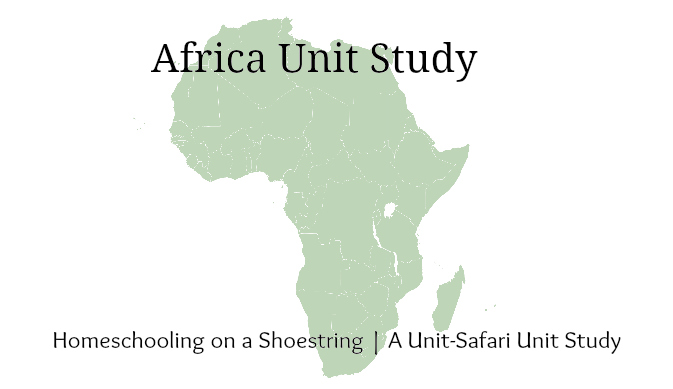
Africa Unit Study
Africa is the second-largest continent on Earth, with 54 countries and more than a billion people. It has the world’s longest river (the Nile), the biggest hot desert (the Sahara), rain forests, grassy savannas full of elephants, lions, giraffes, and zebras, and snowy Mount Kilimanjaro, which sits almost on the equator. People speak more than 2,000 languages across Africa, and some of the world’s oldest kingdoms, from Egypt and Kush to Mali and Great Zimbabwe, grew up here.
This Africa Unit Study covers the geography, animals, people, history, music, and stories of the continent. Make a drum from a coffee can, string salt dough beads, carve out an egg carton mancala board, cook Nigerian banana fritters, read Anansi tales, and play African Safari Rummy. Books, videos, crafts, recipes, lapbook ideas, and homemade games work for every age, from preschool to high school.
Learning Objectives
Many parents and teachers will need to create their own goals. You can compare the goals at these sites to create your own goals depending on how stringent your requirements need to be. All links have several suggested activities for different ages.
Suggested Curriculum Standards:
- World Book Scope Basic Course structure https://www.worldbook.com/typical-course-of-study.aspx
- Michigan Department of Education https://www.michigan.gov/mde/services/academic-standards
- Maine as an example of state level requirements https://www.maine.gov/doe/standards/ela/resources
- California state level requirements https://www.cde.ca.gov/be/st/ss/
- Ontario Canada K-8 Expectations https://www.dcp.edu.gov.on.ca/en/curriculum#elementary
- Abeka Scope and Sequence https://www.abeka.com/HomeSchool/ScopeAndSequence.aspx
- The series of books called “What your nth Grader needs to know” May also be helpful nth representing the grade your child is in. This series only Goes to grade 8
- Label the countries of Africa on a map, along with major cities and capitals
- Locate important rivers, lakes, deserts, and mountains, including the Nile, Lake Victoria, the Sahara, and Kilimanjaro
- Recognize famous landmarks in African countries
- Describe Africa’s climates and ecosystems: desert, savanna, rain forest, and mountains
- Identify some of the languages spoken in African countries
- Learn about African animals and where they live
- Identify important people and events in African history
- Explore African folktales, music, art, and food
Africa Facts
- Africa has 54 countries. Algeria is the largest country by land, and Nigeria has the most people.
- The Nile River flows north for about 4,100 miles, making it one of the two longest rivers in the world.
- The Sahara Desert is about the size of the United States.
- Mount Kilimanjaro in Tanzania is Africa’s highest mountain at 19,341 feet. It has snow on top even though it is near the equator.
- Lake Victoria is the largest lake in Africa and the source of the White Nile.
- The equator runs right through the middle of Africa, so it is the only continent that reaches into all four hemispheres.
- Swahili is spoken by millions of people in East Africa. “Jambo” means hello.
- The baobab tree can live for more than 1,000 years. With its bare branches, it looks like it is growing upside down.
- Diamonds and gold are among the most important natural resources in South Africa.
- Snow seldom falls in Africa, but when it does, children near Johannesburg sometimes make a “snowdeer” instead of a snowman.
Famous People of Africa
Choose one to research and write a short biography:
- Cleopatra, the last queen of ancient Egypt
- King Tutankhamun, the boy pharaoh whose tomb was found in 1922
- Mansa Musa, the rich king of the Mali Empire
- David Livingstone, Scottish explorer of central Africa
- Nelson Mandela, who spent 27 years in prison and became South Africa’s first Black president
- Archbishop Desmond Tutu of South Africa, Nobel Peace Prize winner
- Wangari Maathai of Kenya, who started the Green Belt Movement to plant trees
- Kwame Nkrumah, who led Ghana to independence
Timeline
- ReadWriteThink Timeline Creator
- OurTimelines: Starts at the year 1000 and goes to today.
- Explorers of Africa: From Enchanted Learning.
Events to add to your timeline:
- About 3100 BC: Upper and Lower Egypt are united under one king
- About 2560 BC: The Great Pyramid of Giza is finished
- About 750 BC: The Kingdom of Kush rules Egypt
- About 1100 to 1450: Great Zimbabwe, a city of stone walls, is built in southern Africa
- 1324: Mansa Musa of Mali travels to Mecca with so much gold that its price drops in Egypt
- 1488: Portuguese explorer Bartolomeu Dias sails around the southern tip of Africa
- 1500s to 1800s: Millions of Africans are captured and shipped across the Atlantic in the slave trade
- 1855: David Livingstone is the first European to see Victoria Falls
- 1884 to 1885: European countries divide Africa among themselves at the Berlin Conference
- 1922: Howard Carter finds the tomb of King Tut
- 1957: Ghana becomes the first country south of the Sahara to win independence
- 1960: Seventeen African countries become independent, so it is called the Year of Africa
- 1984: Desmond Tutu wins the Nobel Peace Prize
- 1994: Nelson Mandela becomes president of South Africa after apartheid ends
- 2004: Wangari Maathai becomes the first African woman to win the Nobel Peace Prize
Vocabulary
| Afrikaners | calabash | Hutu | republic |
| ancestor | continent | Khoisan | river |
| animism | country | natural resource | safari |
| apartheid | desert | oasis | savanna |
| authoritarianism | equator | pharaoh | Swahili |
| baobab | halophyte | rain forest | Tutsi |
| bromeliad | Hamitic | segregation | tribe |
- Copy each word and its definition onto a sheet of paper for your portfolio.
- Make flash cards with the word on the front, then have the kids hand write the definition in their own words on the back. It helps them remember the definitions better.
- Look up words with WordWeb, free downloadable software, or the online Dictionary.com.
Swahili Words
- Jambo: Hello
- Asante: Thank you
- Rafiki: Friend
- Safari: Journey
- Simba: Lion
- Tembo: Elephant
- Twiga: Giraffe
- Moja, mbili, tatu: One, two, three
Book Resources
- A Is for Africa by Ifeoma Onyefulu
- Alistair on Safari: Adventure at an African Game Reserve by Amanda Lumry
- Ancient Egypt (Ms. Frizzle’s Adventures) by Joanna Cole, illustrated by Bruce Degen
- Ashanti to Zulu: African Traditions by Margaret W. Musgrove
- Bringing the Rain to Kapiti Plain by Verna Aardema
- Count Your Way Through Africa by Jim Haskins
- Emeka’s Gift: An African Counting Story by Ifeoma Onyefulu
- Eyewitness: Africa (DK)
- Eyewitness: Ancient Egypt by George Hart (DK)
- Jambo Means Hello: Swahili Alphabet Book by Muriel Feelings, illustrated by Tom Feelings
- Jumanji by Chris Van Allsburg
- Learning to Swim in Swaziland by Nila K. Leigh: Written by an eight-year-old girl.
- Lest We Forget: The Passage from Africa to Slavery and Emancipation by Velma Maia Thomas: A three-dimensional book with photographs and documents.
- Moja Means One: Swahili Counting Book by Muriel Feelings, illustrated by Tom Feelings
- The Orphan Boy: A Maasai Story by Tololwa M. Mollel
- We’re Going on a Lion Hunt by David Axtell
- Why Mosquitoes Buzz in People’s Ears by Verna Aardema
- Anansi the spider tales: Look for several versions at your library.
Activity Books
- A Trip Around the World (Carson-Dellosa)
- Another Trip Around the World (Carson-Dellosa)
- The Kids’ Around the World Cookbook by Deri Robins
- The Kids’ Multicultural Art Book by Alexandra Terzian
- The Paper Tube Zoo (Evan-Moor)
See also the African Folktales page here on Homeschooling on a Shoestring.
Poetry and Music
- AfricanMusic.org
- RootsWorld Africa: African music with samples.
- Columbia University: Music and Dance of Africa
- RhymeZone: Find rhyming words for your own poems.
- Tarabu: Music from the Swahili of Kenya (audio CD)
- Gift of the Tortoise: A Musical Journey Through Southern Africa (audio CD)
- Write an onomatopoeia poem full of savanna sounds: the roar, the stomp, the buzz.
- Make your own audio book of an African folktale with Audacity, a free sound recorder.
Videos and Software
- National Geographic: Africa (2001)
- National Geographic: Namib Desert, Africa’s Hostile Dunes (1998)
- National Geographic: Virunga, Heart of Africa (1996)
- National Geographic: Africa’s Animal Oasis (1992)
- National Geographic: Africa’s Stolen River (1988)
- National Geographic: Wilds of Madagascar (1988)
- Great Adventurers: David Livingstone, Journey to the Heart of Africa (1999)
- Africa: The Serengeti (IMAX)
- Children’s Stories From Africa
- Seterra: Africa Countries: A free online map quiz.
Activities
- Map of Africa: Label the countries, capitals, the Nile, the Sahara, Lake Victoria, Kilimanjaro, and the equator.
- Make a traditional African drum: Drums are a big part of African life. They are played with singing and dancing at celebrations, to welcome visitors or honor important people, and long ago to send messages to other villages. A master drummer plays the lead drum. A talking drum has cords down its sides, and when the drummer squeezes the cords, the drum makes a higher sound. Make small drums from coffee cans, oatmeal boxes, chip cans, tennis ball cans, or margarine tubs. Stretch a balloon, paper, or fabric over the top and hold it with a rubber band.
- Salt dough beads: In Nigeria and other countries, beads can show a person’s place in the community by how many there are and their colors and designs. Mix 4 cups flour and 2 cups salt, then slowly add 2 cups water and knead until smooth. Roll beads 1/2 to 1 inch around and poke a hole through each with a toothpick. Bake at 350 degrees for 5 to 20 minutes, checking often. When cool, paint them, let them dry, and string 15 to 20 beads on a 24-inch string.
- African masks: Draw a mask on poster board or a cereal box. Cut round eye holes, and cut a nose flap on three sides so it bends out. Punch holes around the edge, color it with markers, and tie on yarn or raffia. For a longer project, shape the mask from cardboard and cover it with papier mache.
- Nigerian village diorama: Build a village in a shoebox with round huts made from paper cups or toilet paper tubes and cone-shaped paper roofs.
- Study the baobab tree: Draw one and find out how people use its fruit, bark, and leaves.
- Study baboons: After you learn about them, make a “Don’t Feed the Baboons” sign. In South Africa these signs are as common as “Keep Off the Grass” signs here.
- Make a snowdeer: Build a snowdeer out of snow, or cut two deer shapes from white paper, staple them together, and stuff them.
- Play rounders: This game is popular in South Africa. It is played much like baseball, but with a tennis ball and a bat shaped like a ping pong paddle.
- How diamonds form: Learn how heat and pressure deep underground turn carbon into diamonds, and what that tells you about the land in South Africa.
- Apartheid and segregation: Older students can compare apartheid in South Africa with segregation in the southern United States.
- Elephants: Draw, paint, or color the differences between African and Asian elephants.
- Safari: Make animal masks, turn a room into a savanna, and go on a pretend safari with binoculars made from toilet paper tubes.
Writing Prompts
- Describe a time you were chased through a rain forest by an angry elephant. What did you do to get away?
- You spent a week traveling on a safari. What did you see and do?
- You raced camels against a prince or princess from another country. What were the rules? Who won, and how?
- Write a story from an animal’s point of view about life on the savanna.
- Read some Anansi spider tales and write one of your own.
- Read Jumanji and write a sequel.
Recipes
Nigerian Banana Fritters
- 2 1/2 cups flour
- 1/2 cup sugar
- 2 teaspoons cinnamon
- 2 eggs
- 1 cup milk
- 6 bananas, mashed
- Oil for the griddle
- Powdered sugar
In a large bowl, stir together the flour, sugar, and cinnamon. Beat in the eggs. Slowly add the milk and beat until the batter is smooth, then stir in the bananas. Pour a little less than 1/4 cup of batter at a time onto a hot, oiled griddle and cook 2 to 3 minutes on each side. Sprinkle with powdered sugar just before serving. Bananas are a good source of potassium, and cinnamon has been used for thousands of years in Africa and Asia.
- AfriChef Banana Fritters
- Mr. Breakfast Banana Fritters
- Colonial Williamsburg: Peanut Soup: Peanut soup came to America from West Africa.
Field Trips
- Detroit Zoo: Visit the African Grasslands and the giraffes.
- Brookfield Zoo: Chicago Zoological Society.
- Local zoo: Make a list of animals that come from Africa before you go and check them off as you find them.
- Art museum: Look for African masks, carvings, and textiles.
- Natural history museum: Look for Egyptian mummies and African animal exhibits.
- African restaurant or market: Try Ethiopian, Moroccan, or West African food and talk about the spices and grains used.
Art and Craft Ideas
Coloring Pages
Craft Projects
- Making Friends: Make African paper doll friends.
- KizClub: Giraffe growth chart.
- Paper tube animals: Turn toilet paper tubes into giraffes, zebras, lions, and elephants.
3D Paper Models
- Canon Creative Park: Savanna Diorama
- Canon Creative Park: African Elephant
- Canon Creative Park: Giraffe
- Canon Creative Park: Zebra
- Yamaha Paper Craft Animals
Information and General Resources
- Mr. Dowling’s Electronic Passport: Ancient Africa
- Mr. Dowling’s Electronic Passport: Colonial Africa
- Mr. Dowling’s Electronic Passport: Africa Today
- Country Studies: Research individual African countries.
- CIA World Factbook: Maps and facts for every country.
- University of Pennsylvania African Studies Center
- Zambia Tourism
- The Baka People
- King Tut
- Zoobooks: Animal magazines for kids.
- Wikipedia: Africa
- ProTeacher: Africa: Lesson ideas shared by teachers.
Lapbook Ideas
- Map of Africa: Countries, capitals, rivers, deserts, and mountains.
- Biomes Flap Book: Desert, savanna, rain forest, and mountains, with an animal for each.
- African Animals Mini Book: One page for each animal you studied.
- Famous People Pocket: A card for each person with a picture and three facts.
- Swahili Words Flip Book: The word on the front and the meaning underneath.
- Timeline: Accordion fold with the dates above.
- Nile River Fold-Out: Trace the Nile from Lake Victoria to the Mediterranean Sea.
- Folktale Retelling: Retell your favorite Anansi story in pictures.
- Vocabulary Pocket: Flash cards for the vocabulary words.
Games
Use these ideas to turn key concepts from this unit into creative, engaging games your learners will love.
Game Board Blanks
Create your own themed games for this unit using printable templates and inspiration from the sites below:
- Games . . . Tools for Learning by Mark and Janice Vreeland
- Games for Learning ideas from Mary Peterson
- Board Game Templates – Tim’s Printables – free blank game boards
- JustFamilyFun – Board Game Paths
- Cardboard Cognition: Educational Board Games: An archived San Diego State University chart that helps you pick the right type of board or card game to make, with ideas for game boards and pieces.
More Game Ideas
- Mancala: One of the oldest games in the world, played all over Africa. Make a board from an egg carton with a small bowl or cup at each end, and use dried beans, rocks, or marbles for seeds. The Rules of Mancala from Masters of Games and Kalah Rules from Princeton University.
- Yote and Achi: Two traditional West African strategy games played with stones and holes scratched in the ground. Draw a board on paper and use buttons or beans.
- Make cards to match timeline events to their dates.
- True or false cards about African countries and animals.
- Map cards: Match a country, river, or crop to its place on the map.
- Fill-in-the-blank cards about famous people and current events.
- Match Swahili words to their English meanings.
- Use the shape of the continent for any skill in a file folder game.
- Printable Board Games: Blank boards and parts for making your own games.
- Lizard Point Africa Quiz: A customizable countries quiz.
Neverending Card Deck
Use the Neverending Card Deck card and box templates to make your own sets. You can flip the card template to print your custom design on the back. Free clipart works great for themed backs or matching your card box. These cards can be used in both card games and board games.
Africa Card Game: African Safari Rummy
Make a deck of 40 cards from index cards or cut-up cereal boxes. Choose 10 African animals and make 4 cards for each one: the name, a picture, where it lives, and one fact.
- Lion: Savanna. Lions live in groups called prides.
- Elephant: Savanna and forest. The largest land animal.
- Giraffe: Savanna. The tallest animal, eats leaves from acacia trees.
- Zebra: Savanna. No two zebras have the same stripes.
- Hippopotamus: Rivers and lakes. Spends most of the day in water.
- Cheetah: Savanna. The fastest land animal.
- Gorilla: Rain forest. The largest of the apes.
- Camel: Sahara Desert. Can go days without water.
- Nile crocodile: Rivers. Can grow to 16 feet long.
- Baboon: Savanna and mountains. Lives in troops.
How to play:
- Deal 7 cards to each player. Put the rest face down in a pile and turn the top card face up to start a discard pile.
- On your turn, draw one card from either pile, then discard one card.
- When you collect all 4 cards for one animal, lay them down and tell one fact about it.
- The first player to lay down two complete animals wins.
These cards also work with your homemade file folder and board games. Players draw a card and name the animal’s home before they move.
GeoSafari Cards
Using the GeoSafari Instruction Guide, you can create a wide variety of custom cards for this unit. GeoSafari is especially great for independent learning and long car trips!
Donna Young shows you how to make GeoSafari Cards
DIY Card Ideas
- Timeline event ↔ date matching cards
- True or false review questions
- Vocabulary words ↔ real-life images
- Chapter-based quizzes or review sets
More GeoSafari Card Ideas
- Geography cards for the countries and capitals of Africa.
- Map of crops and natural resources.
- Matching cards for animals and their habitats.
Worksheets
Make your own worksheets with these worksheet creation tools:
- SchoolHouseTech https://www.schoolhousetech.com/ This company gives away two free software worksheet factories one for Basic math and one for wordsearch utility that will make wonderful complements to this unit when you include the clipart listed in the clipart section.
- Start Write – This program makes nice reports and handwriting worksheets for the unit. https://www.startwrite.com/
- TeachNology has several online worksheet makers and a ton of Rubric makers. Rubrics work great with Homeschool Tracker because they give you total points and you count up exactly how many points your child gets. https://www.teach-nology.com/worksheets/
- Online Crossword Puzzle Maker to use with your vocabulary words or locations or even dates from the timeline. https://www.happychild.org.uk/wks/english/ssm/crosswords01.htm
- TLS Books: Countries of Africa Word Search
- National Geographic MapMaker: Blank and filled-in maps.
- Teachers Pay Teachers: Free African Animals Worksheets
- Enchanted Learning: Africa: Maps and printables.
Evaluation Ideas
Assemble a three ring binder and please include:
- A copy of this unit
- Course Description (Highschool Students)
- Write a summary about books read for the unit
- Write an essay on the various topics discussed
- Your Lapbook created for the unit (K-8 Students)
- Any worksheets or activity books created with SchoolhouseTech Software https://www.schoolhousetech.com/
- Your journal and its contents
- Your Log of activities from Homeschool Tracker https://www.homeschooltracker.com/free-homeschool-tracker-basic-edition Its Free!
- Your Timeline
- EasyTestMaker: Make your own test with several question types.
- Give the student a blank map of Africa and have them label the countries and landforms from memory.
Related Unit Studies from Homeschooling on a Shoestring
More Unit Studies
Looking for your next topic? The Unit Studies directory has free and low-cost activities, lesson plans, worksheets, study guides, books, recipes, lapbook ideas, and games for homeschooling on a shoestring: https://homeschoolingonashoestring.com/homeschooling/homeschooling-by-subject/unit-studies/
Last Updated on October 31, 2026 by Jodi