
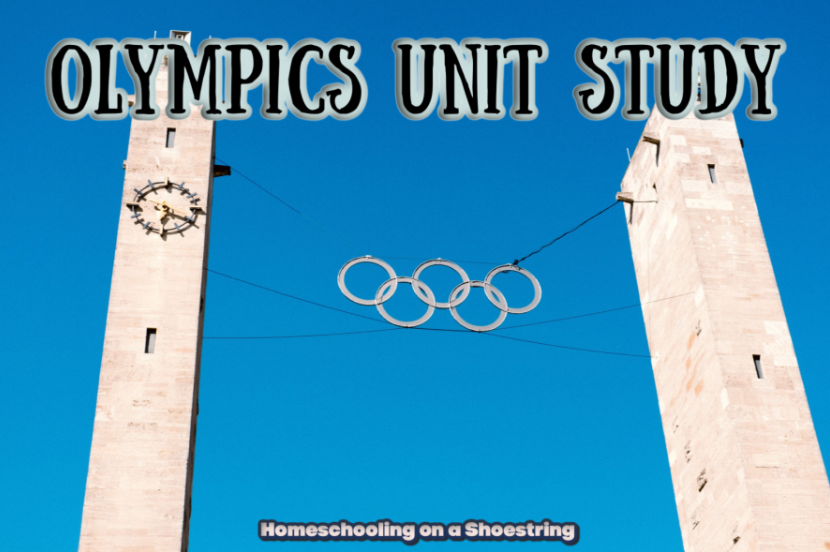
Olympics Unit Study
Every four years, athletes from around the world gather to run, swim, skate, and ski for a medal and the honor of their country. The tradition started nearly 2,800 years ago in Olympia, Greece, where young men raced on a dirt track for a crown of olive leaves. A French educator named Pierre de Coubertin brought the Games back in 1896, and today the Summer and Winter Olympics take turns every two years, with the Paralympic Games following each one.
This Olympics Unit Study covers the ancient Games, the revival of the modern Olympics, the symbols and traditions, famous Olympians, and the geography of the host cities. It works well any time of year, and it is especially fun to start a few weeks before an opening ceremony so your family can follow along. Library books, a world map, some cardboard and foil, and a backyard track meet are all you need.
Learning Objectives
Many parents and teachers will need to create their own goals. You can compare the goals at these sites to create your own goals depending on how stringent your requirements need to be. All links have several suggested activities for different ages.
Suggested Curriculum Standards:
- World Book Scope Basic Course structure https://www.worldbook.com/typical-course-of-study.aspx
- Michigan Department of Education https://www.michigan.gov/mde/services/academic-standards
- Maine as an example of state level requirements https://www.maine.gov/doe/standards/ela/resources
- California state level requirements https://www.cde.ca.gov/be/st/ss/
- Ontario Canada K-8 Expectations https://www.dcp.edu.gov.on.ca/en/curriculum#elementary
- Abeka Scope and Sequence https://www.abeka.com/HomeSchool/ScopeAndSequence.aspx
- The series of books called “What your nth Grader needs to know” May also be helpful nth representing the grade your child is in. This series only Goes to grade 8
- Tell where and when the ancient Olympic Games began and describe the events Greek athletes competed in.
- Explain how Pierre de Coubertin revived the Games and why the first modern Olympics were held in Athens in 1896.
- Describe the meaning of the Olympic rings, flag, flame, torch relay, motto, and oath.
- Compare the Summer, Winter, and Paralympic Games and name several sports from each.
- Find past and future host cities on a world map and learn a little about each host country.
- Read about famous Olympians and the hard work, setbacks, and practice behind their medals.
- Use medal counts and race times to practice graphing, averages, and measurement.
- Set a personal goal, train for it, and record your progress the way an athlete does.
Timeline
Add these dates to an Olympic timeline:
- 776 BC: The first recorded Olympic Games are held at Olympia in honor of Zeus. The only event is a short footrace called the stadion.
- 708 BC: Wrestling and the pentathlon are added to the Games.
- 680 BC: Four-horse chariot racing becomes an Olympic event.
- AD 393: The ancient Games come to an end after more than 1,000 years.
- 1894: Pierre de Coubertin founds the International Olympic Committee in Paris.
- 1896: The first modern Olympics open in Athens, Greece, with athletes from 14 nations. Spyridon Louis, a Greek water carrier, wins the first marathon.
- 1900: Women compete for the first time at the Paris Games.
- 1912: Jim Thorpe wins the pentathlon and decathlon in Stockholm, Sweden.
- 1920: The five-ring Olympic flag flies at the Games for the first time, in Antwerp, Belgium.
- 1924: The first Winter Olympics are held in Chamonix, France.
- 1928: An Olympic flame burns in the stadium in Amsterdam for the first time.
- 1936: The first torch relay carries the flame from Olympia to Berlin, where Jesse Owens wins four gold medals.
- 1960: The first Paralympic Games take place in Rome. Wilma Rudolph wins three gold medals in track.
- 1980: The U.S. men’s hockey team beats the Soviet Union in Lake Placid, New York, a game remembered as the Miracle on Ice.
- 1996: Atlanta hosts the 100th anniversary of the modern Games.
- 2026: Milan and Cortina d’Ampezzo, Italy, share the Winter Olympics.
- 2028: Los Angeles hosts the Summer Olympics for the third time, after 1932 and 1984.
Vocabulary
| Olympia | Olympiad | stadion |
| pentathlon | decathlon | marathon |
| athlete | amateur | professional |
| qualify | heat | relay |
| gold medal | silver medal | bronze medal |
| podium | opening ceremony | closing ceremony |
| Olympic flame | torch relay | Olympic rings |
| host city | Paralympics | International Olympic Committee |
| world record | sportsmanship | mascot |
- WordWeb: Free downloadable dictionary software.
- Dictionary.com: Online definitions and pronunciation.
Book Resources
- Hour of the Olympics by Mary Pope Osborne: Jack and Annie travel to ancient Greece and find out girls were not allowed at the Games. A Magic Tree House chapter book.
- Ancient Greece and the Olympics by Mary Pope Osborne and Natalie Pope Boyce: The nonfiction Fact Tracker that goes with Hour of the Olympics.
- You Wouldn’t Want to Be a Greek Athlete! by Michael Ford: A funny look at training and competing in ancient Olympia.
- What Are the Summer Olympics? by Gail Herman: A Who HQ chapter book about the history of the modern Games.
- The Story of the Olympics by Dave Anderson: A sportswriter’s history of the Games from Greece to modern times.
- DK Eyewitness Olympics: Photographs of equipment, medals, torches, and famous moments.
- Olympics! by B.G. Hennessy: A picture book that walks young children through the Games from the torch to the closing ceremony.
- Koala Lou by Mem Fox: A young koala trains for the Bush Olympics to win her mother’s attention. Great for preschoolers.
- The Mud Flat Olympics by James Stevenson: Silly animal events for beginning readers.
- Wilma Unlimited by Kathleen Krull: How Wilma Rudolph went from wearing a leg brace to winning three gold medals.
- A Picture Book of Jesse Owens by David A. Adler: The track star who won four gold medals in Berlin in 1936.
- Jim Thorpe’s Bright Path by Joseph Bruchac: A picture book biography of the Sac and Fox athlete who won two gold medals in 1912.
- Mount Olympus Basketball by Kevin O’Malley: The Greek gods take on the mortals in a basketball game, a fun way into Greek myths.
- The Boys in the Boat (Young Readers Adaptation) by Daniel James Brown: The University of Washington rowing crew that won gold in 1936, for ages 10 and up.
Poetry and Music
- Listen to “Bugler’s Dream” by Leo Arnaud and “Olympic Fanfare and Theme” by John Williams, written for the 1984 Los Angeles Games. Talk about how the music makes you feel and why it is played at the start of the broadcasts.
- Find a recording of the Olympic Hymn, written by Spyros Samaras for the 1896 Games and still played when the Olympic flag is raised.
- The ancient Greek poet Pindar wrote poems to honor the winners at Olympia. Write your own short victory poem for an athlete you admire or for a family member who reached a goal.
- Learn the national anthem of a country you are following during the Games and listen for it during medal ceremonies.
Videos
- Cool Runnings (1993, PG): A comedy loosely based on the first Jamaican bobsled team at the 1988 Winter Games in Calgary.
- Chariots of Fire (1981, PG): Two British runners prepare for the 1924 Paris Games.
- Miracle (2004, PG): The story of the 1980 U.S. hockey team and coach Herb Brooks.
- Race (2016, PG-13): Jesse Owens at the 1936 Berlin Olympics. Best for teens; preview first.
- The Boys in the Boat (2023, PG-13): The rowing crew from the book above, for older students.
After watching one of the movies, look up what really happened and make a list of what the filmmakers kept and what they changed.
Activities
- Follow a Country: Each child picks two or three countries to cheer for. Make a banner for each one from a paper grocery bag or old wrapping paper with the flag and a small map, then add a sticker or paper medal to the back every time that country wins one.
- Medal Count Math: Keep a daily chart of medals for the countries you follow. Young children can count and compare. Older children can make bar graphs, find averages, and figure out what percent of the medals each country has won.
- Host City Map: Mark every Summer and Winter host city on a world map with two colors of pins or stickers. Which continents have hosted the most? Which have never hosted?
- Ancient and Modern Venn Diagram: Compare the Games at Olympia with today’s Olympics: who could compete, what the prizes were, what events were held, and how long the Games lasted.
- Training Log: Each family member chooses a hard but reachable goal for the month, like jumping rope 100 times in a row or running a mile. Practice a little every day, record your times or counts, and hold a medal ceremony at the end.
- Measure an Event: Mark off 100 meters on a sidewalk or field with a measuring tape. Time each runner, then compare your times to the world record. Try the long jump and measure each jump in feet and in meters.
- Design a Mascot: Look at mascots from past Games and talk about how each one shows something about its host country. Draw a mascot for an Olympics held in your own town.
- Pitch a New Sport: Choose a sport that is not in the Olympics and write a short speech or make a poster explaining why it should be added.
- Older Students: Research how the Olympics have been affected by world events, such as the canceled Games of 1916, 1940, and 1944, the boycotts of 1980 and 1984, or the 2020 Games held a year late in 2021. Write a short report.
Games
Use these ideas to turn key concepts from this unit into creative, engaging games your learners will love.
Game Board Blanks
Create your own themed games for this unit using printable templates and inspiration from the sites below:
- Games . . . Tools for Learning by Mark and Janice Vreeland
- Games for Learning ideas from Mary Peterson
- Board Game Templates – Tim’s Printables – free blank game boards
- JustFamilyFun – Board Game Paths
- Cardboard Cognition: Educational Board Games: An archived San Diego State University chart that helps you pick the right type of board or card game to make, with ideas for game boards and pieces.
- Backyard Olympics: Invite friends or your homeschool group for a mini Games. Try a relay race, a sack race with pillowcases, a beanbag or paper plate toss for the discus, and a long jump into a sandbox. If you have snow, add sled races. Finish with a parade of nations and homemade medals.
- Ancient Pentathlon: Hold the five events from Olympia in a safe, kid-sized way: a short footrace, a standing long jump, a frisbee or paper plate toss for the discus, a pool noodle or rolled newspaper toss for the javelin, and a gentle tug of war in place of wrestling.
- Olympic Torch Relay Board Game: On a file folder, draw a path from Olympia, Greece, to the next host city. Add spaces like “Rain puts out the flame. Go back 2” and “Flame crosses the ocean by plane. Move ahead 3.” Players roll a die and answer a question card to move.
- Who Am I?: Tape the name of a famous Olympian on each player’s back. Players ask yes or no questions until they guess who they are.
Neverending Card Deck
Use the Neverending Card Deck card and box templates to make your own sets. You can flip the card template to print your custom design on the back. Free clipart works great for themed backs or matching your card box. These cards can be used in both card games and board games.
Gold, Silver, Bronze Card Game
Make 36 cards: 12 gold, 12 silver, and 12 bronze. On each card, write one Olympic fact or question, with harder questions on the gold cards. For example, a bronze card might ask “What color are the five Olympic rings?” A silver card might ask “In what city were the first modern Olympics held?” A gold card might ask “Who founded the International Olympic Committee?” Shuffle each color into its own pile. On your turn, choose a pile and answer the top card. A correct answer lets you keep the card. When the piles run out, count points: 3 for each gold, 2 for each silver, and 1 for each bronze. The player with the most points stands on the top step of the podium.
The cards also work as question cards for the Olympic Torch Relay board game and the other homemade board games in this unit.
GeoSafari Cards
Using the GeoSafari Instruction Guide, you can create a wide variety of custom cards for this unit. GeoSafari is especially great for independent learning and long car trips!
Donna Young shows you how to make GeoSafari Cards
DIY Card Ideas
- Timeline event ↔ date matching cards
- True or false review questions
- Vocabulary words ↔ real-life images
- Chapter-based quizzes or review sets
GeoSafari Card Ideas
- Host Cities: Locate each Summer and Winter host city on a world map.
- Flags of the World: Match flags to the countries that compete in the Games.
- Ancient Greece: Find Olympia, Athens, Sparta, Delphi, and Mount Olympus on a map of Greece.
- Sports and Seasons: Sort sports into Summer Games or Winter Games.
- Famous Olympians: Match athletes to their sport, country, and the year they won.
- Olympic Timeline: Match each event on the timeline to its year.
Recipes
Winners at Olympia were crowned with olive leaves, and Greek athletes ate simple foods like figs, cheese, olives, nuts, and honey. This sesame and honey candy, called pasteli, has been made in Greece since ancient times and needs only two main ingredients.
Pasteli (Greek Sesame Honey Bars)
- 1 1/2 cups sesame seeds
- 1/2 cup honey
- 1 tablespoon sugar (optional, for a crisper bar)
- A pinch of salt
- A little oil for the pan
Sesame seeds and honey are naturally gluten-free. For celiac safety, buy sesame seeds labeled gluten-free, since some brands are packed on shared lines with wheat.
Toast the sesame seeds in a dry skillet over medium-low heat, stirring often, until they are light golden, about 5 minutes. Pour them into a bowl. In a small saucepan, bring the honey, sugar, and salt to a boil, then lower the heat and let it bubble for about 5 minutes until it darkens slightly and thickens. Stir in the sesame seeds. Spread the mixture on a sheet of oiled parchment paper, lay a second oiled sheet on top, and roll it about 1/4 inch thick. While it is still warm, cut it into small bars with an oiled knife. Let it cool completely before breaking the pieces apart. Hot honey burns, so an adult should handle the stove and the pouring.
Athlete’s Snack Plate: Set out a tray of foods an ancient Greek runner might have eaten: dried figs, grapes, olives, feta cheese, walnuts or almonds, and plain yogurt drizzled with honey. All of these are naturally gluten-free, but check labels on cheese and dried fruit.
Field Trips
- Visit a local high school or college track meet, swim meet, or gymnastics meet. Many are free to watch.
- Go to an ice rink and try skating, or watch a figure skating or hockey practice. Ask the rink about speed skating or curling clubs in your area.
- Take a virtual tour of the Olympic Museum on Google Arts and Culture to see torches, medals, and uniforms from past Games.
- Explore the ruins of Olympia with the Ancient Olympics exhibit from the Perseus Project at Tufts University.
- If your family travels, Lake Placid, New York, hosted the Winter Games in 1932 and 1980, and visitors can tour the Olympic venues there.
Art and Craft Ideas
- Homemade Medals: Cut circles from a cereal box, cover them with aluminum foil or color them gold, silver, and bronze with crayons or paint, and hang them on yarn or ribbon.
- Olympic Torch: Roll a sheet of construction paper or a paper towel tube into a cone or handle, and add flames made from red, orange, and yellow tissue paper, scrap paper, or a paper bag colored with markers.
- Olive Wreath: Trace leaves on green paper, cut them out, and glue them around a paper plate with the center cut out. Or bend a twig or pipe cleaner into a circle and tie on real leaves from the yard.
- Olympic Rings: Make the five rings with paper plate rims, painted canning jar lids, or bottle caps traced on paper. Pierre de Coubertin picked blue, yellow, black, green, and red on a white background because every nation’s flag of his day used at least one of those colors. Check the flags of the countries you are following.
- Greek Vase Art: Draw an athlete running or throwing a discus in black on an orange paper vase shape, the way Greek potters decorated prize jars.
- Country Flags: Make small flags from paper and craft sticks or straws for a parade of nations at your Backyard Olympics.
Information Web Resources
- History and Origin of the Games (International Olympic Committee): Short answers about how the ancient and modern Games began.
- The Real Story of the Ancient Olympic Games (Penn Museum): The events, athletes, and prizes of ancient Olympia, with photos of artifacts.
- Live from Ancient Olympia (EDSITEment): A lesson where students report on the ancient Games like sports reporters.
- Ancient Greek Olympics Lesson Ideas (Mr. Donn): Classroom activities you can adapt for home.
- Team USA: Athlete profiles and news from the U.S. Olympic and Paralympic teams.
Worksheets
Make your own worksheets with these worksheet creation tools:
- SchoolHouseTech https://www.schoolhousetech.com/ This company gives away two free software worksheet factories one for Basic math and one for wordsearch utility that will make wonderful complements to this unit when you include the clipart listed in the clipart section.
- Start Write – This program makes nice reports and handwriting worksheets for the unit. https://www.startwrite.com/
- TeachNology has several online worksheet makers and a ton of Rubric makers. Rubrics work great with Homeschool Tracker because they give you total points and you count up exactly how many points your child gets. https://www.teach-nology.com/worksheets/
- Online Crossword Puzzle Maker to use with your vocabulary words or locations or even dates from the timeline. https://www.happychild.org.uk/wks/english/ssm/crosswords01.htm
Lapbook Ideas
- Ancient Olympia Flap Book: One flap each for the stadion, pentathlon, wrestling, boxing, and chariot race.
- Olympic Symbols Wheel: A spinning wheel with the rings, flame, motto, oath, flag, and medals.
- Summer and Winter Pockets: Two pockets holding small cards with the sports from each set of Games.
- Host City Map: A small world map with the host cities marked.
- Famous Olympians Mini-Book: One page for each athlete you read about.
- Medal Count Graph: The bar graph from the Medal Count Math activity.
- My Training Log: Your goal, your daily progress, and your final result.
- Vocabulary Matchbook: Each vocabulary word outside and its definition inside.
Evaluation Ideas
Assemble a three ring binder and please include:
- A copy of this unit
- Course Description (Highschool Students)
- Write a summary about books read for the unit
- Write an essay on the various topics discussed
- Your Lapbook created for the unit (K-8 Students)
- Any worksheets or activity books created with SchoolhouseTech Software https://www.schoolhousetech.com/
- Your journal and its contents
- Your Log of activities from Homeschool Tracker https://www.homeschooltracker.com/free-homeschool-tracker-basic-edition Its Free!
- Your Timeline
Related Unit Studies from Homeschooling on a Shoestring

More Unit Studies
Looking for your next topic? The Unit Studies directory has free and low-cost activities, lesson plans, worksheets, study guides, books, recipes, lapbook ideas, and games for homeschooling on a shoestring: https://homeschoolingonashoestring.com/homeschooling/homeschooling-by-subject/unit-studies/
Last Updated on November 2, 2026 by Jodi