
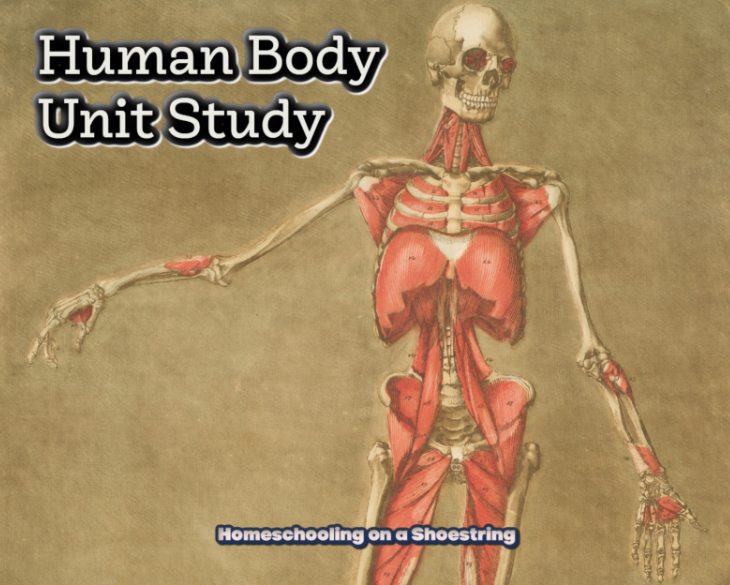
Human Body Unit Study
Your body is built from trillions of tiny cells that team up to form tissues, organs, and whole systems. Bones hold you up, muscles move you, your heart pumps blood all day and night, your lungs bring in fresh air, and your brain keeps everything working together. An adult has 206 bones, and a baby is born with closer to 300, many of which fuse together as the child grows.
This Human Body Unit Study takes children on a tour of the body one system at a time. Trace a life-size body outline and fill it with paper organs, build a working model of a lung from a plastic bottle and a balloon, check your pulse before and after jumping jacks, and bake bone-shaped pretzels. Books, songs, crafts, lapbook ideas, and a Body Systems Rummy card game work for preschool through high school.
Learning Objectives
Many parents and teachers will need to create their own goals. You can compare the goals at these sites to create your own goals depending on how stringent your requirements need to be. All links have several suggested activities for different ages.
Suggested Curriculum Standards:
- World Book Scope Basic Course structure https://www.worldbook.com/typical-course-of-study.aspx
- Michigan Department of Education https://www.michigan.gov/mde/services/academic-standards
- Maine as an example of state level requirements https://www.maine.gov/doe/standards/ela/resources
- California state level requirements https://www.cde.ca.gov/be/st/ss/
- Ontario Canada K-8 Expectations https://www.dcp.edu.gov.on.ca/en/curriculum#elementary
- Abeka Scope and Sequence https://www.abeka.com/HomeSchool/ScopeAndSequence.aspx
- The series of books called “What your nth Grader needs to know” May also be helpful nth representing the grade your child is in. This series only Goes to grade 8
- Name the main body systems and the job each one does
- Explain how cells, tissues, organs, and systems fit together
- Locate the major organs on a body outline
- Name the five senses and the organ used for each
- Find and count your pulse and explain what changes it
- Follow a bite of food through the digestive system
- Explain how germs spread and how washing hands and vaccines help the body stay well
- Practice daily habits that care for the body, such as sleep, exercise, and brushing teeth
- Learn about scientists who helped us understand the body
Timeline
- About 1600 BC: The Edwin Smith Papyrus, an Egyptian medical scroll, describes injuries and how to treat them.
- About 400 BC: Greek physician Hippocrates teaches that illness has natural causes. Doctors still take an oath named after him.
- About AD 160: Galen, a Greek doctor working in Rome, writes about muscles, nerves, and the pulse. His books are used for more than 1,000 years.
- About 1510: Leonardo da Vinci fills notebooks with careful drawings of bones, muscles, and the heart.
- 1543: Andreas Vesalius publishes On the Fabric of the Human Body, a book of detailed anatomy drawings that corrects many old mistakes.
- 1628: William Harvey shows that the heart pumps blood around the body in a circle.
- 1670s: Antonie van Leeuwenhoek builds simple microscopes and is among the first to see red blood cells.
- 1796: Edward Jenner tests the first vaccine, against smallpox.
- 1816: Rene Laennec invents the stethoscope, first made from a rolled-up tube of paper.
- 1858: Henry Gray publishes Gray’s Anatomy, still printed in new editions today.
- 1895: Wilhelm Roentgen discovers X-rays and makes a picture of the bones in his wife’s hand.
- 1901: Karl Landsteiner discovers the main blood groups, which makes blood transfusions safer.
- 1928: Alexander Fleming discovers penicillin.
- 1953: Rosalind Franklin, James Watson, and Francis Crick’s work reveals the double helix shape of DNA.
- 1954: Doctors in Boston perform the first successful kidney transplant.
- 1967: Christiaan Barnard performs the first human heart transplant in South Africa.
- 1994: The Visible Human Project releases detailed images of a whole human body for students and scientists.
- 2003: The Human Genome Project finishes mapping human DNA.
Vocabulary
| Word | Meaning |
| Anatomy | The study of the parts of the body and where they are |
| Physiology | The study of how the parts of the body work |
| Cell | The smallest living unit of the body |
| Tissue | A group of similar cells working together, like muscle tissue |
| Organ | A body part made of tissues that does a special job, like the heart or stomach |
| System | A group of organs that work together, like the digestive system |
| Skeleton | The frame of bones that supports and protects the body |
| Cartilage | Firm, bendable tissue found in your nose, ears, and the ends of bones |
| Tendon | A tough cord that connects a muscle to a bone |
| Ligament | A strong band that connects one bone to another at a joint |
| Artery | A blood vessel that carries blood away from the heart |
| Vein | A blood vessel that carries blood back to the heart |
| Pulse | The beat you feel in your wrist or neck each time your heart pumps |
| Neuron | A nerve cell that carries messages to and from the brain |
| Digestion | Breaking food down so the body can use it |
| Germ | A tiny living thing, like a bacterium or virus, that can cause sickness |
| Immune system | The body’s defense team against germs |
| Vaccine | A shot or drop that teaches the immune system to fight a certain germ |
| Hormone | A chemical message carried in the blood that tells parts of the body what to do |
Memory tricks help with long lists of body words. Carpals are in the hand and tarsals are in the foot, so try “carpenters use their hands.” Make up your own sayings for the parts that give you trouble.
Book Resources
Picture Books and Early Readers
- The Magic School Bus Inside the Human Body by Joanna Cole: Ms. Frizzle’s class rides through Arnold’s body after he swallows the bus.
- Your Insides by Joanna Cole: A simple first look at the organs inside a child’s body.
- I’m Growing! by Aliki: A Let’s-Read-and-Find-Out book about how bodies grow.
- My Five Senses by Aliki: A gentle introduction to seeing, hearing, smelling, tasting, and touching.
- Parts by Tedd Arnold: A rhyming, silly story about a boy who worries he is falling apart.
- The Busy Body Book by Lizzy Rockwell: Bright pictures show what the body does when kids run, jump, and play.
- Germs Make Me Sick! by Melvin Berger: How germs spread and how the body fights back.
Nonfiction for Elementary and Middle School
- The Human Body by Seymour Simon: Large photos and clear writing on every system.
- Blood and Guts by Linda Allison: A Brown Paper School book full of hands-on body experiments.
- Eyewitness Human Body by Steve Parker: Photo-packed pages for browsing and reports.
- The Way We Work by David Macaulay: Detailed drawings of how every part of the body works, for older children.
- Outside and Inside You by Sandra Markle: Photos and X-rays show what’s under your skin.
- The Skeletal System by Helen Frost: Part of a short, simple series on each body system. Look for the others too.
- Brain Lab for Kids by Eric Chudler: Fifty-two hands-on activities about the brain and senses.
- Mysterious You: Burp! by Diane Swanson: Fun facts about eating and digestion.
For High School and Parents
- Gray’s Anatomy by Henry Gray: The classic anatomy reference with hundreds of labeled drawings.
- The Anatomy Coloring Book by Wynn Kapit: Color each structure as you learn it. A favorite for high school biology.
- Leonardo da Vinci Anatomical Drawings: Compare his notebook sketches with modern diagrams.
Poetry and Music
- Sing “Head, Shoulders, Knees, and Toes,” faster each time through.
- Sing “The Hokey Pokey” to practice left and right body parts.
- Neuroscience for Kids: Brain Songs: Silly songs about the brain and nerves set to familiar tunes.
- Schoolhouse Rock Science Rock: Watch “The Body Machine,” about turning food into energy.
- Write a cinquain or acrostic poem about one organ, such as HEART or LUNGS.
Videos
- Magic School Bus Inside Ralphie: The class travels inside a sick classmate to see how the body fights germs.
- Magic School Bus For Lunch: A ride through the digestive system.
- Magic School Bus Explores the Senses: How eyes, ears, and noses gather information.
- Once Upon a Time Life DVD: A classic cartoon series that follows cells and blood through the body.
- Eyewitness Human Machine DVD: The Eyewitness video on how the body works.
Activities
- Body outline: Ask your child to stretch out on a long sheet of butcher paper, newsprint, or taped-together paper bags while you trace around them. Add organs cut from construction paper or scrap paper as you study each system.
- Pulse check: Find your pulse at your wrist or neck and count the beats for 15 seconds, then multiply by 4. Do 30 jumping jacks and count again. Graph the results for everyone in the family.
- Bottle lung: Cut the bottom off a plastic bottle. Put a small balloon inside the neck and stretch a cut balloon or plastic wrap over the open bottom. Pull down on the bottom sheet and watch the inside balloon fill with air, just like your diaphragm and lungs.
- Digestion in a bag: Put a slice of bread and some water in a zip-top bag and squish it to show how the stomach churns food. Then squeeze it through the leg of an old pair of tights to show the intestines.
- Measure the intestines: The small intestine of an adult is about 20 feet long. Measure out 20 feet of yarn or string and stretch it across the yard.
- Glitter germs: Rub a little glitter or flour on your hands, then shake hands or touch a doorknob. See how far it spreads, then test which washes it off best: water alone or soap and water.
- Five senses stations: Set up a smell test with spices in cups, a touch bag with mystery objects, and a taste test of sweet, salty, sour, and bitter foods.
- Blind spot test: Draw an X and a dot about 3 inches apart on an index card. Close one eye, stare at the X, and slowly move the card toward your face until the dot disappears.
- Reaction time: Drop a ruler between a child’s fingers and see how many inches it falls before they catch it. Try it with each hand.
- Bone strength: Soak a clean chicken bone in vinegar for a few days to see what happens when the hard minerals are removed.
- Healthy habits chart: Track sleep, outdoor play, and brushing teeth for one week.
Writing Prompts
- You are a red blood cell. Describe your trip around the body.
- Which body system do you think works the hardest? Explain why.
- Older students: Write a short biography of one scientist from the timeline.
Recipes
Gluten-Free Pretzel Bones
- Stir 1 packet (2 1/4 teaspoons) of yeast and 1 tablespoon of sugar into 1 1/4 cups of warm water. Let it sit for 5 minutes until foamy.
- In a large bowl, whisk 3 1/2 cups of gluten-free 1-to-1 flour blend (one that already has xanthan gum in it), 1 teaspoon of baking powder, and 1 teaspoon of salt. Add the yeast water and 2 tablespoons of oil or melted butter and stir until a soft, sticky dough forms. Gluten-free dough doesn’t need kneading.
- With oiled hands, roll pieces of dough into short ropes on parchment paper. Shape each into a bone by pressing both ends into knobs, or name a bone (femur, rib, finger bone) and try to copy it. If the dough cracks, just press it back together. Let them rise for 30 minutes.
- Heat the oven to 425°F. A grown-up should simmer 6 cups of water with 1/4 cup of baking soda, then use a slotted spatula to gently lower each bone in for 20 seconds.
- Set the bones on a parchment-lined baking sheet, sprinkle with coarse salt, and bake for 15 to 18 minutes, until golden brown.
More Recipe Ideas
- Veggie skeleton tray: Arrange celery and carrot sticks, cauliflower, and cucumber slices into a skeleton on a platter, with a bowl of dip for the head.
- Five senses snack: Make a plate with something crunchy, something smooth, something sweet, something sour, and something with a strong smell.
- Smoothie blood model: Blend red berries and juice, then add a few banana slices for white blood cells and a sprinkle of chia seeds or tiny pieces of fruit for platelets.
Field Trips
- Doctor or dentist visit: Have your child make a list of questions before the next checkup.
- Science museum: Many science centers have exhibits on the heart, brain, or senses.
- Hospital or fire station tour: Ask about the equipment used to check breathing and heartbeat.
- Eye doctor or hearing center: Ask how eyes and ears are tested.
- Gym, pool, or park: Talk about which muscles you use for each activity.
Art and Craft Ideas
- Pipe cleaner skeleton: Bend and twist pipe cleaners into bones and glue them to dark paper. Twist ties or cotton swabs work too.
- Ear model: Cover one end of a toilet paper tube with wax paper and a rubber band for the eardrum. Hang three beads on threads inside to stand for the three tiny ear bones.
- Paper bag lungs: Tape two small paper lunch bags to the ends of a straw and blow gently to fill them.
- Brain hat: Cover a balloon with papier-mache, let it dry, then cut it in half to make a cap. Paint on the wrinkles and label the parts of the brain with small flags.
- Hand X-ray: Trace your hand on black paper and glue on cotton swab pieces for the finger bones.
- Clay heart: Shape a heart from play dough or salt dough and use red and blue yarn for the blood vessels.
- Body systems book: Make a flip book with one page for each system.
Information Web Resources
- KidsHealth: Your Body: Short, kid-friendly articles and movies on every part of the body.
- Neuroscience for Kids: Experiments, games, and worksheets about the brain and nervous system.
- Innerbody: Human Anatomy Explorer: Labeled diagrams of every body system for older students.
- The Visible Human Project: The National Library of Medicine project that photographed a whole human body in thin slices.
- Enchanted Learning: Human Anatomy: Diagrams and fact pages. Some pages need a membership.
Games
Use these ideas to turn key concepts from this unit into creative, engaging games your learners will love.
Game Board Blanks
Create your own themed games for this unit using printable templates and inspiration from the sites below:
- Games . . . Tools for Learning by Mark and Janice Vreeland
- Games for Learning ideas from Mary Peterson
- Board Game Templates – Tim’s Printables – free blank game boards
- JustFamilyFun – Board Game Paths
- Cardboard Cognition: Educational Board Games: An archived San Diego State University chart that helps you pick the right type of board or card game to make, with ideas for game boards and pieces.
- Simon Says, Body Edition: Use real names: “Simon says touch your clavicle.”
- Organ toss: Draw a large body outline on the driveway with chalk. Name an organ and have children toss a beanbag onto the right spot.
- Bone puzzle race: Cut a paper skeleton into pieces and race to put it back together.
- Germ tag: The child who is It is a germ. Players are safe while “washing their hands” at a base for a count of 20.
Neverending Card Deck
Use the Neverending Card Deck card and box templates to make your own sets. You can flip the card template to print your custom design on the back. Free clipart works great for themed backs or matching your card box. These cards can be used in both card games and board games.
Human Body Card Game: Body Systems Rummy
Make 24 cards from index cards or old cereal boxes, one body part per card, with a quick drawing. There are six systems, with four cards in each:
- Skeletal: skull, ribs, spine, femur
- Muscular: biceps, quadriceps, diaphragm, tendon
- Nervous: brain, spinal cord, nerve, neuron
- Circulatory: heart, artery, vein, capillary
- Respiratory: nose, trachea, lungs, alveoli
- Digestive: esophagus, stomach, small intestine, liver
How to play:
- Deal 6 cards to each player. Stack the rest face down and turn one card face up for a discard pile.
- On your turn, draw from either pile, then discard one card.
- When you collect all four cards in one system, lay them down and tell what that system does.
- The first player to lay down two systems wins.
Little ones can play Go Fish by asking for systems, or Memory with the cards face down. These cards also work with the homemade board games for this unit. Draw a card and name the system before you move.
GeoSafari Cards
Using the GeoSafari Instruction Guide, you can create a wide variety of custom cards for this unit. GeoSafari is especially great for independent learning and long car trips!
Donna Young shows you how to make GeoSafari Cards
DIY Card Ideas
- Timeline event ↔ date matching cards
- True or false review questions
- Vocabulary words ↔ real-life images
- Chapter-based quizzes or review sets
GeoSafari Card Ideas
- Label the major bones of the skeleton.
- Match each organ to its body system.
- Label the parts of the eye or ear.
- Trace the path of blood through the heart.
- Match each scientist on the timeline to a discovery.
Worksheets
Make your own worksheets with these worksheet creation tools:
- SchoolHouseTech https://www.schoolhousetech.com/ This company gives away two free software worksheet factories one for Basic math and one for wordsearch utility that will make wonderful complements to this unit when you include the clipart listed in the clipart section.
- Start Write – This program makes nice reports and handwriting worksheets for the unit. https://www.startwrite.com/
- TeachNology has several online worksheet makers and a ton of Rubric makers. Rubrics work great with Homeschool Tracker because they give you total points and you count up exactly how many points your child gets. https://www.teach-nology.com/worksheets/
- Online Crossword Puzzle Maker to use with your vocabulary words or locations or even dates from the timeline. https://www.happychild.org.uk/wks/english/ssm/crosswords01.htm
- Enchanted Learning: Label Human Anatomy: Printable label-the-diagram pages. Some need a membership.
- KidsHealth: How the Body Works Articles: Read an article, then write three facts in your notebook.
Lapbook Ideas
- A flap book with one flap for each body system and its main organs underneath.
- Five senses pocket with a card for each sense.
- Path of food: an accordion fold from mouth to large intestine.
- Pulse graph from the jumping jacks activity.
- Timeline strip of famous discoveries.
- Healthy habits wheel.
- My Body Systems Science Booklet: A free printable booklet from Totschooling for younger children.
Evaluation Ideas
Assemble a three ring binder and please include:
- A copy of this unit
- Course Description (Highschool Students)
- Write a summary about books read for the unit
- Write an essay on the various topics discussed
- Your Lapbook created for the unit (K-8 Students)
- Any worksheets or activity books created with SchoolhouseTech Software https://www.schoolhousetech.com/
- Your journal and its contents
- Your Log of activities from Homeschool Tracker https://www.homeschooltracker.com/free-homeschool-tracker-basic-edition Its Free!
- Your Timeline
- Have younger students point to and name organs on their life-size body outline.
- Have students explain one body system to a family member using their lapbook.
- Older students can write a report on one system, with a labeled diagram and a list of sources.
- Include the pulse graph and the bottle lung write-up in the binder.
Related Unit Studies from Homeschooling on a Shoestring


More Unit Studies
Looking for your next topic? The Unit Studies directory has free and low-cost activities, lesson plans, worksheets, study guides, books, recipes, lapbook ideas, and games for homeschooling on a shoestring: https://homeschoolingonashoestring.com/homeschooling/homeschooling-by-subject/unit-studies/
Last Updated on November 2, 2026 by Jodi