
Time and Measurement Unit Study
Long before anyone owned a wristwatch, people kept track of time by watching the sun move across the sky, the moon change shape, and the seasons come and go. Ancient Egyptians read the shadows on sundials, Babylonians gave us the habit of counting in sixties, and sailors once risked their lives on a good guess about how far they had traveled. Measuring length, weight, and volume has a story too, starting with body parts like the cubit and the foot and ending with the metric system scientists use today.
This Time and Measurement Unit Study gives young children plenty of hands-on practice reading clocks, using rulers, and filling measuring cups, while older students explore calendars, time zones, the Prime Meridian, and the race to build a clock that worked at sea. Build a sundial and a water clock, measure the family with string, bake with fractions, and play Clock Rummy with homemade cards. Books, activities, lapbook ideas, and worksheets work from preschool through high school.
Learning Objectives
Many parents and teachers will need to create their own goals. You can compare the goals at these sites to create your own goals depending on how stringent your requirements need to be. All links have several suggested activities for different ages.
Suggested Curriculum Standards:
- World Book Scope Basic Course structure https://www.worldbook.com/typical-course-of-study.aspx
- Michigan Department of Education https://www.michigan.gov/mde/services/academic-standards
- Maine as an example of state level requirements https://www.maine.gov/doe/standards/ela/resources
- California state level requirements https://www.cde.ca.gov/be/st/ss/
- Ontario Canada K-8 Expectations https://www.dcp.edu.gov.on.ca/en/curriculum#elementary
- Abeka Scope and Sequence https://www.abeka.com/HomeSchool/ScopeAndSequence.aspx
- The series of books called “What your nth Grader needs to know” May also be helpful nth representing the grade your child is in. This series only Goes to grade 8
- Read an analog clock to the hour, half hour, quarter hour, and minute
- Change between analog and digital time and use a.m. and p.m. correctly
- Figure out elapsed time, such as how long a trip or a TV show lasts
- Know the units of time from seconds to centuries and how they relate
- Explain why we have days, months, years, and leap years
- Tell how people kept time with sundials, water clocks, hourglasses, and mechanical clocks
- Measure length, weight, volume, and temperature with the right tools
- Compare U.S. customary units with metric units and make simple conversions
- Explain how time zones work and find the Prime Meridian and the International Date Line on a globe
- Keep a notebook or lapbook of what you measured and learned
Time and Measurement Facts
- We have 60 seconds in a minute and 60 minutes in an hour because the ancient Babylonians counted in groups of 60.
- A day is one full spin of the Earth. A year is one full trip around the sun, which takes about 365 and one quarter days. That extra quarter day is why we add February 29 every four years.
- A month comes from the moon. It takes about 29 and a half days for the moon to go from one new moon to the next.
- The cubit was the length from a person’s elbow to the tip of the middle finger. Because arms come in different sizes, kings set an official cubit so everyone measured the same way.
- France created the metric system in the 1790s, using a base of 10 so it is easy to multiply and divide.
- The United States uses customary units (inches, pounds, gallons) in daily life, but scientists everywhere use metric units.
- Before 1883, each American town set its clocks by the sun, so noon in one town could be a few minutes off from noon in the next. Railroads pushed for standard time zones so train schedules made sense.
- The Prime Meridian at Greenwich, England, is the starting line for longitude and for the world’s time zones.
- Atomic clocks keep time by counting the vibrations of atoms. The best ones would lose less than a second in millions of years.
Timeline
- ReadWriteThink Timeline Creator
- Wikipedia: Timeline of Time Measurement Inventions: A long list for older students to pick events from.
Events to add to your timeline:
- About 3000 BC: Egyptians use the cubit to measure building stones
- About 1500 BC: Egyptians tell time with shadow clocks and water clocks
- 46 BC: Julius Caesar starts the Julian calendar with a leap day every four years
- 1300s: Hourglasses and large mechanical tower clocks appear in Europe
- 1582: Pope Gregory XIII adjusts the calendar, giving us the Gregorian calendar used today
- 1656: Christiaan Huygens builds the first pendulum clock
- 1761: John Harrison’s sea watch, the H4, passes its test voyage to Jamaica
- 1790s: France introduces the metric system
- 1883: U.S. and Canadian railroads begin using standard time zones
- 1884: World leaders choose Greenwich, England, as the Prime Meridian
- 1918: The United States first uses daylight saving time
- 1949: The first atomic clock is built in the United States
- 1967: The second is officially defined by the cesium atom
Vocabulary
| analog | century | elapsed time | leap year |
| a.m. | customary | estimate | longitude |
| calendar | decade | gram | meridian |
| capacity | digital | hourglass | metric |
| Celsius | Fahrenheit | length | sundial |
| p.m. | pendulum | time zone | volume |
- Copy each word and its meaning onto a sheet of paper for your notebook.
- Make a measurement word wall with a drawing of the tool used for each unit.
- Learn the metric prefixes: kilo means 1,000, centi means one hundredth, and milli means one thousandth.
- Time sayings: Talk about what these mean: time flies, in the nick of time, killing time, beat the clock, give an inch and they’ll take a mile, and measure twice, cut once.
- Look up words with WordWeb, free downloadable software, or the online Dictionary.com.
Book Resources
Picture Books
- The Grouchy Ladybug by Eric Carle
- Clocks and More Clocks by Pat Hutchins
- Telling Time with Big Mama Cat by Dan Harper
- Game Time! by Stuart J. Murphy
- A Second Is a Hiccup by Hazel Hutchins
- Inch by Inch by Leo Lionni
- How Big Is a Foot? by Rolf Myller
- Measuring Penny by Loreen Leedy
- Me and the Measure of Things by Joan Sweeney
- Actual Size by Steve Jenkins
Nonfiction and Workbooks
- How Long or How Wide?: A Measuring Guide by Brian P. Cleary
- Telling Time by Patricia J. Murphy (DK Readers)
- My Book of Easy Telling Time by Kumon
- Millions to Measure by David M. Schwartz
- The Story of Clocks and Calendars by Betsy Maestro
- Telling Time: How to Tell Time on Digital and Analog Clocks by Jules Older
- Time by John Farndon (Science Experiments series)
- Shoe Box Learning Centers: Time and Measurement by Pamela Chanko
Older Students
- The Longitude Prize by Joan Dash
- Longitude by Dava Sobel
Poetry and Music
- Sing “Hickory Dickory Dock” and move a paper mouse up the clock as the hour changes.
- Learn the old rhyme for the days in each month, “Thirty days hath September,” or use the knuckle trick: every knuckle is a 31-day month and every dip between knuckles is a shorter one.
- Write a poem about one minute. Set a timer and write down everything you notice in sixty seconds.
- Listen to “The Clock” movement of Haydn’s Symphony No. 101 and tap along with the steady tick-tock beat.
- Write a cinquain about a sundial, an hourglass, or a ruler.
Videos
- Math Mammoth Telling Time Videos: Free short lessons from whole hours to elapsed time.
- Longitude (2000, with Michael Gambon and Jeremy Irons): The story of John Harrison’s sea clocks, for older students.
Activities
- Shadow clock: Push a pencil into a lump of clay on a paper plate and set it outside on a sunny morning. Every hour, mark where the shadow falls and write the time. The next sunny day, use it to tell time.
- Water clock: Poke a small hole in the bottom of a paper or plastic cup and hang it over a clear jar. Fill the cup and mark the water level in the jar each minute. Now you have a timer.
- Homemade hourglass: Tape the mouths of two small plastic bottles together with a piece of cardboard between them that has a small hole in the middle. Add dry salt or sand until it takes about a minute to run through.
- Paper plate clock: Write the numbers around a paper plate and attach two hands with a brass fastener, a bent paper clip, or a pushpin into a cork. Practice setting times you call out.
- Daily schedule: Make a picture schedule of your day with the clock time beside each activity. Older children can figure out how long each part of the day lasts.
- How long is a minute? Close your eyes and raise your hand when you think a minute has passed. Then see how many jumping jacks, words written, or blocks stacked fit in one minute.
- Non-standard units: Measure the table with paper clips, the hallway with shoes, and the couch with hand spans. Talk about why everyone got different answers.
- Body measurements: Use string to measure your height, arm span, and the distance around your head. Is your arm span close to your height?
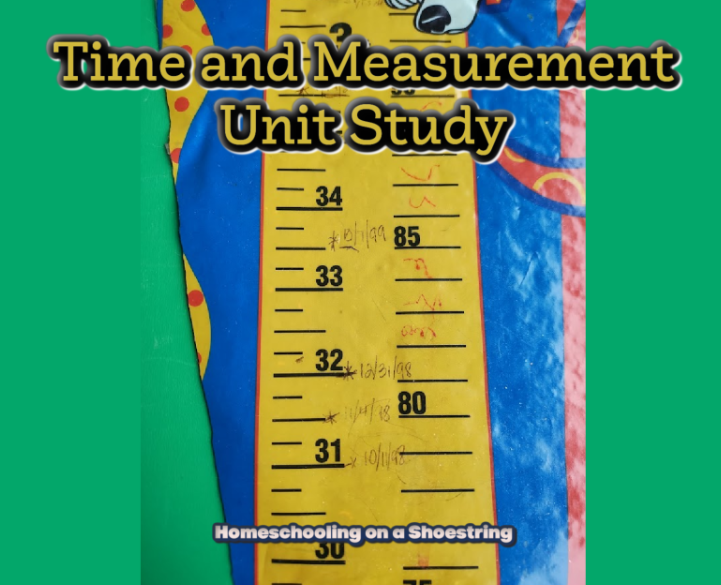
- Growth chart: Tape a long strip of paper to the wall, such as a cut-open paper grocery bag, the back of old wrapping paper, or taped-together sheets of printer paper. Mark inches or centimeters up the side with a ruler. Have your child stand with their back to the wall and mark their height with the date. Measure again every few months, on birthdays, or on the first day of each school year. Let your child decorate it. Older children can figure out how many inches they grew between marks and make a line graph. A paper chart rolls up and moves with you, so it works for apartments and rentals too, or you can mark a door frame if you own your home. A removable wall sticker growth chart works too.
- Inches and centimeters: Read each mark in both. Most growth charts show both sides.
- Guess next year: Look at how much your child grew last year, predict where the next mark will land, then check.
- Baby book tie-in: Find your child’s length at birth and add it at the bottom of the chart as the very first mark.
- How tall compared to: Use the chart to see which animals in Actual Size by Steve Jenkins are taller or shorter than your child.
- Family line-up: Mark everyone in the family on the chart, each in a different color.
- Weigh it: Use a kitchen or bathroom scale to weigh fruit, books, and toys. Guess first, then check.
- Volume play: Fill cups, pints, quarts, and gallons with water or rice at the sink and find out how many cups fill a gallon.
- Temperature log: Read an outdoor thermometer at the same time each day for two weeks and graph the results in Fahrenheit and Celsius.
- Calendar work: Mark birthdays and holidays, count the days until an event, and find which day of the week you were born.
- Time zones: Use a world clock to see what time it is where friends or relatives live, then mark the zones on a map.
- Measure the house: Measure a room and draw it to scale on graph paper, one square for each foot.
- Dollhouse decorating: Measure each wall of a dollhouse or a cardboard box house, cut scrapbook paper or old wrapping paper to fit, and glue it on. Fractions of an inch will come up quickly.
Writing Prompts
- If you could stop time for one hour, what would you do?
- Write a story about a clock that runs backward.
- Write a diary entry for a sailor who is lost at sea because no one can tell how far east or west the ship has gone.
- Write instructions for measuring something, then have someone follow them exactly.
Recipes
Cooking is the best measuring practice there is. Let children read the recipe, find the right measuring cups and spoons, and watch the timer.
No-Bake Oat Bites
- 1 cup sprouted rolled oats, labeled gluten-free
- 1/2 cup peanut butter or sunflower seed butter
- 1/3 cup honey
- 1/2 cup mini chocolate chips or raisins
- 1 teaspoon vanilla
Stir everything together in a bowl, chill for 30 minutes, then roll into 1-inch balls. Measure a few with a ruler to check. To practice fractions, try doubling the recipe or cutting it in half and write down the new amounts.
More Recipe Ideas
- Egg timer: Boil eggs for 3, 6, and 9 minutes using an hourglass or kitchen timer, then cut them open to see the difference.
- Pancakes: Use a timer to flip at just the right moment, and measure each pancake across with a ruler.
- Pizza fractions: Cut a homemade or frozen pizza into halves, quarters, and eighths.
- Trail mix by weight: Weigh out equal amounts of cereal, pretzels, and raisins on a kitchen scale.
Field Trips
- Clock or watch repair shop: Ask to see the gears inside a clock.
- Hardware store: Look at tape measures, levels, and scales, and see how lumber and pipe are measured.
- Post office: Watch packages get weighed and measured for postage.
- Farmers market or grocery store: Find things sold by the pound, by the dozen, and by the bushel.
- A town square or courthouse with a clock tower.
- A science museum with a planetarium or a pendulum display.
Art and Craft Ideas
- Clock face collage: Cut numbers from old magazines, catalogs, or junk mail and glue them around a paper plate.
- Sundial: Draw a circle on cardboard, stand a pencil or straw in the middle, and mark the hours as the shadow moves.
- Ruler art: Use a ruler to draw only straight lines and make a colorful geometric design.
- Footprint chart: Trace everyone’s feet on paper, cut them out, and line them up from smallest to largest.
- Seasons wheel: Divide a paper plate into four parts and draw a tree in winter, spring, summer, and fall.
- Pendulum painting: Hang a cup with a tiny hole from a string over a sheet of paper, fill it with thin paint or colored sand, and give it a push. Change the string length and see how the pattern changes.
Information Web Resources
- Official U.S. Time (time.gov): The time from the National Institute of Standards and Technology atomic clocks.
- NIST Metric System Education Resources: Free metric charts, activities, and posters.
- Royal Museums Greenwich: Who Was John Harrison?: The story of the clockmaker who solved the longitude problem.
- Wikipedia: History of Timekeeping Devices
- Wikipedia: Hourglass
- HomeschoolMath Interactive Clock: Move the hands and see the time.
Games
Use these ideas to turn key concepts from this unit into creative, engaging games your learners will love.
Game Board Blanks
Create your own themed games for this unit using printable templates and inspiration from the sites below:
- Games . . . Tools for Learning by Mark and Janice Vreeland
- Games for Learning ideas from Mary Peterson
- Board Game Templates – Tim’s Printables – free blank game boards
- JustFamilyFun – Board Game Paths
- Cardboard Cognition: Educational Board Games: An archived San Diego State University chart that helps you pick the right type of board or card game to make, with ideas for game boards and pieces.
- What time is it, Mr. Wolf? Players call out the question and take as many steps as the hour the wolf names, until the wolf calls “Dinner time!” and chases them.
- Human clock: Draw a big clock on the driveway with chalk. Two children are the hands and lie down to show the time someone calls out.
- Measurement scavenger hunt: Find something about an inch long, something that weighs about a pound, and something that holds about a cup.
- Estimation contest: Everyone guesses the length of an object, then measures. The closest guess wins a point.
- HomeschoolMath Online Clock Games: A list of free games for clocks, calendars, and elapsed time.
Neverending Card Deck
Use the Neverending Card Deck card and box templates to make your own sets. You can flip the card template to print your custom design on the back. Free clipart works great for themed backs or matching your card box. These cards can be used in both card games and board games.
Time and Measurement Card Game: Clock Rummy
Make 32 cards from index cards or cut-up cereal boxes. Pick eight times, such as 1:00, 3:30, 4:15, 6:45, 8:20, 9:05, 10:50, and 12:00. Make four cards for each time:
- An analog clock face with the hands drawn in
- The digital time, such as 4:15
- The time in words, such as quarter past four
- A clue card, such as “one hour after 3:15”
How to play:
- Deal 6 cards to each player. Stack the rest face down and turn one card up for a discard pile.
- On your turn, draw from either pile, then discard one card.
- When you collect all four cards for one time, lay them down and read the time out loud.
- The first player to lay down two complete times wins.
Little ones can play Memory with just the clock face and digital cards. These cards also work with the homemade board games for this unit. Draw a card and read the time before you move.
GeoSafari Cards
Using the GeoSafari Instruction Guide, you can create a wide variety of custom cards for this unit. GeoSafari is especially great for independent learning and long car trips!
Donna Young shows you how to make GeoSafari Cards
DIY Card Ideas
- Timeline event ↔ date matching cards
- True or false review questions
- Vocabulary words ↔ real-life images
- Chapter-based quizzes or review sets
GeoSafari Card Ideas
- Match analog clock faces to digital times.
- Match each measuring tool to what it measures.
- Put the units of time in order from shortest to longest.
- Find the time zones on a map of the United States.
- Match customary units to their metric partners.
Worksheets
Make your own worksheets with these worksheet creation tools:
- SchoolHouseTech https://www.schoolhousetech.com/ This company gives away two free software worksheet factories one for Basic math and one for wordsearch utility that will make wonderful complements to this unit when you include the clipart listed in the clipart section.
- Start Write – This program makes nice reports and handwriting worksheets for the unit. https://www.startwrite.com/
- TeachNology has several online worksheet makers and a ton of Rubric makers. Rubrics work great with Homeschool Tracker because they give you total points and you count up exactly how many points your child gets. https://www.teach-nology.com/worksheets/
- Online Crossword Puzzle Maker to use with your vocabulary words or locations or even dates from the timeline. https://www.happychild.org.uk/wks/english/ssm/crosswords01.htm
- HomeschoolMath Clock Worksheet Generator: Make your own telling time worksheets.
- K5 Learning: Telling Time to 5 Minutes: Free printable clock worksheets.
- K5 Learning: Elapsed Time: Free printable worksheets for older students.
- Math Goodies Measurement Worksheets: Length, weight, capacity, and conversions.
- NIST Measurement League Card Set: Free printable superhero cards for the seven metric base units.
Lapbook Ideas
- Paper plate clock with movable hands in a pocket.
- Units of time flap book: second, minute, hour, day, week, month, year, decade, century.
- History of clocks accordion fold: shadow clock to atomic clock.
- Days in each month wheel.
- Customary and metric conversion chart.
- Measuring tools matchbook: ruler, scale, measuring cup, thermometer, clock.
- Body measurement record from the string activity.
- Growth graph: a fold-out line graph of your height from the growth chart.
- Time zone map of the United States.
- Vocabulary pocket with flash cards.
Evaluation Ideas
Assemble a three ring binder and please include:
- A copy of this unit
- Course Description (Highschool Students)
- Write a summary about books read for the unit
- Write an essay on the various topics discussed
- Your Lapbook created for the unit (K-8 Students)
- Any worksheets or activity books created with SchoolhouseTech Software https://www.schoolhousetech.com/
- Your journal and its contents
- Your Log of activities from Homeschool Tracker https://www.homeschooltracker.com/free-homeschool-tracker-basic-edition Its Free!
- Your Timeline
- Have younger students set the paper plate clock to times you call out.
- Have students measure five objects in both inches and centimeters and record the results.
- Older students can write a report on John Harrison or the history of time zones.
- Include the temperature graph and shadow clock notes in the binder.
Related Unit Studies from Homeschooling on a Shoestring
More Unit Studies
Looking for your next topic? The Unit Studies directory has free and low-cost activities, lesson plans, worksheets, study guides, books, recipes, lapbook ideas, and games for homeschooling on a shoestring: https://homeschoolingonashoestring.com/homeschooling/homeschooling-by-subject/unit-studies/
Last Updated on November 2, 2026 by Jodi