
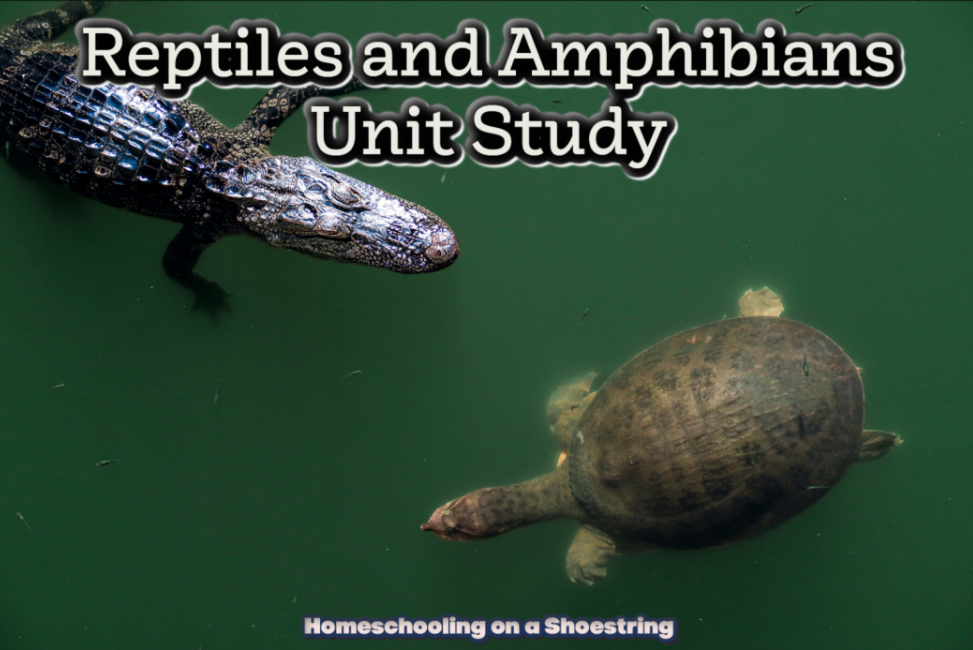
Reptiles and Amphibians Unit Study
Reptiles and amphibians are the animals that hiss, croak, bask, and burrow. Turtles, snakes, lizards, crocodiles, and the rare tuatara are reptiles, with dry, scaly skin and eggs that can be laid on land. Frogs, toads, salamanders, newts, and the legless caecilians are amphibians, with thin, damp skin and young that usually start life in water. Both groups depend on the sun and their surroundings to warm up, which is why you find a turtle sunning on a log on a spring morning.
This Reptiles and Amphibians Unit Study helps children of every age sort these cold-blooded animals into their families, learn the parts of a turtle shell, test how basking works with two thermometers, go on a salamander search, and read classics like Lyle, Lyle, Crocodile and The Day Jimmy’s Boa Ate the Wash. Make a sock snake, bake turtle bread rolls, visit a reptile house, and play Scales and Slime Rummy. Books, crafts, lapbook ideas, and homemade games work from preschool through high school.
Learning Objectives
Many parents and teachers will need to create their own goals. You can compare the goals at these sites to create your own goals depending on how stringent your requirements need to be. All links have several suggested activities for different ages.
Suggested Curriculum Standards:
- World Book Scope Basic Course structure https://www.worldbook.com/typical-course-of-study.aspx
- Michigan Department of Education https://www.michigan.gov/mde/services/academic-standards
- Maine as an example of state level requirements https://www.maine.gov/doe/standards/ela/resources
- California state level requirements https://www.cde.ca.gov/be/st/ss/
- Ontario Canada K-8 Expectations https://www.dcp.edu.gov.on.ca/en/curriculum#elementary
- Abeka Scope and Sequence https://www.abeka.com/HomeSchool/ScopeAndSequence.aspx
- The series of books called “What your nth Grader needs to know” May also be helpful nth representing the grade your child is in. This series only Goes to grade 8
- Tell the difference between a reptile and an amphibian by skin, eggs, and life cycle
- Name the four groups of reptiles and the three groups of amphibians, with an example of each
- Explain what cold-blooded (ectothermic) means and why reptiles bask in the sun
- Describe how amphibians like salamanders and frogs change from water-living young to adults (metamorphosis)
- Identify the parts of a turtle shell and explain how snakes and lizards shed their skin
- Compare a shelled reptile egg with the jelly-coated eggs of frogs and salamanders
- Learn which snakes in your area are venomous and how to stay safe outdoors
- Explain why amphibians are called an early warning sign for polluted water
- Practice safe habits around reptiles and amphibians, including washing hands after handling them
Timeline
- About 375 million years ago: Fish with sturdy, limb-like fins, such as Tiktaalik, live in shallow water and point the way toward four-legged animals.
- About 340 to 370 million years ago: The first amphibians spread through swampy forests.
- About 312 million years ago: Hylonomus, one of the earliest known reptiles, lives in what is now Nova Scotia, Canada. Its egg did not need water.
- About 220 million years ago: Early turtles appear, some with a shell on the belly side only.
- About 100 million years ago: Early snakes are living alongside the dinosaurs.
- 1758: Swedish scientist Carl Linnaeus groups reptiles and amphibians together under one name. Later scientists split them into two classes.
- 1912: Scientists describe the Komodo dragon, the largest living lizard, after reports from the island of Komodo in Indonesia.
- 1973: The United States passes the Endangered Species Act, which protects sea turtles, American crocodiles, and many other animals.
- 1995: Michigan names the painted turtle its state reptile.
- 1998: Scientists identify a fungus (chytrid) as a cause of amphibian die-offs around the world.
Vocabulary
| Word | Meaning |
| Reptile | A cold-blooded animal with a backbone, dry scales or plates, and lungs, such as a snake, lizard, turtle, or crocodile |
| Amphibian | A cold-blooded animal with a backbone and thin, moist skin that usually begins life in water, such as a frog or salamander |
| Ectotherm (cold-blooded) | An animal that gets its body heat from its surroundings instead of making its own |
| Bask | To lie in the sun to warm up |
| Metamorphosis | A big change in body shape as an animal grows, like a tadpole turning into a frog |
| Tadpole | The young, water-living stage of a frog or toad, with gills and a tail. Young salamanders are called larvae. |
| Gills | Body parts that take oxygen from water |
| Scute | A hard, bony plate, like the sections of a turtle shell |
| Carapace | The top part of a turtle’s shell |
| Plastron | The bottom part of a turtle’s shell |
| Molt (shed) | To lose an old outer layer of skin so a new one can take its place |
| Venomous | Able to inject venom with a bite or sting, like a rattlesnake |
| Poisonous | Harmful to touch or eat, like the skin of a poison dart frog |
| Herpetology | The study of reptiles and amphibians; a scientist who studies them is a herpetologist |
| Habitat | The natural home of an animal or plant |
| Endangered | At risk of disappearing forever |
| Camouflage | Colors or patterns that help an animal blend into its surroundings |
| Hibernate (brumate) | To rest through the cold months; reptiles do a version called brumation |
Have children add each word to a vocabulary page in their notebook with a quick drawing. Older students can look up the Greek roots: herpeton means creeping thing, and amphibios means living a double life.
Book Resources
 Want to go deeper with frogs? Our Frogs Unit Study has more frog books, frog calls to listen to, a virtual frog dissection, and a Pond Go Fish card game.
Picture Books and Read-Alouds
- Lyle, Lyle, Crocodile by Bernard Waber: A friendly crocodile lives with a family on East 88th Street in New York.
- The Day Jimmy’s Boa Ate the Wash by Trinka Hakes Noble: A class trip to a farm goes silly when a pet snake comes along.
- Verdi by Janell Cannon: A young python doesn’t want to grow up into a lazy green snake.
- Chickens Aren’t the Only Ones by Ruth Heller: A rhyming look at the many animals that lay eggs, including reptiles and amphibians.
- How to Hide a Crocodile and Other Reptiles by Ruth Heller: Bright pictures show how reptiles use camouflage.
- Tracks in the Sand by Loreen Leedy: A mother loggerhead digs a nest on the beach, and weeks later the babies race to the ocean.
Nonfiction
- Take a Look at Snakes by Betsy Maestro: How snakes move, eat, and grow, for early elementary.
- Snakes, Salamanders, and Lizards by Diane Burns: A Take-Along Guide with tips on where to look for each one outdoors.
- Extremely Weird Reptiles by Sarah Lovett: Photos and facts about the oddest reptiles on earth.
- Eyewitness Reptile by Colin McCarthy: Photo-filled pages for browsing and report writing.
- Eyewitness Amphibian by Barry Clarke: The companion volume on frogs, toads, newts, and salamanders.
- Everything Reptiles by Blake Hoena: A National Geographic Kids book packed with photos.
- Moon of the Alligators by Jean Craighead George: A month in the life of an alligator in the Florida Everglades.
For Older Students and Field Guides
- Peterson First Guide to Reptiles and Amphibians by Roger Conant: A pocket guide for nature walks in North America.
- National Audubon Society Field Guide to Reptiles and Amphibians by John L. Behler: Photos and range maps for identifying what you find.
- Amphibians, Reptiles, and Their Conservation by Marty Crump: Why these animals are in trouble and what people are doing to help.
Poetry and Music
- Lizards, Frogs, and Polliwogs by Douglas Florian: Short, funny poems with watercolor paintings. Read one a day and copy a favorite into your notebook.
- Poetry for Young People: Emily Dickinson: Look for “A narrow Fellow in the Grass,” her poem about meeting a snake.
- Read “The Little Turtle” by Vachel Lindsay, a short poem about a turtle who snaps at a mosquito, a flea, and a minnow. Little ones can act it out.
- Write a shape poem: write a poem about a snake along a wiggly line, or about a turtle inside an oval shell.
- Never Smile at a Crocodile: The cheerful song from Disney’s Peter Pan.
Videos
- Magic School Bus Goes Cold Bloodied: Ms. Frizzle’s class learns why Liz the lizard needs the sun.
- Eyewitness Reptile DVD: The video version of the Eyewitness book.
- Life in Cold Blood: A five-part BBC series on reptiles and amphibians for older students.
Activities
- Reptile or Amphibian? Cut animal pictures from old magazines or calendars and sort them onto a two-column chart. Add a third column for animals that fool people, like the salamander (an amphibian that looks like a lizard).
- Basking experiment: Set one thermometer in a sunny spot and another in the shade. Check both every 15 minutes and graph the results. Talk about why a lizard moves between sun and shade during the day.
- Egg compare: Soak a raw chicken egg in white vinegar for two days until the shell dissolves. Gently feel the rubbery membrane underneath. Compare it with pictures of jelly-coated frog eggs and talk about why reptile eggs can survive on dry land.
- Salamander search: On a damp spring or fall day, gently roll over a log or flat rock in the woods with an adult. Look for salamanders, then roll the log back exactly how you found it. Sketch what you see.
- Shed skin: Ask a pet store or nature center if they have a shed snake skin you can look at. Use a magnifying glass to see the pattern of the scales, even over the eyes.
- Measure it: Find the length of an anaconda, a Komodo dragon, a leatherback sea turtle, and the tiniest frog you can find in your books. Mark each length on the sidewalk with chalk or along the hallway with masking tape.
- State reptiles and amphibians: Look up your own state’s reptile or amphibian, if it has one. In Michigan, it’s the painted turtle. Find out which snakes in your state are venomous (in Michigan, only the eastern massasauga rattlesnake).
- Turtle shell math: Count the scutes on a picture of a painted turtle’s shell. Draw your own shell on graph paper and color the scutes in a repeating pattern.
- Pond water check: Explain how amphibians breathe partly through their skin, so they are often the first animals harmed when water is polluted. Older students can research a local frog survey or the FrogWatch USA program.
- Safety talk: Never pick up a snake you don’t know. Always wash hands with soap after touching any reptile, amphibian, or their tank, since they can carry salmonella germs. Don’t touch wild frogs with lotion or bug spray on your hands.
Writing Prompts
- You are a turtle carrying your house on your back. Describe a day in your life.
- Write a news report about a nest of baby sea turtles hatching on the beach.
- Older students: Write a persuasive letter explaining why your town should protect a nearby wetland.
Recipes
Turtle Bread Rolls
Use your favorite bread dough, a batch of frozen dough thawed in the fridge, or a can of refrigerated biscuits.
- Roll a ball of dough the size of a small orange for the shell.
- Roll five smaller balls for the head and four legs, and a tiny pinch for the tail. Tuck them under the edges of the shell.
- With kitchen scissors, snip a crisscross pattern on the top of the shell so it looks like scutes.
- Press in two raisins or peppercorns for eyes.
- Let rise if using yeast dough, then bake at 375°F until golden, about 15 to 20 minutes.
More Recipe Ideas
- Swamp cups: Make green gelatin in clear cups and drop in a gummy snake or gummy lizard before it sets.
- Veggie snake: Line up cucumber slices in a wiggly row on a plate. Add a cherry tomato head and a strip of red pepper for a tongue.
- Crocodile cucumber: Cut a zigzag mouth into one end of a whole cucumber and fill the platter with dip and crackers.
Field Trips
- Detroit Zoo: Holden Reptile Conservation Center: Snakes, lizards, turtles, crocodilians, and amphibians from around the world, in Royal Oak, Michigan.
- Your local zoo or nature center: Ask if a naturalist can show you a turtle or snake up close and answer questions.
- Pet store: Watch the frogs, geckos, and bearded dragons. Ask what each one eats and how warm its tank needs to be.
- Pond or wetland walk: Go in spring to look for egg masses and tadpoles, or in summer to spot turtles basking on logs.
- Reptile shows and herp society meetings: Many areas have reptile expos or clubs that welcome families.
Art and Craft Ideas
- Clothespin crocodile: Color a wooden clothespin green and glue on paper teeth and eyes. Squeeze it to make the crocodile snap.
- Paper plate turtle: Paint or color a paper plate for the shell. Cut the head, legs, and tail from cardboard from a cereal box and glue them on.
- Sock snake: Stuff an old sock with fabric scraps or plastic grocery bags. Draw on eyes and a forked tongue with markers or add felt.
- Egg carton crocodile: Paint the bumpy side of a cardboard egg carton green and add paper teeth and eyes. Use two cartons for a longer croc.
- Salt dough lizards: Mix 1 cup flour, 1/2 cup salt, and about 1/2 cup water. Shape lizards, bake at a low heat until hard, then paint scales.
- Paper chain snake: Link strips of colored scrap paper in a pattern copied from a real snake, like a corn snake or garter snake.
- Pop-up habitat card: Draw a snake in its habitat and add one moving part, like a lift-the-flap rock with a snake hiding under it or a pull tab that slides a rattlesnake’s rattle back and forth.
- Sea turtle life cycle wheel: Divide a paper plate into four parts (egg in the sand, hatchling, young turtle, adult) and attach a second plate with a window cut out and a brad in the middle.
Information Web Resources
- Enchanted Learning: Reptile Printouts: Fact sheets and label pages for many reptiles. Some pages need a membership.
- Smithsonian National Zoo: Animals: Fact pages for the zoo’s reptiles and amphibians, with photos.
- Detroit Zoo: Holden Reptile Conservation Center: Learn about the animals and conservation work before you visit.
Games
Use these ideas to turn key concepts from this unit into creative, engaging games your learners will love.
Game Board Blanks
Create your own themed games for this unit using printable templates and inspiration from the sites below:
- Games . . . Tools for Learning by Mark and Janice Vreeland
- Games for Learning ideas from Mary Peterson
- Board Game Templates – Tim’s Printables – free blank game boards
- JustFamilyFun – Board Game Paths
- Cardboard Cognition: Educational Board Games: An archived San Diego State University chart that helps you pick the right type of board or card game to make, with ideas for game boards and pieces.
- Hiss or Croak relay: Call out an animal name. Children run to the reptile side of the room or the amphibian side.
- Turtle Trot number line: Chalk a line of rocks numbered 1 to 20 on the driveway. Roll a die and creep that many rocks like a turtle, then add or subtract to find where you land.
- Snakes and Ladders: Play the classic board game and name a reptile fact every time you slide down a snake.
- Animal charades: Act out a basking lizard, a swimming crocodile, a hopping toad, or a turtle pulling into its shell.
Neverending Card Deck
Use the Neverending Card Deck card and box templates to make your own sets. You can flip the card template to print your custom design on the back. Free clipart works great for themed backs or matching your card box. These cards can be used in both card games and board games.
Reptiles and Amphibians Card Game: Scales and Slime Rummy
Make 24 cards from index cards or cut-up cereal boxes. Write one animal on each card, with a quick drawing if you like. There are six families, with four cards in each:
- Turtles: painted turtle, box turtle, snapping turtle, leatherback sea turtle
- Crocodilians: American alligator, saltwater crocodile, caiman, gharial
- Lizards: Komodo dragon, gecko, chameleon, iguana
- Snakes: garter snake, corn snake, king cobra, eastern massasauga rattlesnake
- Frogs and Toads: American toad, bullfrog, red-eyed tree frog, poison dart frog
- Salamanders: tiger salamander, red eft (eastern newt), axolotl, mudpuppy
How to play:
- Deal 6 cards to each player. Put the rest face down and turn one card face up to start a discard pile.
- On your turn, draw from either pile, then discard one card.
- When you hold all four cards in one family, lay them down and say whether the family is reptile or amphibian, plus one fact about it.
- The first player to lay down two families wins.
Younger children can play Go Fish with the same cards, asking for families instead of numbers. These cards also work with the homemade board games for this unit. Draw a card and move ahead one space for a reptile or two spaces for an amphibian.
GeoSafari Cards
Using the GeoSafari Instruction Guide, you can create a wide variety of custom cards for this unit. GeoSafari is especially great for independent learning and long car trips!
Donna Young shows you how to make GeoSafari Cards
DIY Card Ideas
- Timeline event ↔ date matching cards
- True or false review questions
- Vocabulary words ↔ real-life images
- Chapter-based quizzes or review sets
GeoSafari Card Ideas
- Match each animal to reptile or amphibian.
- Match each reptile to its group: turtle, crocodilian, lizard, or snake.
- Label the parts of a turtle shell (carapace, plastron, scutes).
- Match reptiles and amphibians to their home continents.
- Name the venomous snakes found in your state.
Worksheets
Make your own worksheets with these worksheet creation tools:
- SchoolHouseTech https://www.schoolhousetech.com/ This company gives away two free software worksheet factories one for Basic math and one for wordsearch utility that will make wonderful complements to this unit when you include the clipart listed in the clipart section.
- Start Write – This program makes nice reports and handwriting worksheets for the unit. https://www.startwrite.com/
- TeachNology has several online worksheet makers and a ton of Rubric makers. Rubrics work great with Homeschool Tracker because they give you total points and you count up exactly how many points your child gets. https://www.teach-nology.com/worksheets/
- Online Crossword Puzzle Maker to use with your vocabulary words or locations or even dates from the timeline. https://www.happychild.org.uk/wks/english/ssm/crosswords01.htm
- Free Printable Reptiles and Amphibians Pack: A printable pack listed on Free Homeschool Deals.
- Little Bins for Little Hands: Reptile Worksheets: Printable reptile pages for younger children.
Lapbook Ideas
- Two-pocket sort: one pocket labeled Reptiles and one labeled Amphibians, filled with small picture cards.
- Reptile groups four-flap book: turtles, crocodilians, lizards, and snakes, with a drawing and a fact under each flap.
- Amphibian groups tri-fold: frogs and toads, salamanders and newts, and caecilians.
- Turtle shell flap book: lift the carapace to find the plastron and labeled scutes underneath.
- Accordion fold of the vocabulary words with drawings.
- Venomous or not? A mini book of snakes in your state.
- A pocket for your basking experiment graph.
- Reptiles Lapbook Printables: Free printable lapbook pieces from Tina’s Dynamic Homeschool Plus.
Evaluation Ideas
Assemble a three ring binder and please include:
- A copy of this unit
- Course Description (Highschool Students)
- Write a summary about books read for the unit
- Write an essay on the various topics discussed
- Your Lapbook created for the unit (K-8 Students)
- Any worksheets or activity books created with SchoolhouseTech Software https://www.schoolhousetech.com/
- Your journal and its contents
- Your Log of activities from Homeschool Tracker https://www.homeschooltracker.com/free-homeschool-tracker-basic-edition Its Free!
- Your Timeline
- Have younger students sort a stack of picture cards into reptiles and amphibians and explain one choice.
- Have students draw and label a turtle shell from memory, or name one animal from each reptile and amphibian group.
- Older students can write a report on one endangered reptile or amphibian, what threatens it, and what people are doing to help.
- Include the basking experiment graph and a short lab write-up in the binder.
Related Unit Studies from Homeschooling on a Shoestring



More Unit Studies
Looking for your next topic? The Unit Studies directory has free and low-cost activities, lesson plans, worksheets, study guides, books, recipes, lapbook ideas, and games for homeschooling on a shoestring: https://homeschoolingonashoestring.com/homeschooling/homeschooling-by-subject/unit-studies/
Last Updated on November 2, 2026 by Jodi