
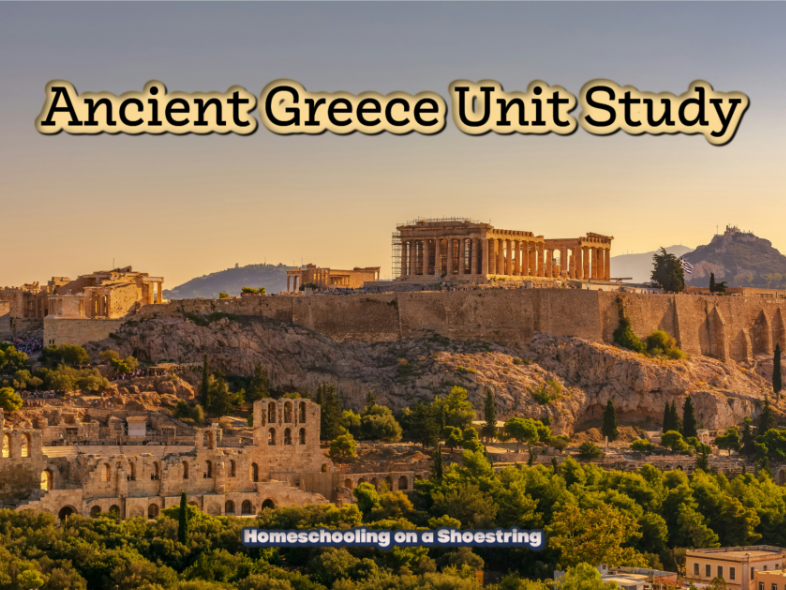
Ancient Greece Unit Study
Ancient Greece was not one country but hundreds of small city-states, each with its own government, spread across mountains, islands, and the shores of the Aegean Sea. The Greeks gave us democracy, the Olympic Games, theater, the columns you still see on banks and courthouses, and many of the words we use in math and science. Their myths about Zeus, Athena, Hercules, and Odysseus have been told for nearly 3,000 years.
This Ancient Greece Unit Study covers the Minoans and Mycenaeans, Athens and Sparta, the gods and myths, the Olympics, Greek thinkers, and daily life. Make a laurel wreath and a paper mache helmet, build a lyre, read the Odyssey, hold your own family Olympics, cook a Greek meal, and play Greek Gods Rummy. Books, videos, crafts, recipes, lapbook ideas, and homemade games work for every age, from preschool to high school.
Learning Objectives
Many parents and teachers will need to create their own goals. You can compare the goals at these sites to create your own goals depending on how stringent your requirements need to be. All links have several suggested activities for different ages.
Suggested Curriculum Standards:
- World Book Scope Basic Course structure https://www.worldbook.com/typical-course-of-study.aspx
- Michigan Department of Education https://www.michigan.gov/mde/services/academic-standards
- Maine as an example of state level requirements https://www.maine.gov/doe/standards/ela/resources
- California state level requirements https://www.cde.ca.gov/be/st/ss/
- Ontario Canada K-8 Expectations https://www.dcp.edu.gov.on.ca/en/curriculum#elementary
- Abeka Scope and Sequence https://www.abeka.com/HomeSchool/ScopeAndSequence.aspx
- The series of books called “What your nth Grader needs to know” May also be helpful nth representing the grade your child is in. This series only Goes to grade 8
- Locate Greece, Athens, Sparta, Troy, Crete, the Aegean Sea, and the Mediterranean Sea on a map
- Compare the Minoan and Mycenaean civilizations, and describe what a “dark age” is
- Compare life in Athens and Sparta: government, school, and the army
- Explain what democracy means and how the Athenians practiced it
- Read and retell Greek myths, and write an original myth
- Learn about Homer, the Iliad and the Odyssey, and why oral history matters
- Learn about Aesop and his fables
- Describe the ancient Olympics and compare them with the modern games
- Learn what Greek thinkers, doctors, and mathematicians discovered
- Keep a notebook or lapbook to organize your research
Ancient Greece Facts
- The Minoans lived on the island of Crete and built a huge palace at Knossos. The Mycenaeans lived on the mainland, at cities like Mycenae, Tiryns, and Pylos.
- Each Greek city-state was called a polis. The Greeks called themselves Hellenes.
- Athens was the first democracy. Citizens met in a group called the ecclesia to vote on laws. Women, slaves, and foreigners could not vote.
- Sparta trained its boys to be soldiers starting at age 7.
- The first recorded Olympic Games were held in 776 BC at Olympia, in honor of Zeus. They were held every four years, and wars stopped so athletes could travel safely.
- The Parthenon, a temple to the goddess Athena, sits on a rocky hill in Athens called the Acropolis.
- The word “alphabet” comes from the first two Greek letters, alpha and beta.
- Greek plays were performed in huge outdoor theaters. Actors wore masks so people in the back rows could see their faces.
- The Greeks told time with a water clock called a clepsydra.
- Hippocrates is called the father of medicine. Doctors still take an oath named after him.
Famous Greeks
Choose one to research and write a short report about why the person was important:
- Homer, the poet of the Iliad and the Odyssey
- Aesop, teller of fables
- Pericles, leader of Athens during its Golden Age
- Socrates, Plato, and Aristotle, philosophers and teachers
- Hippocrates, the father of medicine
- Pythagoras and Euclid, mathematicians
- Archimedes, inventor and mathematician
- Herodotus, the father of history
- Sophocles, writer of plays
- Leonidas, the Spartan king at Thermopylae
- Alexander the Great, who built an empire from Greece to India
Timeline
Events to add to your timeline:
- About 2000 BC: The Minoans build the palace at Knossos on Crete
- About 1600 to 1100 BC: The Mycenaeans rule mainland Greece
- About 1200 BC: The Trojan War, told in Homer’s Iliad
- About 1100 to 800 BC: The Greek Dark Age
- About 750 BC: Homer’s Iliad and Odyssey take shape
- 776 BC: The first recorded Olympic Games
- About 600 BC: Aesop tells his fables
- 508 BC: Democracy begins in Athens
- 490 BC: The Athenians defeat the Persians at the Battle of Marathon
- 480 BC: The Spartans hold the pass at Thermopylae
- 461 to 429 BC: Pericles leads Athens during its Golden Age
- 447 to 432 BC: The Parthenon is built
- 431 to 404 BC: Athens and Sparta fight the Peloponnesian War
- 399 BC: Socrates is put on trial and dies
- 336 to 323 BC: Alexander the Great builds his empire
- 146 BC: Rome takes control of Greece
- 1896: The first modern Olympic Games are held in Athens
Vocabulary
| Acropolis | clepsydra | immortal | oracle |
| agora | colony | lyre | Parthenon |
| barter | column | marathon | peninsula |
| chariot | constellation | Minoan | phalanx |
| chiton | democracy | monarchy | philosophy |
| city-state | discus | mortal | polis |
| drachma | drama | Mycenaean | trident |
| ecclesia | epic | myth | trireme |
| fresco | Hellenes | oligarchy | tyrant |
- Copy each word and its definition onto a sheet of paper for your portfolio.
- Make flash cards with the word on the front, then have the kids hand write the definition in their own words on the back. It helps them remember the definitions better.
- Word detectives: Many English words come from Greek myths. Look up where these come from: panic (Pan), echo (Echo), cereal (Ceres, the Roman name for Demeter), titanic (the Titans), atlas (Atlas), and arachnid (Arachne).
- Learn the Greek alphabet and write your name with Greek letters.
- Look up words with WordWeb, free downloadable software, or the online Dictionary.com.
Book Resources
Myths and Stories
- D’Aulaires’ Book of Greek Myths by Ingri and Edgar Parin d’Aulaire
- The Gods and Goddesses of Olympus by Aliki
- The Olympians: Great Gods and Goddesses of Ancient Greece by Leonard Everett Fisher
- Jason and the Golden Fleece by Leonard Everett Fisher
- The Macmillan Book of Greek Gods and Heroes by Alice Low
- Favorite Greek Myths by Mary Pope Osborne
- Greek Myths by Geraldine McCaughrean
- Classic Myths to Read Aloud by William F. Russell
- Atalanta’s Race: A Greek Myth by Shirley Climo
- Cupid and Psyche by M. Charlotte Craft
- Odysseus and the Cyclops and The Trojan Horse by Warwick Hutton
- The Trojan Horse (Step into Reading) by Emily Little
- Daughter of Earth by Gerald McDermott
- Aesop’s Fables by Ann McGovern
- Tales of the Greek Heroes by Roger Lancelyn Green
- Black Ships Before Troy and The Wanderings of Odysseus by Rosemary Sutcliff
- The Children’s Homer by Padraic Colum
- Mythology by Edith Hamilton (older students)
- The Greek Gods by Bernard Evslin, Dorothy Evslin, and Ned Hoopes
History and Daily Life
- The Great Alexander the Great by Joe Lasker
- Growing Up in Ancient Greece by Chris Chelepi
- See Inside an Ancient Greek Town by Jonathan Rutland
- The Ancient Greeks in the Land of the Gods by Sophie Descamps-Lequime and Denise Vernerey
- History as Evidence: Ancient Greece by John Ellis Jones
- The Greeks (Usborne)
- The Groovy Greeks (Horrible Histories) by Terry Deary
- Ancient Greece (Eyewitness) by Anne Pearson
- The Penguin Historical Atlas of Ancient Greece
- By Jove! and It’s Greek to Me! by Michael Macrone: Where our everyday words and sayings came from.
- Kids Discover: Ancient Greece (magazine)
Activity and Coloring Books
- Ancient Greece: A Civilization Project Book by Susan Purdy and Cass R. Sandak
- Ancient Greece Activity Book by Mary Jo Keller (Edupress)
- Drawing History: Ancient Greece by Elaine Raphael and Don Bolognese
- Life in Ancient Greece Coloring Book by John Green (Dover)
- Aesop’s Fables Coloring Book (Dover)
- A Coloring Book of Ancient Greece (Bellerophon Books)
Free Books at Project Gutenberg
- The Iliad by Homer
- The Odyssey by Homer
- Aesop’s Fables
Poetry and Music
- Make a lyre: Stretch rubber bands of different thicknesses across a shoebox lid or a sturdy paper plate cut in a U shape. Pluck the strings and see how the thick and thin bands make different notes.
- The Greeks sang long poems called epics. Read the part of the Odyssey about the Cyclops cave and talk about how the story was passed down by memory before it was written.
- Write your own short epic poem about a family hero, or an ode to something you love.
- Learn about Pythagoras, who discovered that musical notes follow math patterns.
Videos
- The Greek Gods (History Channel)
- Rise and Fall of the Spartans (History Channel)
- Mystical Monuments of Ancient Greece (History Channel)
- The Odyssey of Troy (A&E)
- Treasure! The Ancient Gold of Troy
Activities
- Map of Greece: Label Athens, Sparta, Olympia, Delphi, Troy, Crete, Mount Olympus, the Peloponnesus, the Aegean Sea, and the Mediterranean Sea.
- Athens or Sparta: Make a T-chart comparing school, sports, the army, government, and life for girls in Athens and Sparta. Which one would you rather live in, and why?
- What is democracy? Write your own definition in your journal, then look it up and compare. Hold a family vote the Athenian way, with pebbles in a jar.
- Family Olympics: Hold your own games with a footrace, a long jump, a paper plate discus throw, and a pool noodle javelin. Crown the winners with laurel wreaths.
- Write and act out a play: Pick a Greek myth, write a short play, make masks, and perform it for the family.
- Write your own myth: Make up a story that explains something in nature, like why the moon changes shape, using a Greek god or goddess.
- Greek columns: Learn the three kinds of columns (Doric, Ionic, and Corinthian), then look for them on buildings in your town.
- Constellations: Many star patterns are named for Greek myths. Find Orion, Hercules, Perseus, and Cassiopeia on a star chart or a clear night.
- Hippocrates: Read the Hippocratic Oath. What does it mean? Write about it in your journal.
- Greek math: Use Pythagoras’ rule to check whether the corner of a room is square. Measure 3 feet along one wall and 4 feet along the other. If the distance between the two marks is 5 feet, it is a right angle.
- Water clock: Poke a small hole in the bottom of a paper cup and set it over a jar. Mark how high the water is every minute to make your own clepsydra.
Writing Prompts
- You are an athlete at the first Olympics in 776 BC. Write about your race.
- You are a citizen voting in Athens. What law would you vote for, and why?
- Write a letter home from a Greek soldier hiding inside the Trojan Horse.
- Write a short report on a famous Greek: who they were and why they matter today.
Recipes
Greek Feast
Ancient Greeks ate barley bread, olives, cheese, figs, grapes, lentils, fish, and honey. Lay out a feast on a low table and recline on pillows to eat, like a Greek symposium.
- Greek salad: Toss chopped cucumber, tomato, red onion, and olives with olive oil, lemon juice, oregano, and crumbled feta. Olive oil and olives have healthy fats, and cucumbers and tomatoes add vitamins and water.
- Yogurt with honey and walnuts: Greek yogurt has protein and calcium, and walnuts have healthy fats.
- Gluten-free pita or rice crackers with hummus or tzatziki: Mix plain yogurt with grated cucumber, garlic, and a little dill to make tzatziki.
- Fruit platter: Grapes, figs, dates, and pomegranate seeds.
See the Greek Recipes page here on Homeschooling on a Shoestring for more.
Field Trips
- Art museum: Look for Greek vases, statues, and coins. Many art museums have a Greek and Roman gallery.
- Greek festival: Many Greek Orthodox churches hold a summer food festival with dancing and music.
- Greek restaurant: Try spanakopita, souvlaki, or baklava.
- Columns walk: Visit downtown buildings, banks, and courthouses and find Doric, Ionic, and Corinthian columns.
- Planetarium: See the constellations named for Greek myths.
- The British Museum: Ancient Greece: A virtual visit with online activities.
Art and Craft Ideas
- Laurel wreath: Twist two pipe cleaners into a circle, or use a paper plate with the center cut out. Cut out green paper leaves and glue them around it.
- Greek helmet: Cover a blown-up balloon with newspaper strips dipped in a mix of 1 part white glue to 3 parts water. Let it dry overnight, pop the balloon, cut out a space for the face, and paint it gray or gold. Glue on a paper fringe across the top.
- Shield and spear: Cut a round shield from cardboard and paint a design on it. Make a spear from a cardboard tube or paper towel roll.
- Trident: Draw a trident on cardboard, cut it out, and paint it gold.
- Greek pottery: Draw a vase shape on orange or tan paper and decorate it with black figures and patterns. Or paint designs on a clay pot.
- Scroll: Roll paper around two dowels or pencils and write the Greek alphabet or a poem on it.
- Greek masks: Make comedy and tragedy masks from paper plates.
- Chiton: Make a simple Greek tunic from an old sheet folded in half, pinned at the shoulders, and tied with a belt or cord.
- Sandals: Trace your foot on cardboard, cut it out, and attach yarn or ribbon straps.
- Greek statue: Shape a statue from clay, salt dough, or soap.
- Storm the Castle: Paper Parthenon: A free printable model to glue onto cereal box cardboard.
- Mr. Donn: Ancient Greek Clothing: See what to copy for your chiton and sandals.
Information and General Resources
- The British Museum: Ancient Greece
- Penn Museum: The Real Story of the Ancient Olympic Games
- History for Kids: Ancient Greece
- History for Kids: Ancient Greek Olympics
- BBC Bitesize: How Did the Olympic Games Begin?
- Mr. Donn: Ancient Greece for Kids: Daily life, myths retold for kids, and interactive quizzes.
- Ducksters: Ancient Greece
- The Met: Theater in Ancient Greece
- The Met: Music in Ancient Greece
- Wikipedia: Ancient Greek Cuisine
- Wikipedia: Ancient Greece
More Free Books at Project Gutenberg
- The History of Herodotus, Volume 1 (older students)
- The History of Herodotus, Volume 2 (older students)
Lapbook Ideas
- Map of Ancient Greece: City-states, seas, and islands.
- Athens and Sparta Venn Diagram
- Gods and Goddesses Flap Book: Zeus, Hera, Poseidon, Athena, Apollo, Artemis, Ares, Aphrodite, Hermes, Hephaestus, Demeter, and Hades, with each one’s symbol.
- Three Columns Fold-Out: Doric, Ionic, and Corinthian.
- Olympics Then and Now Pocket
- Greek Alphabet Chart
- Famous Greeks Mini Book: One page for each person you studied.
- Words From Myths Pocket: Panic, echo, cereal, titanic, atlas, and arachnid.
- Timeline: Accordion fold with the dates above.
- Vocabulary Pocket: Flash cards for the vocabulary words.
Games
Use these ideas to turn key concepts from this unit into creative, engaging games your learners will love.
Game Board Blanks
Create your own themed games for this unit using printable templates and inspiration from the sites below:
- Games . . . Tools for Learning by Mark and Janice Vreeland
- Games for Learning ideas from Mary Peterson
- Board Game Templates – Tim’s Printables – free blank game boards
- JustFamilyFun – Board Game Paths
- Cardboard Cognition: Educational Board Games: An archived San Diego State University chart that helps you pick the right type of board or card game to make, with ideas for game boards and pieces.
More Game Ideas
- Family Olympics: See the Activities section above.
- Odyssey board game: Draw Odysseus’ route home on a file folder, with stops at Troy, the Cyclops cave, Circe’s island, the Sirens, Scylla and Charybdis, and Ithaca. Roll a die to move, and draw a card at each stop.
- Knucklebones: Greek children played a game like jacks with small animal bones. Play with five small stones or dice.
- Make matching cards for gods and their symbols.
- Use the shape of a Greek column or vase for any skill in a file folder game.
- Printable Board Games: Blank boards and parts for making your own games.
Neverending Card Deck
Use the Neverending Card Deck card and box templates to make your own sets. You can flip the card template to print your custom design on the back. Free clipart works great for themed backs or matching your card box. These cards can be used in both card games and board games.
Ancient Greece Card Game: Greek Gods Rummy
Make a deck of 40 cards from index cards or cut-up cereal boxes. Choose 10 Greek gods and goddesses and make 4 cards for each one: the name, a picture, the symbol, and what he or she ruled over.
- Zeus: Thunderbolt. King of the gods and the sky.
- Hera: Peacock. Queen of the gods, marriage and family.
- Poseidon: Trident. The sea, earthquakes, and horses.
- Athena: Owl. Wisdom and crafts. Athens was named for her.
- Apollo: Lyre. Music, poetry, and the sun.
- Artemis: Bow and arrows. The hunt and the moon.
- Ares: Spear. War.
- Hermes: Winged sandals. Messenger of the gods.
- Demeter: Wheat. The harvest.
- Hades: Helmet. The underworld.
How to play:
- Deal 7 cards to each player. Put the rest face down in a pile and turn the top card face up to start a discard pile.
- On your turn, draw one card from either pile, then discard one card.
- When you collect all 4 cards for one god or goddess, lay them down and tell a myth about him or her.
- The first player to lay down two complete sets wins.
These cards also work with your homemade Odyssey board game and file folder games. Players draw a card and name the god’s symbol before they move.
GeoSafari Cards
Using the GeoSafari Instruction Guide, you can create a wide variety of custom cards for this unit. GeoSafari is especially great for independent learning and long car trips!
Donna Young shows you how to make GeoSafari Cards
DIY Card Ideas
- Timeline event ↔ date matching cards
- True or false review questions
- Vocabulary words ↔ real-life images
- Chapter-based quizzes or review sets
More GeoSafari Card Ideas
- Match gods and goddesses to their symbols.
- Match famous Greeks to what they are known for.
- Label city-states and seas on a map card.
- Match Greek letters to their English sounds.
Worksheets
Make your own worksheets with these worksheet creation tools:
- SchoolHouseTech https://www.schoolhousetech.com/ This company gives away two free software worksheet factories one for Basic math and one for wordsearch utility that will make wonderful complements to this unit when you include the clipart listed in the clipart section.
- Start Write – This program makes nice reports and handwriting worksheets for the unit. https://www.startwrite.com/
- TeachNology has several online worksheet makers and a ton of Rubric makers. Rubrics work great with Homeschool Tracker because they give you total points and you count up exactly how many points your child gets. https://www.teach-nology.com/worksheets/
- Online Crossword Puzzle Maker to use with your vocabulary words or locations or even dates from the timeline. https://www.happychild.org.uk/wks/english/ssm/crosswords01.htm
- National Geographic MapMaker: Blank and filled-in maps.
Evaluation Ideas
Assemble a three ring binder and please include:
- A copy of this unit
- Course Description (Highschool Students)
- Write a summary about books read for the unit
- Write an essay on the various topics discussed
- Your Lapbook created for the unit (K-8 Students)
- Any worksheets or activity books created with SchoolhouseTech Software https://www.schoolhousetech.com/
- Your journal and its contents
- Your Log of activities from Homeschool Tracker https://www.homeschooltracker.com/free-homeschool-tracker-basic-edition Its Free!
- Your Timeline
- Make a three-ring binder with your journal, essays, a high school course outline, your lapbook in a page protector, and photos of projects too big to fit.
- Have the student retell a Greek myth from memory, or perform the play they wrote.
Related Unit Studies from Homeschooling on a Shoestring


More Unit Studies
Looking for your next topic? The Unit Studies directory has free and low-cost activities, lesson plans, worksheets, study guides, books, recipes, lapbook ideas, and games for homeschooling on a shoestring: https://homeschoolingonashoestring.com/homeschooling/homeschooling-by-subject/unit-studies/
Last Updated on November 2, 2026 by Jodi