
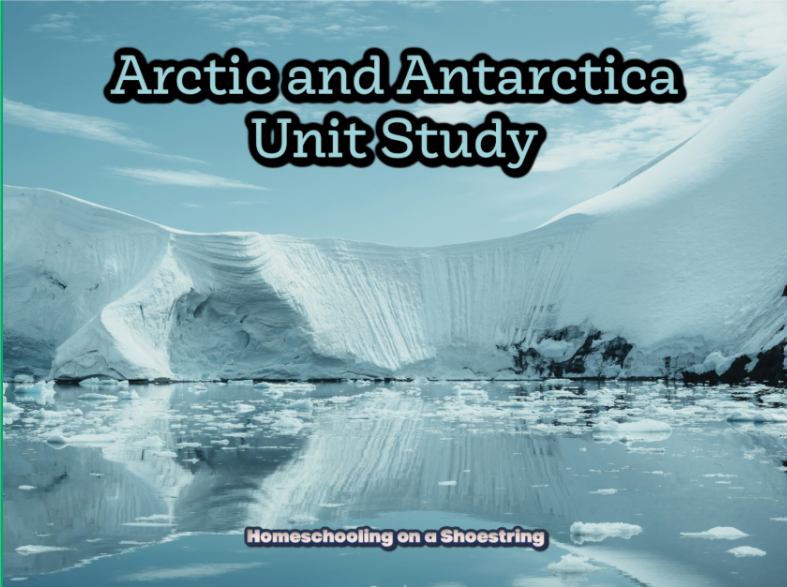
Arctic and Antarctica Unit Study
The Arctic and the Antarctic are the coldest places on Earth, but they are very different. The Arctic, at the top of the world, is a frozen ocean surrounded by land, where polar bears hunt seals and the Inuit and other peoples have lived for thousands of years. Antarctica, at the bottom of the world, is a continent covered by ice more than a mile thick, where penguins nest and no one lives year round except scientists at research stations. Both have days when the sun never sets and nights when it never rises.
This Arctic and Antarctica Unit Study covers the poles, polar animals, the people of the Arctic, the race to the South Pole, and the scientists who work on the ice today. Test how blubber keeps animals warm, build an igloo from sugar cubes, read Shackleton’s survival story, compare the two poles in a Venn diagram, and play Polar Animal Rummy. Books, videos, crafts, recipes, lapbook ideas, and homemade games work for every age, from preschool to high school.
Learning Objectives
Many parents and teachers will need to create their own goals. You can compare the goals at these sites to create your own goals depending on how stringent your requirements need to be. All links have several suggested activities for different ages.
Suggested Curriculum Standards:
- World Book Scope Basic Course structure https://www.worldbook.com/typical-course-of-study.aspx
- Michigan Department of Education https://www.michigan.gov/mde/services/academic-standards
- Maine as an example of state level requirements https://www.maine.gov/doe/standards/ela/resources
- California state level requirements https://www.cde.ca.gov/be/st/ss/
- Ontario Canada K-8 Expectations https://www.dcp.edu.gov.on.ca/en/curriculum#elementary
- Abeka Scope and Sequence https://www.abeka.com/HomeSchool/ScopeAndSequence.aspx
- The series of books called “What your nth Grader needs to know” May also be helpful nth representing the grade your child is in. This series only Goes to grade 8
- Locate the Arctic, the North Pole, Antarctica, the South Pole, and the Arctic and Antarctic Circles on a map or globe
- Compare the Arctic and the Antarctic: land, ice, weather, animals, and people
- Explain why the poles have months of daylight and months of darkness
- Describe how polar animals stay warm and survive
- Learn about the Inuit and other peoples of the Arctic
- Learn about polar explorers such as Peary, Henson, Amundsen, Scott, and Shackleton
- Find out what scientists study in Antarctica today
- Explain why Antarctica is called a desert
Arctic and Antarctic Facts
- The Arctic is mostly a frozen ocean surrounded by the northern parts of North America, Europe, and Asia. Antarctica is a continent of land covered with ice.
- Antarctica is the coldest, windiest, and driest continent. The coldest temperature ever recorded on Earth, about 128 degrees below zero Fahrenheit, was at Vostok Station in Antarctica.
- Antarctica gets so little snow and rain that it is the largest desert in the world.
- About 70 percent of the world’s fresh water is frozen in the Antarctic ice sheet.
- Polar bears live only in the Arctic. Penguins live only in the Southern Hemisphere. They never meet in the wild.
- A polar bear’s fur looks white, but its skin is black, which helps soak up the sun’s heat.
- Emperor penguin fathers keep the egg warm on their feet for about two months in the middle of winter without eating.
- At the North and South Poles, the sun stays up for about six months and then stays down for about six months.
- No country owns Antarctica. The Antarctic Treaty of 1959 set it aside for peace and science.
- The northern and southern lights (aurora borealis and aurora australis) glow in the sky near the poles.
Famous Polar Explorers
Choose one to research and write a short biography:
- Robert Peary and Matthew Henson, who led the first expedition claiming to reach the North Pole in 1909
- Roald Amundsen, the first to reach the South Pole in 1911
- Robert Falcon Scott, who reached the South Pole a month after Amundsen and died on the way back
- Ernest Shackleton, whose ship Endurance was crushed by ice and who brought every one of his men home
- Douglas Mawson, Australian explorer of Antarctica
- Richard E. Byrd, who flew over the South Pole in 1929
- Wilfred Grenfell, the doctor who built hospitals in Labrador and Newfoundland
- Ann Bancroft and Liv Arnesen, the first women to cross Antarctica on skis
Timeline
Events to add to your timeline:
- About 1000: Inuit ancestors (the Thule people) spread across the Arctic
- 1773: Captain James Cook crosses the Antarctic Circle
- 1820: Antarctica is first seen by explorers
- 1909: Peary and Henson’s expedition claims to reach the North Pole
- December 14, 1911: Amundsen’s team reaches the South Pole
- January 17, 1912: Scott’s team reaches the South Pole
- 1914 to 1916: Shackleton’s Endurance expedition
- 1929: Richard Byrd flies over the South Pole
- 1959: The Antarctic Treaty is signed
- 2001: Ann Bancroft and Liv Arnesen cross Antarctica
Vocabulary
| Antarctic Circle | blubber | ice sheet | krill |
| Arctic Circle | continent | ice shelf | migration |
| aurora | expedition | iceberg | permafrost |
| axis | glacier | igloo | research station |
| blizzard | hemisphere | Inuit | tundra |
- Copy each word and its definition onto a sheet of paper for your portfolio.
- Make flash cards with the word on the front, then have the kids hand write the definition in their own words on the back.
- Look up words with WordWeb, free downloadable software, or the online Dictionary.com.
Book Resources
Picture Books and Early Readers
- Polar Bears Past Bedtime (Magic Tree House) by Mary Pope Osborne, and its Research Guide, Penguins and Antarctica
- Mr. Popper’s Penguins by Richard and Florence Atwater
- Tacky the Penguin by Helen Lester
- Arctic Lights, Arctic Nights by Debbie S. Miller
- Mama, Do You Love Me? by Barbara M. Joosse
- Penguin Chick by Betty Tatham
Chapter Books and Novels
- Julie of the Wolves by Jean Craighead George
- Ice Story: Shackleton’s Lost Expedition by Elizabeth Cody Kimmel
- Call of the Wild and White Fang by Jack London
- An Antarctic Mystery by Jules Verne
Nonfiction
- Polar Explorers for Kids: Historic Expeditions to the Arctic and Antarctic with 21 Activities by Maxine Snowden
- Shipwreck at the Bottom of the World: The Extraordinary True Story of Shackleton and the Endurance by Jennifer Armstrong
- Ice Bound: A Doctor’s Incredible Battle for Survival at the South Pole by Jerri Nielsen (older students; parents read first)
- Eyewitness: Arctic and Antarctic (DK)
Free Books at Project Gutenberg
- The South Pole, Volume 1 and Volume 2 by Roald Amundsen
- The Worst Journey in the World by Apsley Cherry-Garrard
- The Home of the Blizzard by Douglas Mawson
- An Antarctic Mystery by Jules Verne
- The Arctic Prairies by Ernest Thompson Seton
- The Call of the Wild and White Fang by Jack London
Poetry and Music
- Write a cinquain about a polar animal.
- Write a diamante poem that goes from “Arctic” to “Antarctic.”
- Listen to recordings of whale songs and the calls of seals and penguins.
Videos
- March of the Penguins (2005)
- Eight Below (2006)
- Balto (1995)
- Antarctica (IMAX)
- Shackleton’s Antarctic Adventure (IMAX)
- The Race for the Poles
- Blue Planet: Frozen Seas (BBC)
- Australian Antarctic Program: Look for the live station webcams.
Activities
- Map the poles: On a globe or world map, find the North Pole, the South Pole, the Arctic Circle, the Antarctic Circle, and the oceans around each. Label Antarctica’s ice shelves.
- Arctic or Antarctic? Make a Venn diagram comparing the two: land or ocean, animals, people, temperature, and ice.
- Blubber glove: Fill a zip bag with shortening, put another zip bag inside it so your hand stays clean, and put your hand in ice water. Compare it to your bare hand. This is how seals, whales, and walruses stay warm.
- Why the poles have long days and nights: Shine a flashlight on a globe and tilt the globe as you walk it around the “sun.” Watch how one pole stays in light while the other stays dark.
- Floating icebergs: Freeze water in a balloon, peel it off, and float the ice in a tub of water. How much of your iceberg is under the water?
- Sugar cube igloo: Build an igloo on a paper plate with sugar cubes and frosting for glue.
- Penguin egg pass: Practice balancing a ball or bean bag on your feet and passing it to a partner without using your hands, like an emperor penguin.
- Pack for an expedition: Make a list of what you would need to survive a month in Antarctica. Compare it to what Amundsen and Scott took.
- Research station: Find out what scientists at the Amundsen-Scott South Pole Station study, eat, and do for fun.
- Track the temperature: Look up today’s weather at the South Pole and in the Arctic, and compare it with your town for a week.
Writing Prompts
- You are a member of Shackleton’s crew after the Endurance sinks. Write a journal entry.
- Describe a day when the sun never sets.
- Write a letter home from a scientist at the South Pole.
- Would you rather visit the Arctic or Antarctica, and why?
Recipes
- Expedition trail mix: Polar explorers needed high-energy food. Mix nuts, raisins, dried fruit, and a few chocolate chips. Nuts have healthy fats and protein, and dried fruit has natural sugars for quick energy.
- Igloo cake: Bake a gluten-free cake (a gluten-free cake mix works) in a round, oven-safe bowl, turn it upside down, and frost it white with lines to look like snow blocks.
- Penguin snacks: Make penguins from black olives and cream cheese, or banana slices with chocolate.
- Hot cocoa: Explorers and research station workers warm up with hot drinks.
Field Trips
- Zoo or aquarium: Look for penguins, polar bears, seals, and arctic foxes.
- Natural history museum: Look for Inuit tools, clothing, and art.
- Ice rink: Feel what it’s like to walk and skate on ice.
- Planetarium: Ask about the northern lights.
Art and Craft Ideas
- Paper plate penguin: Paint a paper plate black with a white belly, and add an orange beak and feet.
- Polar bear from cotton balls: Glue cotton balls onto a polar bear shape.
- Northern lights painting: Use chalk pastels or watercolors on black paper to make the colors of the aurora.
- Shoebox diorama: Make a polar scene with cotton batting snow, aluminum foil water, and clay animals.
- Inuit-style soapstone carving: Carve a small animal from a bar of soap with a plastic knife.
- Snowflakes: Fold and cut paper snowflakes.
3D Paper Models
- Canon Creative Park: South Pole Diorama
- Canon Creative Park: North Pole Diorama
- Canon Creative Park: Emperor Penguin
- Canon Creative Park: Timber Wolf
- Canon Creative Park: Globe
Information and General Resources
- National Snow and Ice Data Center: Photos, satellite images, and facts about ice at both poles.
- Cool Antarctica: Pictures and facts about Antarctica.
- CIA World Factbook: Antarctica
- Smithsonian Arctic Studies Center
- British Antarctic Survey
- Enchanted Learning: Arctic Animals
- Students on Ice: Learning expeditions to the Arctic and Antarctic for students 14 to 19, homeschoolers included.
- Wikipedia: Wilfred Grenfell
Lapbook Ideas
- Arctic and Antarctic Venn Diagram
- Polar Map: Both poles with the circles and oceans labeled.
- Polar Animals Flap Book: Polar bear, arctic fox, walrus, seal, narwhal, emperor penguin, and krill.
- How Animals Stay Warm Pocket: Blubber, fur, feathers, and huddling.
- Explorers Mini Book: One page for each explorer.
- Race to the South Pole: Amundsen and Scott side by side.
- Day and Night Wheel: Why the poles have months of light and dark.
- Vocabulary Pocket: Flash cards for the vocabulary words.
Games
Use these ideas to turn key concepts from this unit into creative, engaging games your learners will love.
Game Board Blanks
Create your own themed games for this unit using printable templates and inspiration from the sites below:
- Games . . . Tools for Learning by Mark and Janice Vreeland
- Games for Learning ideas from Mary Peterson
- Board Game Templates – Tim’s Printables – free blank game boards
- JustFamilyFun – Board Game Paths
- Cardboard Cognition: Educational Board Games: An archived San Diego State University chart that helps you pick the right type of board or card game to make, with ideas for game boards and pieces.
More Game Ideas
- Race to the Pole board game: Draw a path across Antarctica on a file folder. Add blizzards, crevasses, and supply depots that move players forward or back.
- Concentration: Make matching cards of polar animals and their homes (Arctic or Antarctic).
- Penguin waddle race: Hold a ball between your knees and waddle to the finish line.
- Use the shape of an iceberg or igloo for any skill in a file folder game.
- Printable Board Games: Blank boards and parts for making your own games.
Neverending Card Deck
Use the Neverending Card Deck card and box templates to make your own sets. You can flip the card template to print your custom design on the back. Free clipart works great for themed backs or matching your card box. These cards can be used in both card games and board games.
Arctic and Antarctica Card Game: Polar Animal Rummy
Make a deck of 40 cards from index cards or cut-up cereal boxes. Choose 10 polar animals and make 4 cards for each one: the name, a picture, which pole it lives at, and how it stays warm or finds food.
- Polar bear: Arctic. Thick fur and fat, hunts seals.
- Arctic fox: Arctic. Fur turns white in winter.
- Walrus: Arctic. Blubber, uses tusks to climb onto ice.
- Narwhal: Arctic. A whale with a long tusk.
- Snowy owl: Arctic. Feathered feet.
- Caribou: Arctic. Hollow hairs trap warm air.
- Emperor penguin: Antarctic. Huddles with other penguins.
- Adelie penguin: Antarctic. Builds nests from stones.
- Leopard seal: Antarctic. Blubber, hunts penguins.
- Krill: Antarctic. Tiny shrimp-like animals that feed whales and penguins.
How to play:
- Deal 7 cards to each player. Put the rest face down in a pile and turn the top card face up to start a discard pile.
- On your turn, draw one card from either pile, then discard one card.
- When you collect all 4 cards for one animal, lay them down and tell one fact about it.
- The first player to lay down two complete animals wins.
These cards also work with your homemade Race to the Pole and file folder games. Players draw a card and name the animal’s pole before they move.
GeoSafari Cards
Using the GeoSafari Instruction Guide, you can create a wide variety of custom cards for this unit. GeoSafari is especially great for independent learning and long car trips!
Donna Young shows you how to make GeoSafari Cards
DIY Card Ideas
- Timeline event ↔ date matching cards
- True or false review questions
- Vocabulary words ↔ real-life images
- Chapter-based quizzes or review sets
More GeoSafari Card Ideas
- Arctic or Antarctic? Sort animals, explorers, and places.
- Match explorers to what they did.
- Label the oceans, circles, and poles on a map card.
Worksheets
Make your own worksheets with these worksheet creation tools:
- SchoolHouseTech https://www.schoolhousetech.com/ This company gives away two free software worksheet factories one for Basic math and one for wordsearch utility that will make wonderful complements to this unit when you include the clipart listed in the clipart section.
- Start Write – This program makes nice reports and handwriting worksheets for the unit. https://www.startwrite.com/
- TeachNology has several online worksheet makers and a ton of Rubric makers. Rubrics work great with Homeschool Tracker because they give you total points and you count up exactly how many points your child gets. https://www.teach-nology.com/worksheets/
- Online Crossword Puzzle Maker to use with your vocabulary words or locations or even dates from the timeline. https://www.happychild.org.uk/wks/english/ssm/crosswords01.htm
- Enchanted Learning: Antarctica: Maps, printables, and coloring pages.
- Bogglesworld: Climate Zones
Evaluation Ideas
Assemble a three ring binder and please include:
- A copy of this unit
- Course Description (Highschool Students)
- Write a summary about books read for the unit
- Write an essay on the various topics discussed
- Your Lapbook created for the unit (K-8 Students)
- Any worksheets or activity books created with SchoolhouseTech Software https://www.schoolhousetech.com/
- Your journal and its contents
- Your Log of activities from Homeschool Tracker https://www.homeschooltracker.com/free-homeschool-tracker-basic-edition Its Free!
- Your Timeline
- Have the student explain the Venn diagram comparing the Arctic and Antarctica.
- Give a blank map and have the student label both poles, the circles, and the oceans.
Related Unit Studies from Homeschooling on a Shoestring


More Unit Studies
Looking for your next topic? The Unit Studies directory has free and low-cost activities, lesson plans, worksheets, study guides, books, recipes, lapbook ideas, and games for homeschooling on a shoestring: https://homeschoolingonashoestring.com/homeschooling/homeschooling-by-subject/unit-studies/
Last Updated on November 2, 2026 by Jodi