
Germany Unit Study
Germany sits in the middle of Europe, with the cold North Sea and Baltic Sea on top and the snowy Alps along the bottom. In between are thick forests, castles on hills, old walled towns, and busy cities like Berlin, Hamburg, and Munich. This is the land of the Brothers Grimm, Bach and Beethoven, Gutenberg’s printing press, the first gasoline-powered car, and the Christmas tree. It was split into two countries after World War II and came back together in 1990, just a year after the Berlin Wall came down.
This Germany Unit Study works for the whole family. Little ones can listen to Grimm fairy tales, color the flag, and learn to count to ten in German, while older students trace German history from the Holy Roman Empire to the Berlin Wall, listen to the great German composers, and map the rivers and states. Bake soft pretzels, make a paper cut-out silhouette, take a day trip to Frankenmuth if you live near Michigan, and play Deutschland Rummy with homemade cards.
Learning Objectives
Many parents and teachers will need to create their own goals. You can compare the goals at these sites to create your own goals depending on how stringent your requirements need to be. All links have several suggested activities for different ages.
Suggested Curriculum Standards:
- World Book Scope Basic Course structure https://www.worldbook.com/typical-course-of-study.aspx
- Michigan Department of Education https://www.michigan.gov/mde/services/academic-standards
- Maine as an example of state level requirements https://www.maine.gov/doe/standards/ela/resources
- California state level requirements https://www.cde.ca.gov/be/st/ss/
- Ontario Canada K-8 Expectations https://www.dcp.edu.gov.on.ca/en/curriculum#elementary
- Abeka Scope and Sequence https://www.abeka.com/HomeSchool/ScopeAndSequence.aspx
- The series of books called “What your nth Grader needs to know” May also be helpful nth representing the grade your child is in. This series only Goes to grade 8
- Find Germany on a world map and name the nine countries that border it
- Label Berlin, major cities, the Rhine, Danube, and Elbe rivers, the Alps, and the Black Forest
- Draw and color the German flag and compare it with flags of nearby countries
- Retell several Grimm fairy tales and compare them with modern versions
- Name German composers, inventors, and scientists and what each is known for
- Explain why Germany was divided after World War II and how it was reunited
- Learn simple German words, greetings, and numbers
- Describe German foods, holidays, and customs and try a German recipe
- Keep a notebook or lapbook of what you learned
Germany Facts
- Capital: Berlin
- Official name: Federal Republic of Germany (Bundesrepublik Deutschland). Germans call their country Deutschland.
- Language: German
- Money: the euro, since 2002. Before that it was the Deutsche Mark.
- Germany has 16 states. Bavaria is the largest.
- About 84 million people live in Germany, more than in any other country entirely in Europe.
- The flag has three stripes: black on top, red in the middle, and gold on the bottom.
- The highest mountain is the Zugspitze in the Alps, at 9,718 feet.
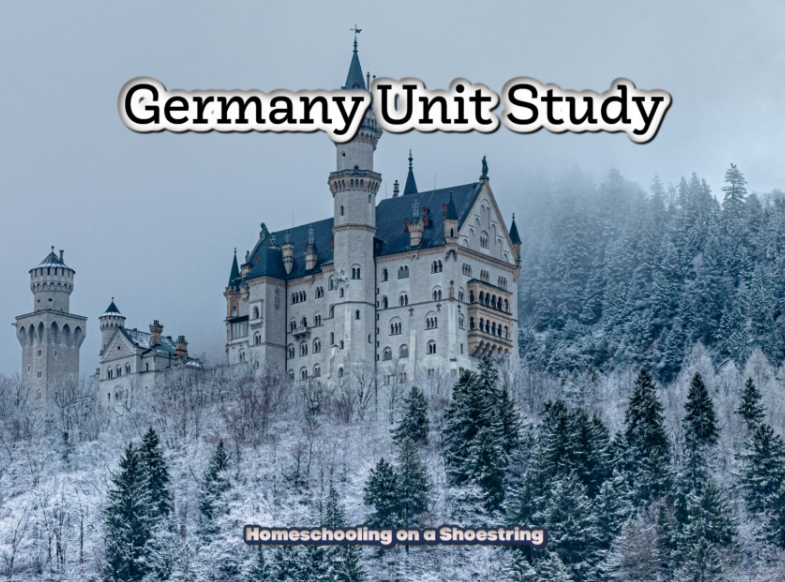
- Germany has more than 20,000 castles and castle ruins. Neuschwanstein, built for King Ludwig II of Bavaria, was a model for a famous theme park castle.
- The word kindergarten is German for “children’s garden.” Friedrich Froebel opened the first one in 1837.
- Albert Einstein was born in Ulm, Germany, in 1879.
- Gummy bears were invented in Bonn, Germany, in 1922.
Timeline
- ReadWriteThink Timeline Creator
- Wikipedia: Timeline of German History: A detailed list for older students.
Events to add to your timeline:
- 9 AD: Germanic tribes defeat three Roman legions in the Teutoburg Forest
- 962: Otto I is crowned emperor, beginning the Holy Roman Empire
- 1284: The legend of the Pied Piper of Hamelin is said to take place
- About 1440: Johannes Gutenberg builds a printing press with movable type in Mainz
- 1685: Johann Sebastian Bach and George Frideric Handel are born
- 1770: Ludwig van Beethoven is born in Bonn
- 1812: The Brothers Grimm publish their first book of fairy tales
- 1871: The German states unite into one empire with Otto von Bismarck as chancellor
- 1886: Karl Benz patents the first gasoline-powered automobile
- 1914 to 1918: World War I
- 1933 to 1945: Adolf Hitler and the Nazi party rule Germany
- 1939 to 1945: World War II
- 1948 to 1949: The Berlin Airlift flies food and coal into West Berlin
- 1949: Germany is split into West Germany and East Germany
- August 13, 1961: East Germany builds the Berlin Wall
- November 9, 1989: The Berlin Wall opens
- October 3, 1990: Germany is reunited
- 2002: The euro replaces the Deutsche Mark
Vocabulary
History and Geography Words
| Alps | Bavaria | chancellor | emperor |
| airlift | border | Cold War | Holocaust |
| autobahn | castle | composer | reunification |
| Baltic Sea | Black Forest | Deutschland | Rhine |
Simple German Words
| Hallo: hello | Danke: thank you | Bitte: please |
| Ja: yes | Nein: no | Guten Morgen: good morning |
| Auf Wiedersehen: goodbye | Gute Nacht: good night | und: and |
| aber: but | oder: or | auch: also |
| immer: always | nie: never | oft: often |
| manchmal: sometimes | vielleicht: maybe | sehr: very |
- Count to ten in German: eins, zwei, drei, vier, fünf, sechs, sieben, acht, neun, zehn.
- Look for German words we use in English: kindergarten, pretzel, hamburger, frankfurter, noodle, dachshund, and gesundheit.
- German puts nouns together to make long words. Try to figure out Handschuh (hand + shoe = glove) and Kühlschrank (cool + cupboard = refrigerator).
- Look up words with WordWeb, free downloadable software, or the online Dictionary.com.
Book Resources
Fairy Tales
- Grimms’ Fairy Tales by Jacob and Wilhelm Grimm (free at Project Gutenberg)
- Fairy Tales of the Brothers Grimm by Neil Philip
- Little Red Riding Hood by Jerry Pinkney
- Hansel and Gretel by Will Moses
- Rapunzel by Paul O. Zelinsky
- Rumpelstiltskin by Paul O. Zelinsky
- The Elves and the Shoemaker by Jim LaMarche
- The Pied Piper of Hamelin by Robert Browning
Learning About Germany
- Germany ABCs: A Book About the People and Places of Germany by Sarah Heiman
- Look What Came from Germany by Kevin Davis
- Getting to Know Germany and German by Janine Amos
- Germany by Cath Senker (Letters from Around the World)
- Cooking the German Way by Helga Parnell
- The Berlin Airlift by Michael Burgan
- The Berlin Wall: How It Rose and Why It Fell by Doris M. Epler
- World War II for Kids: A History with 21 Activities by Richard Panchyk
Composers
- Johann Sebastian Bach by Mike Venezia (Getting to Know the World’s Greatest Composers)
- Ludwig van Beethoven by Mike Venezia (Getting to Know the World’s Greatest Composers)
- The Great German Composers by George T. Ferris (free at Project Gutenberg, for older students)
Historical Fiction and Memoir (older students)
- The Journey of Emilie by Marcia Hoehne
- Lord of the Nutcracker Men by Iain Lawrence
- When Hitler Stole Pink Rabbit by Judith Kerr
- Good-bye Marianne by Irene N. Watts
- Number the Stars by Lois Lowry
- Surviving Hitler: A Boy in the Nazi Death Camps by Andrea Warren
- Summer of My German Soldier by Bette Greene
Some of these books deal with World War II and the Holocaust. Parents may want to read them first and choose what fits their children.
Poetry and Music
- Listen to one German composer each week: Bach, Handel, Beethoven, Brahms, Mendelssohn, Schumann, and Wagner. Find each composer’s hometown on the map.
- Listen to Beethoven’s “Ode to Joy” from his Ninth Symphony, then learn to play the melody on a recorder, keyboard, or water glasses.
- Mama Lisa’s World: Top German Kids Songs: Children’s songs with German words and English translations.
- Learn the German round “Bruder Jakob,” the tune we know as “Are You Sleeping?”
- Read “The Pied Piper of Hamelin” by Robert Browning aloud as a family.
- Johann Wolfgang von Goethe is Germany’s most famous poet. Older students can read a short Goethe poem in English translation.
Videos
- Beethoven Lives Upstairs (Classical Kids, 1992)
- Bach’s Fight for Freedom (Composers’ Specials, 1995)
- Rick Steves’ Europe: Germany (travel series DVD)
Activities
- Map work: Print or trace a map of Germany. Label Berlin, Hamburg, Munich, Cologne, and Frankfurt, the Rhine, Danube, and Elbe rivers, the North Sea and Baltic Sea, the Alps, and the Black Forest.
- Neighbors: Color Germany on a map of Europe and the nine countries around it: Denmark, Poland, the Czech Republic, Austria, Switzerland, France, Luxembourg, Belgium, and the Netherlands.
- Fairy tale compare: Read a Grimm tale in an older translation, then watch or read a modern version. Make a chart of what changed.
- Fractured fairy tales: Rewrite a Grimm tale with a twist, such as a kind witch or a giant who is afraid of children.
- Fairy tale math: Make story problems with the characters. If Snow White baked 21 cookies for seven dwarfs, how many does each get?
- Printing press: Carve a letter into a potato half (backward), dip it in paint, and stamp your name. Talk about how printing changed the world.
- A day in Germany: Find out what school, meals, and games are like for German children. Try one of the games.
- The Berlin Wall: Build a wall across the living room with boxes or blocks and talk about what it would be like if it split your town and you could not visit family on the other side.
- Flag match: Make index cards with the flags of countries you have studied and play a matching game.
- Holiday traditions: Learn about Advent calendars, the Christmas tree, Christmas markets, St. Martin’s Day lantern walks, and Oktoberfest.
- German dinner night: Cook a German meal, decorate with your crafts, play German music, and let the children tell what they learned.
- Composer notebook: After reading a composer biography, fill in a page with his life dates, hometown, a portrait, and a favorite piece.
Writing Prompts
- Write a letter from a child in West Berlin in 1948 when the airplanes started bringing food.
- Write your own fairy tale set in the Black Forest.
- Pretend you were at the Berlin Wall on November 9, 1989. Write what you saw and heard.
- Compare your town with a German town of the same size.
Recipes
Gluten-Free Soft Pretzels
- 1 1/4 cups warm water
- 1 packet (2 1/4 teaspoons) active dry yeast
- 1 tablespoon sugar
- 3 1/2 cups gluten-free 1-to-1 flour blend (one that already has xanthan gum in it)
- 1 teaspoon baking powder
- 1 teaspoon salt
- 2 tablespoons oil or melted butter
- For the bath: 6 cups water and 1/4 cup baking soda
- 1 egg, beaten (optional), and coarse salt for the tops
Stir the yeast and sugar into the warm water and let it sit for 5 minutes until foamy. In a large bowl, whisk the flour blend, baking powder, and salt. Add the yeast water and oil and stir until a soft, sticky dough forms. Gluten-free dough doesn’t need kneading. Divide it into 8 pieces. With oiled hands, roll each piece into a rope on a sheet of parchment paper and twist it into a pretzel shape. If a rope cracks, just press it back together. Let the pretzels rise for 30 minutes.
Heat the oven to 425°F and bring the water and baking soda to a simmer. Using a slotted spatula, gently lower each pretzel into the water for 20 seconds, then lift it out and set it on a parchment-lined baking sheet. Brush with egg for a shiny top, sprinkle with coarse salt, and bake for 15 to 18 minutes until golden brown. They are best eaten warm the same day.
If the dough is too crumbly to twist, roll it into pretzel sticks or cut it into bites instead. In Germany, pretzels are called Brezeln, and you’ll find them at bakeries everywhere, especially in Bavaria.
More Recipe Ideas
- Apfelpfannkuchen: A big German apple pancake baked in a skillet.
- Kartoffelsalat: Warm potato salad with a vinegar dressing instead of mayonnaise.
- Bratwurst with sauerkraut on a hard roll.
- Spaetzle: Small homemade egg noodles, served with butter or gravy.
- Black Forest cake: Chocolate cake layered with cherries and whipped cream.
- Lebkuchen or spritz cookies at Christmastime.
- Breakfast German style: Hard rolls, sliced cheese, cold cuts, and jam.
Field Trips
- Frankenmuth, Michigan: A town settled by Germans from Franconia in 1845, with Bavarian buildings, a glockenspiel tower, a covered bridge, and the huge Bronner’s Christmas store.
- A German restaurant, bakery, or deli near you.
- An Oktoberfest or German heritage festival in the fall.
- A Christmas market, if one is held in your area.
- A symphony concert or library listening room for Bach and Beethoven.
- A car museum to see early automobiles like the ones Karl Benz and Gottlieb Daimler built.
Art and Craft Ideas
- Flag: Color, paint, or glue strips of black, red, and yellow paper, fabric scraps, or tissue paper.
- Scherenschnitte: Fold paper and cut out a symmetrical design, a German paper cutting art. Plain printer paper works fine.
- St. Martin’s lantern: Decorate a clean jar or a cylinder of paper with tissue paper and add a battery tea light.
- Castle: Build Neuschwanstein from cereal boxes, paper towel tubes, and toilet paper rolls.
- Advent calendar: Make 24 paper doors on a poster, or use small envelopes or matchboxes.
- Cuckoo clock: Draw one on a paper plate or decorate a small box with leaves and a paper bird.
- Nutcracker: Paint a toilet paper roll or clothespin like a toy soldier.
- Albrecht Duerer study: Look at his drawing of a hare and try drawing a pet or stuffed animal in close detail.
Information Web Resources
- CIA World Factbook: Germany: Maps, flag, and current facts.
- National Geographic Kids: Germany: Facts, photos, and a map for younger students.
- Goethe-Institut: Geography of Germany: Free teaching materials for middle school.
- Berlin Wall Memorial: History of the wall and the memorial on Bernauer Strasse.
- Wikipedia: History of Germany
Games
Use these ideas to turn key concepts from this unit into creative, engaging games your learners will love.
Game Board Blanks
Create your own themed games for this unit using printable templates and inspiration from the sites below:
- Games . . . Tools for Learning by Mark and Janice Vreeland
- Games for Learning ideas from Mary Peterson
- Board Game Templates – Tim’s Printables – free blank game boards
- JustFamilyFun – Board Game Paths
- Cardboard Cognition: Educational Board Games: An archived San Diego State University chart that helps you pick the right type of board or card game to make, with ideas for game boards and pieces.
- Fairy tale concentration: Make pairs of cards matching characters with their objects, such as Cinderella and a glass slipper or Little Red Riding Hood and her basket.
- Enchanted kingdom board game: Draw a path through a forest to a castle and add spaces from the fairy tales, such as “lost in the woods, go back 2.”
- Map race: Call out a German city or river and see who can find it first.
- German number bingo: Make bingo cards with numbers 1 to 20 and call them out in German.
Neverending Card Deck
Use the Neverending Card Deck card and box templates to make your own sets. You can flip the card template to print your custom design on the back. Free clipart works great for themed backs or matching your card box. These cards can be used in both card games and board games.
Germany Card Game: Deutschland Rummy
Make 28 cards from index cards or cut-up cereal boxes, one name per card with a quick drawing. There are seven groups with four cards in each:
- Cities: Berlin, Hamburg, Munich, Cologne
- Rivers: Rhine, Danube, Elbe, Main
- Composers: Bach, Handel, Beethoven, Brahms
- Fairy tales: Hansel and Gretel, Rapunzel, Rumpelstiltskin, Snow White
- Inventors: Gutenberg, Benz, Diesel, Roentgen
- Foods: pretzel, bratwurst, sauerkraut, strudel
- Landmarks: Brandenburg Gate, Neuschwanstein Castle, Zugspitze, Berlin Wall
How to play:
- Deal 6 cards to each player. Stack the rest face down and turn one card up for a discard pile.
- On your turn, draw from either pile, then discard one card.
- When you collect all four cards in a group, lay them down and tell one fact about one of them.
- The first player to lay down two groups wins.
Little ones can play Go Fish by asking for groups, and older students can say the group names in German. These cards also work with the homemade board games for this unit. Draw a card and find it on the map before you move.
GeoSafari Cards
Using the GeoSafari Instruction Guide, you can create a wide variety of custom cards for this unit. GeoSafari is especially great for independent learning and long car trips!
Donna Young shows you how to make GeoSafari Cards
DIY Card Ideas
- Timeline event ↔ date matching cards
- True or false review questions
- Vocabulary words ↔ real-life images
- Chapter-based quizzes or review sets
GeoSafari Card Ideas
- Label the 16 German states.
- Find the major cities and rivers of Germany.
- Name the countries that border Germany.
- Match composers to their famous works.
- Match German words to their English meanings.
Worksheets
Make your own worksheets with these worksheet creation tools:
- SchoolHouseTech https://www.schoolhousetech.com/ This company gives away two free software worksheet factories one for Basic math and one for wordsearch utility that will make wonderful complements to this unit when you include the clipart listed in the clipart section.
- Start Write – This program makes nice reports and handwriting worksheets for the unit. https://www.startwrite.com/
- TeachNology has several online worksheet makers and a ton of Rubric makers. Rubrics work great with Homeschool Tracker because they give you total points and you count up exactly how many points your child gets. https://www.teach-nology.com/worksheets/
- Online Crossword Puzzle Maker to use with your vocabulary words or locations or even dates from the timeline. https://www.happychild.org.uk/wks/english/ssm/crosswords01.htm
- CIA World Factbook: Germany: Print the map and flag pages to label and color.
Lapbook Ideas
- Germany map with the states, cities, and rivers labeled.
- Flag with a pocket explaining the three colors.
- Fairy tale flap book: one flap for each Grimm tale you read.
- Composer matchbooks: Bach, Handel, Beethoven, and Brahms.
- German words pocket with greeting and number cards.
- Inventions wheel: printing press, car, diesel engine, X-rays.
- Berlin Wall accordion fold: built, standing, falling, reunited.
- Recipe card for the food you made.
Evaluation Ideas
Assemble a three ring binder and please include:
- A copy of this unit
- Course Description (Highschool Students)
- Write a summary about books read for the unit
- Write an essay on the various topics discussed
- Your Lapbook created for the unit (K-8 Students)
- Any worksheets or activity books created with SchoolhouseTech Software https://www.schoolhousetech.com/
- Your journal and its contents
- Your Log of activities from Homeschool Tracker https://www.homeschooltracker.com/free-homeschool-tracker-basic-edition Its Free!
- Your Timeline
- Have younger students point out Berlin, the Rhine, and the Alps on their map and retell a favorite Grimm tale.
- Have students introduce themselves and count to ten in German.
- Older students can write a report on the Berlin Wall, a German composer, or Gutenberg’s printing press.
- Include the map, the composer pages, and photos from your German dinner night in the binder.
Related Unit Studies from Homeschooling on a Shoestring
More Unit Studies
Looking for your next topic? The Unit Studies directory has free and low-cost activities, lesson plans, worksheets, study guides, books, recipes, lapbook ideas, and games for homeschooling on a shoestring: https://homeschoolingonashoestring.com/homeschooling/homeschooling-by-subject/unit-studies/
Last Updated on November 2, 2026 by Jodi