
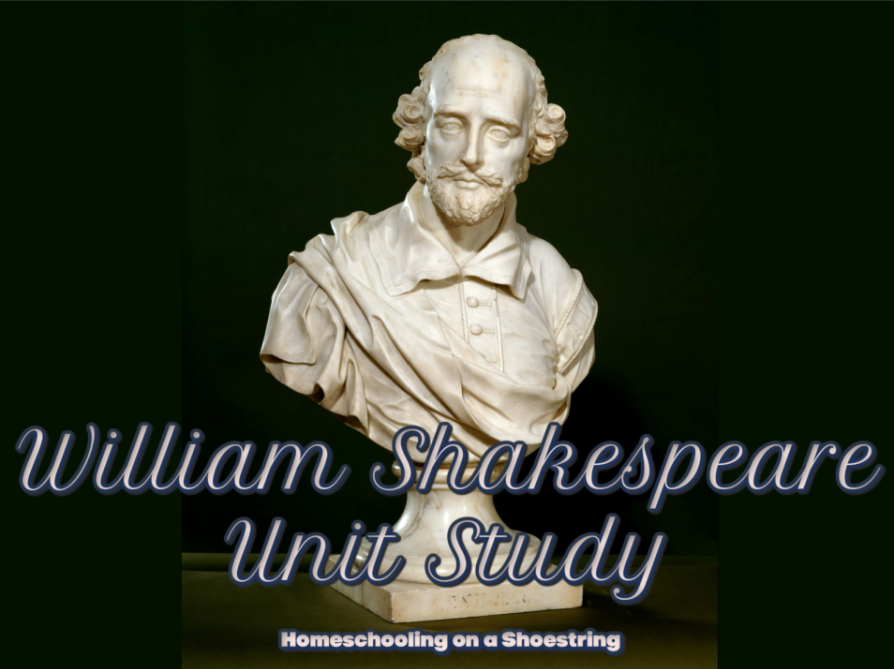
William Shakespeare Unit Study
William Shakespeare was born in a small market town in England in 1564 and grew up to become the most famous writer in the English language. He wrote at least 37 plays and 154 sonnets, acted on the stage, and helped run the company that built the Globe Theatre in London. More than 400 years later, his plays are still performed all over the world, and we still use words and sayings he made popular, like “break the ice” and “wild-goose chase.”
This William Shakespeare Unit Study covers his life in Stratford-upon-Avon and London, the Globe Theatre, Elizabethan England, and his comedies, tragedies, histories, and sonnets. All of his plays are free to read online, children’s retellings make the stories easy to follow, and a paper Globe Theatre, a homemade quill, and a living room stage are all you need to bring his world to life.
Learning Objectives
Many parents and teachers will need to create their own goals. You can compare the goals at these sites to create your own goals depending on how stringent your requirements need to be. All links have several suggested activities for different ages.
Suggested Curriculum Standards:
- World Book Scope Basic Course structure https://www.worldbook.com/typical-course-of-study.aspx
- Michigan Department of Education https://www.michigan.gov/mde/services/academic-standards
- Maine as an example of state level requirements https://www.maine.gov/doe/standards/ela/resources
- California state level requirements https://www.cde.ca.gov/be/st/ss/
- Ontario Canada K-8 Expectations https://www.dcp.edu.gov.on.ca/en/curriculum#elementary
- Abeka Scope and Sequence https://www.abeka.com/HomeSchool/ScopeAndSequence.aspx
- The series of books called “What your nth Grader needs to know” May also be helpful nth representing the grade your child is in. This series only Goes to grade 8
- Learn about William Shakespeare’s life, family, and work in Stratford-upon-Avon and London.
- Learn how plays were performed in Elizabethan England, from the Globe Theatre to the actors who played every part.
- Understand the difference between a comedy, a tragedy, a history play, and a sonnet.
- Read or listen to at least one Shakespeare story and retell it in your own words.
- Practice reading aloud and memorizing a short speech or sonnet.
- Find words and sayings from Shakespeare that we still use today.
Timeline
Add these dates to a timeline of Shakespeare’s life and the Elizabethan era:
- 1564: Baby William is baptized on April 26 in Stratford-upon-Avon, the English market town where he grew up.
- 1582: Shakespeare marries Anne Hathaway.
- 1583: Their daughter Susanna is born.
- 1585: Twins Hamnet and Judith are born.
- 1592: By now Shakespeare is working in London, writing plays and acting in them.
- 1594: He joins the Lord Chamberlain’s Men, an acting company.
- 1596: His son Hamnet dies at age 11.
- 1599: The Globe Theatre opens in London.
- 1603: Queen Elizabeth I dies. King James I becomes the company’s patron, and they are renamed the King’s Men.
- 1609: Shakespeare’s sonnets are published.
- 1613: The Globe burns down when a cannon fired during a play sets the thatched roof on fire. It is rebuilt the next year.
- 1616: Shakespeare dies on April 23 in Stratford-upon-Avon.
- 1623: Two of his fellow actors publish 36 of his plays in a book known as the First Folio.
- 1997: A new Globe Theatre, built to look like the original, opens near the old site in London.
Vocabulary
| playwright | bard | sonnet |
| comedy | tragedy | history play |
| soliloquy | monologue | prologue |
| epilogue | verse | iambic pentameter |
| Elizabethan | playhouse | groundling |
| folio | quill | patron |
- WordWeb: Free downloadable dictionary software.
- Dictionary.com: Online definitions and pronunciation.
Book Resources
- Tales from Shakespeare by Charles and Mary Lamb: Twenty of the plays retold as short stories for young readers in 1807, with Arthur Rackham’s illustrations. Free on Project Gutenberg.
- The Folger Shakespeare: Every play, sonnet, and poem free to read online or download from the Folger Shakespeare Library.
- Shakespeare for Kids: His Life and Times, 21 Activities by Colleen Aagesen and Margie Blumberg: Biography and hands-on projects in one book.
- Bard of Avon: The Story of William Shakespeare by Diane Stanley and Peter Vennema: A picture book biography for elementary ages.
- William Shakespeare and the Globe by Aliki: The story of the first Globe Theatre and how the new one was built.
- Will’s Quill by Don Freeman: A picture book about a goose who helps young Will Shakespeare in London.
- Shakespeare Stories by Leon Garfield: Retellings for older children that keep much of Shakespeare’s own language.
- Shakespeare Can Be Fun series by Lois Burdett: The plays retold in rhyming verse with drawings by children.
Poetry and Music
- Shakespeare wrote 154 sonnets. A sonnet has 14 lines and a set rhyme pattern. Read Sonnet 18 (“Shall I compare thee to a summer’s day?”) and try writing your own 14-line poem.
- Shakespeare Monologues (LibriVox): Free recordings of famous speeches from the plays, read by volunteers.
- “Greensleeves” was a popular song in Shakespeare’s day, and he mentions it in The Merry Wives of Windsor. Listen to it and talk about how it sounds different from music today.
- Pick a short speech, like Puck’s last speech in A Midsummer Night’s Dream, and memorize it to perform for your family.
Audio and Videos
- Beautiful Stories from Shakespeare by E. Nesbit: A free LibriVox audiobook of the plays retold for children.
- Shakespeare Birthplace Trust Learning: Short films about Shakespeare’s life and times made for primary school children.
- Shakespeare: The Animated Tales: Half-hour animated versions of the plays, a good first look before reading.
- Renaissance Man (1994, PG-13): Danny DeVito plays a teacher who wins over a class of Army recruits with Hamlet.
Watch a film version of a play after reading a retelling, and compare the two. Which parts are the same? What did the filmmakers change?
Games
Use these ideas to turn key concepts from this unit into creative, engaging games your learners will love.
Game Board Blanks
Create your own themed games for this unit using printable templates and inspiration from the sites below:
- Games . . . Tools for Learning by Mark and Janice Vreeland
- Games for Learning ideas from Mary Peterson
- Board Game Templates – Tim’s Printables – free blank game boards
- JustFamilyFun – Board Game Paths
- Cardboard Cognition: Educational Board Games: An archived San Diego State University chart that helps you pick the right type of board or card game to make, with ideas for game boards and pieces.
- Who Said It?: Read a famous line out loud and have everyone guess which character or play it came from.
- Shakespeare Charades: Act out a scene from one of the stories without words while the others guess the play.
- Everyday Shakespeare Hunt: Make a list of sayings Shakespeare made popular, like “break the ice,” “wild-goose chase,” and “in a pickle,” and keep score as you hear them in books, shows, or conversation.
- Race to the Globe Board Game: Draw a winding path from Stratford-upon-Avon to the Globe Theatre in London on a file folder. Players roll a die and answer a question card to move ahead. The first one to reach the stage wins.
Neverending Card Deck
Use the Neverending Card Deck card and box templates to make your own sets. You can flip the card template to print your custom design on the back. Free clipart works great for themed backs or matching your card box. These cards can be used in both card games and board games.
Play Collector Card Game
Make sets of four cards for each play you study. Each set has a title card, a main character card, a setting card, and a famous line card. For example, the Romeo and Juliet set could be Romeo and Juliet, Juliet, Verona, and “Wherefore art thou Romeo?” Shuffle and deal five cards to each player. Like Go Fish, ask another player for a card from a play you are collecting (“Do you have a card from Macbeth?”). If they don’t, draw from the pile. When you collect all four cards from a play, lay them down and name the play. The player with the most complete sets wins.
The same cards can be used as question cards for the Race to the Globe board game.
GeoSafari Cards
Using the GeoSafari Instruction Guide, you can create a wide variety of custom cards for this unit. GeoSafari is especially great for independent learning and long car trips!
Donna Young shows you how to make GeoSafari Cards
DIY Card Ideas
- Timeline event ↔ date matching cards
- True or false review questions
- Vocabulary words ↔ real-life images
- Chapter-based quizzes or review sets
GeoSafari Card Ideas
- Who’s Who in the Plays: Match characters like Romeo, Juliet, Macbeth, Puck, and Hamlet to their plays.
- Comedy, Tragedy, or History?: Sort each play into the right kind.
- Shakespeare’s Life: Match the events on the timeline to their dates.
- Map of England: Locate Stratford-upon-Avon, London, and the River Thames.
- Theater Vocabulary: Match each vocabulary word to its definition.
Recipes
Archaeologists digging at the sites of London’s early playhouses found nutshells and fruit seeds left behind by audiences, who snacked while they watched. Set out bowls of nuts, apples, pears, and oranges for a family play reading. For a bigger Elizabethan meal, serve bread, cheese, roast chicken, and a gingerbread or fruit tart for dessert.
Field Trips
- See a live Shakespeare play. Many towns have free “Shakespeare in the Park” shows in the summer, and community and college theaters often put on his plays during the school year.
- Michigan families can check the Michigan Shakespeare Festival and the Grand Valley Shakespeare Festival for upcoming shows and student performances, or make the trip to the Stratford Festival in Stratford, Ontario.
- Visit a Renaissance festival, where you can see Elizabethan costumes, music, and street performers.
Art and Craft Ideas
- Globe Theatre Paper Model (Agecroft Hall): Print, color, cut, and tape together a model of the Globe.
- Homemade Quill: Shakespeare wrote with a feather quill and ink. Tape a feather, or a feather cut from paper, to a pen or pencil and use it to write out a favorite line.
- Playbill: Design a poster or playbill for one of the plays, with the title, the actors, and a picture of a scene.
- Living Room Stage: Hang a sheet for a curtain, make simple costumes from clothes you already have, and act out a scene for your family.
Information Web Resources
- Shakespeare Birthplace Trust: Information about Shakespeare’s family homes in Stratford-upon-Avon, including the house where he was born.
- The Complete Works of William Shakespeare (MIT): A simple, ad-free site with every play to read online.
- The Complete Works of William Shakespeare (Project Gutenberg): Free to read online or download to an e-reader.
Worksheets
Make your own worksheets with these worksheet creation tools:
- SchoolHouseTech https://www.schoolhousetech.com/ This company gives away two free software worksheet factories one for Basic math and one for wordsearch utility that will make wonderful complements to this unit when you include the clipart listed in the clipart section.
- Start Write – This program makes nice reports and handwriting worksheets for the unit. https://www.startwrite.com/
- TeachNology has several online worksheet makers and a ton of Rubric makers. Rubrics work great with Homeschool Tracker because they give you total points and you count up exactly how many points your child gets. https://www.teach-nology.com/worksheets/
- Online Crossword Puzzle Maker to use with your vocabulary words or locations or even dates from the timeline. https://www.happychild.org.uk/wks/english/ssm/crosswords01.htm
Lapbook Ideas
- Shakespeare’s Life Timeline: A fold-out strip with the main dates of his life.
- Comedy, Tragedy, History Tabbed Book: One tab for each kind of play, with examples under each.
- Globe Theatre Flap: A drawing of the Globe on top, with facts about how plays were performed underneath.
- Family Tree Pocket: Cards for William, Anne, Susanna, Hamnet, and Judith.
- Everyday Shakespeare Mini-Book: Sayings we still use today and what they mean.
- My Sonnet: A mini-book with your own 14-line poem.
- Map of England: Mark Stratford-upon-Avon and London.
- Vocabulary Matchbook: Each vocabulary word outside and its definition inside.
Evaluation Ideas
Assemble a three ring binder and please include:
- A copy of this unit
- Course Description (Highschool Students)
- Write a summary about books read for the unit
- Write an essay on the various topics discussed
- Your Lapbook created for the unit (K-8 Students)
- Any worksheets or activity books created with SchoolhouseTech Software https://www.schoolhousetech.com/
- Your journal and its contents
- Your Log of activities from Homeschool Tracker https://www.homeschooltracker.com/free-homeschool-tracker-basic-edition Its Free!
- Your Timeline
Related Unit Studies from Homeschooling on a Shoestring
More Unit Studies
Looking for your next topic? The Unit Studies directory has free and low-cost activities, lesson plans, worksheets, study guides, books, recipes, lapbook ideas, and games for homeschooling on a shoestring: https://homeschoolingonashoestring.com/homeschooling/homeschooling-by-subject/unit-studies/
Last Updated on November 1, 2026 by Jodi