
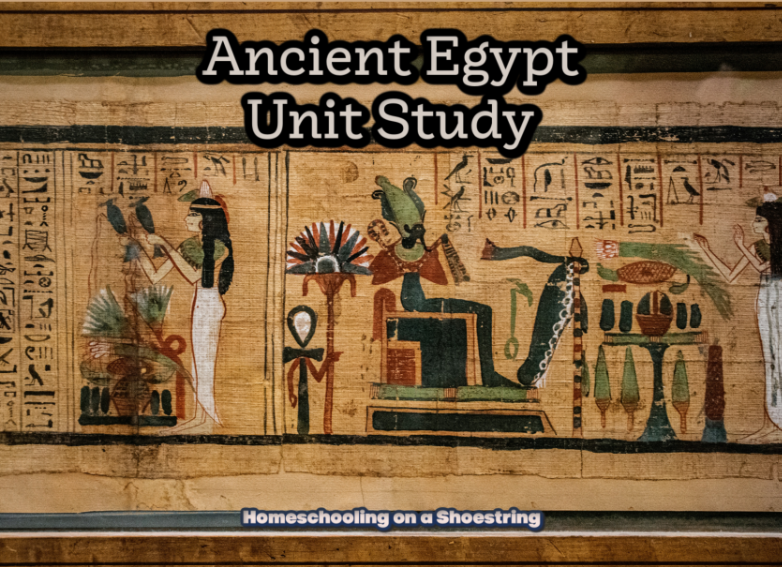
Ancient Egypt Unit Study
Ancient Egypt grew up along the Nile River more than 5,000 years ago. Every summer the Nile flooded and left behind rich black soil, so farmers could grow wheat, barley, and flax in the middle of the desert. The Egyptians built giant pyramids and temples, wrote with picture symbols called hieroglyphs, made paper from papyrus reeds, and preserved their dead as mummies. Their kingdom lasted for about 3,000 years, longer than almost any other civilization in history.
This Ancient Egypt Unit Study covers the Nile, the pharaohs, the pyramids, mummies, hieroglyphs, and daily life in ancient Egypt. Mummify an apple or a Cornish hen, write your name in a cartouche, make Egyptian flat bread, build a clay pyramid, play Senet, and make your own Pharaoh Rummy cards. Books, videos, crafts, recipes, lapbook ideas, and homemade games work for every age, from preschool to high school.
Learning Objectives
Many parents and teachers will need to create their own goals. You can compare the goals at these sites to create your own goals depending on how stringent your requirements need to be. All links have several suggested activities for different ages.
Suggested Curriculum Standards:
- World Book Scope Basic Course structure https://www.worldbook.com/typical-course-of-study.aspx
- Michigan Department of Education https://www.michigan.gov/mde/services/academic-standards
- Maine as an example of state level requirements https://www.maine.gov/doe/standards/ela/resources
- California state level requirements https://www.cde.ca.gov/be/st/ss/
- Ontario Canada K-8 Expectations https://www.dcp.edu.gov.on.ca/en/curriculum#elementary
- Abeka Scope and Sequence https://www.abeka.com/HomeSchool/ScopeAndSequence.aspx
- The series of books called “What your nth Grader needs to know” May also be helpful nth representing the grade your child is in. This series only Goes to grade 8
- Locate Egypt, the Nile River, the Nile Delta, the Mediterranean Sea, and the Red Sea on a map
- Explain why the Nile was so important to the people of ancient Egypt
- Describe the Old, Middle, and New Kingdoms and name some famous pharaohs
- Learn how and why the Egyptians made mummies
- Learn how the pyramids were built, and build a model of one
- Understand how hieroglyphs work and how the Rosetta Stone helped us read them
- Compare daily life, food, clothing, and games in ancient Egypt with life today
- Learn about the beliefs of the ancient Egyptians and their many gods
Ancient Egypt Facts
- The Egyptians called their country Kemet, “the Black Land,” for the dark, rich soil left by the Nile. The desert was Deshret, “the Red Land.”
- Upper Egypt is in the south and Lower Egypt is in the north, because the Nile flows from south to north.
- The pharaoh wore a double crown, the white crown of Upper Egypt joined with the red crown of Lower Egypt.
- The Great Pyramid of Giza was built for the pharaoh Khufu about 4,500 years ago. It was the tallest building in the world for almost 4,000 years.
- Making a mummy took about 70 days. The body was dried with a salt called natron, then wrapped in linen. The organs were kept in canopic jars.
- There were more than 700 hieroglyph symbols. Some stood for sounds and some stood for whole words or ideas.
- Scribes went to school for years to learn to read and write. Most Egyptians could not read.
- Farmers used a shaduf, a long pole with a bucket on one end and a weight on the other, to lift water from the river to their fields.
- The Egyptians invented a 365-day calendar, based on the yearly flood of the Nile.
- Both men and women wore eye makeup, which also helped protect their eyes from the bright sun.
Famous People of Ancient Egypt
Choose one to research and write a short biography:
- Narmer (Menes), the first king to unite Upper and Lower Egypt
- Imhotep, the architect of the first pyramid, the Step Pyramid of Djoser
- Khufu, the pharaoh who built the Great Pyramid
- Hatshepsut, a woman who ruled as pharaoh
- Thutmose III, the warrior pharaoh
- Akhenaten and Queen Nefertiti
- Tutankhamun, the boy king
- Ramses II (Ramses the Great), the builder of Abu Simbel
- Cleopatra VII, the last pharaoh of Egypt
- Howard Carter, who found King Tut’s tomb
- Jean-Francois Champollion, who figured out hieroglyphs with the Rosetta Stone
Timeline
Events to add to your timeline:
- About 3100 BC: King Narmer (Menes) unites Upper and Lower Egypt and founds the city of Memphis
- About 3000 BC: Hieroglyphic writing is in use
- About 2650 BC: Imhotep builds the Step Pyramid for King Djoser
- 2686 to 2181 BC: The Old Kingdom, the age of the pyramids
- About 2560 BC: The Great Pyramid of Khufu is finished at Giza
- 2055 to 1650 BC: The Middle Kingdom; Thebes becomes an important capital
- About 1650 BC: The Hyksos take over northern Egypt and bring horses and chariots
- 1550 to 1069 BC: The New Kingdom, Egypt’s golden age of temples and empire
- About 1479 to 1458 BC: Hatshepsut rules as pharaoh
- About 1353 BC: Akhenaten tells Egyptians to worship only the sun god Aten
- About 1332 to 1323 BC: Tutankhamun is king
- About 1279 to 1213 BC: Ramses II rules for 66 years
- 332 BC: Alexander the Great conquers Egypt and founds Alexandria
- About 280 BC: The Lighthouse of Alexandria is built
- 196 BC: The words of the Rosetta Stone are carved
- 30 BC: Cleopatra dies and Egypt becomes part of the Roman Empire
- 1799: French soldiers find the Rosetta Stone
- 1822: Champollion figures out how to read hieroglyphs
- 1922: Howard Carter finds the tomb of Tutankhamun
Vocabulary
| amulet | delta | mastaba | pyramid |
| archaeologist | Deshret | mummy | Rosetta Stone |
| Ba and Ka | double crown | natron | sarcophagus |
| canopic jar | dynasty | Nile River | scarab |
| caravan | hieroglyph | nomad | scribe |
| cartographer | irrigation | oasis | shaduf |
| cartouche | Kemet | papyrus | sphinx |
| cataract | linen | pharaoh | temple |
| dunes | Lower Egypt | Upper Egypt | tomb |
- Copy each word and its definition onto a sheet of paper for your portfolio.
- Make flash cards with the word on the front, then have the kids hand write the definition in their own words on the back. It helps them remember the definitions better.
- Write an alliteration poem using several of the vocabulary words.
- Look up words with WordWeb, free downloadable software, or the online Dictionary.com.
Book Resources
Picture Books and Early Readers
- The Best Book of Mummies by Philip Steele
- Bill and Pete Go Down the Nile by Tomie dePaola
- Cleopatra by Diane Stanley
- The Egyptian Cinderella by Shirley Climo
- Gift of the Nile: An Ancient Egyptian Legend by Jan M. Mike
- Mummies (All Aboard Reading) by Joyce Milton
- Mummies Made in Egypt by Aliki
- Mummies in the Morning (Magic Tree House) by Mary Pope Osborne, and its Research Guide, Mummies and Pyramids
- Seeker of Knowledge: The Man Who Deciphered Egyptian Hieroglyphs by James Rumford
- The Shipwrecked Sailor by Tamara Bower
- Tut’s Mummy: Lost and Found by Judy Donnelly
- Tutankhamen’s Gift by Robert Sabuda
- Pyramids (A First Discovery Book), Scholastic
Chapter Books and Novels
- Cleopatra VII: Daughter of the Nile (The Royal Diaries) by Kristiana Gregory
- The Egypt Game by Zilpha Keatley Snyder
- The Golden Goblet by Eloise Jarvis McGraw
- Mara, Daughter of the Nile by Eloise Jarvis McGraw
- Shadow Hawk by Andre Norton
- Tales of Ancient Egypt by Roger Lancelyn Green
Nonfiction
- Ancient Egypt (Eyewitness) by George Hart
- Pyramid (Eyewitness) by James Putnam
- The Great Pyramid by Elizabeth Mann
- Growing Up in Ancient Egypt by Rosalie David
- How Would You Survive as an Ancient Egyptian? by Jacqueline Morley
- Mummies, Tombs, and Treasure: Secrets of Ancient Egypt by Lila Perl
- The Pharaohs of Ancient Egypt (Landmark Books) by Elizabeth Payne
- Pyramid by David Macaulay
- The Riddle of the Rosetta Stone by James Cross Giblin
- Science in Ancient Egypt by Geraldine Woods
- Pharaohs and Pyramids (Usborne Time Traveler)
- Historical Atlas of Ancient Egypt by Bill Manley
Activity and Coloring Books
- Great Ancient Egypt Projects You Can Build Yourself by Carmella Van Vleet
- Pyramids! 50 Hands-On Activities to Experience Ancient Egypt by Avery Hart and Paul Mantell
- Ancient Egypt (Make It Work) by Andrew Haslam
- Crafts From the Past: The Egyptians by Gillian Chapman
- Usborne Make This Egyptian Temple and Make This Model Egyptian Mummy
- Ancient Egyptian Costumes Paper Dolls (Dover)
- Life in Ancient Egypt Coloring Book by John Green (Dover)
- Ancient Egyptian Designs Coloring Book (Dover)
Audio Books
- Egyptian Treasures by Jim Weiss
Poetry and Music
- Ancient Nile: Poems: Translations of ancient Egyptian poems and songs.
- Songs for Teaching: Along the Nile
- Write a cinquain or acrostic poem about the Nile, a pyramid, or a pharaoh.
- Ancient Egyptians played harps, flutes, lyres, drums, and a rattle called a sistrum. Make a sistrum from a forked stick or a bent wire coat hanger with bottle caps or washers strung across it.
Videos and Software
- Mysteries of Egypt (IMAX)
- Mummies and the Wonders of Ancient Egypt (A&E)
- Egypt: Secrets of the Pharaohs (National Geographic)
- The Great Pharaohs of Egypt (A&E)
- Pyramid by David Macaulay (PBS)
- Ancient Lives by John Romer: Daily life in the village of the tomb builders near the Valley of the Kings.
- Reading Rainbow: Mummies Made in Egypt
- Ancient Egypt (Schlessinger Media)
- NOVA Online: Egypt
- NOVA Online: Pyramids, the Inside Story
Activities
- Map of Egypt: Label the Nile, the Nile Delta, the Mediterranean Sea, the Red Sea, Upper and Lower Egypt, Memphis, Thebes, Giza, and Alexandria. Color the Black Land green and the Red Land red.
- Mummify an apple: Cut an apple into wedges. Weigh each one and put them in cups. Cover one with table salt, one with baking soda, one with Epsom salt, one with a mix of all three, and leave one uncovered. After a week, weigh them again and compare which one dried out the most.
- Mummify a Cornish hen: Wash and dry the hen, put it in a large zip bag, and bury it completely in salt. After 2 weeks, pour off the salt, pat it dry, and bury it in fresh salt for 4 more weeks. Then rub it with oil and spices if you like and wrap it in strips of cloth. Tuck small paper “good luck charms” between the layers like the Egyptians did. Give your mummy a name and make a sarcophagus for it from a shoebox or plastic tub. You can even bury it out back and dig it up when you study archaeology.
- Write your name in a cartouche: Look up the hieroglyph for each sound in your name and draw it inside an oval. Use fabric markers to put it on a T-shirt.
- Make papyrus paper: Cut strips of brown paper bag or paper towel, dip them in thinned white glue, and lay them side by side, then lay another layer across them. Press flat and let dry.
- Build a shaduf: Use a ruler balanced on a pencil, a paper cup on one end, and a ball of clay on the other to lift water from a bowl.
- Egyptian math: The Egyptians wrote numbers with a stroke for 1, a heel bone for 10, a coiled rope for 100, and a lotus flower for 1,000. Write your age and your house number in Egyptian numbers.
- Egyptian lunch: Sit around a low table on the floor and eat with your fingers like the Egyptians did. Serve grapes, melon, figs, dates, plums, and flat bread, and give each person a small bowl of water and share a towel for wiping fingers. Dress up in a white sheet tied at the waist, make headbands and bracelets from leftover fabric, and line your eyes in black.
- ABC book: Make an Ancient Egypt ABC book, from A for amulet to Z for zigzag (the hieroglyph for water).
- Build with blocks: Use Legos or other blocks to build a pyramid, a temple, or a mastaba tomb.
- Travel brochure: Pick up travel brochures for Egypt from a travel agent or print some from tourism sites, then make your own brochure for a trip to ancient Egypt.
Writing Prompts
- You are a scribe in the court of the pharaoh. Write a page in your diary about your day.
- You are on Howard Carter’s team the day the tomb of King Tut is opened. What do you see?
- Write a letter from a worker building the Great Pyramid to his family back home.
- Compare a farmer’s life in ancient Egypt with a farmer’s life today.
Recipes
Egyptian Flat Bread
- 2 cups gluten-free all-purpose flour blend (one with xanthan gum)
- 1 teaspoon salt
- About 1 cup warm water
Stir the flour and salt together in a bowl, then slowly mix in the water until you have a soft dough that isn’t sticky. Let it rest 10 minutes. Divide it into 6 pieces and pat each into a flat round about 1/4 inch thick. Cook each round in a hot, dry skillet for 2 to 3 minutes per side, until it has brown spots. Use a flour blend labeled certified gluten-free so it is safe for anyone with celiac. The Egyptians made their bread from emmer wheat and barley, and flat bread like this was the main food of ancient Egypt.
Shorbet Ads (Egyptian Lentil Soup)
- 2 cups split red lentils, rinsed
- 2 quarts gluten-free broth or water
- 2 medium onions, cut in chunks, plus 1 tablespoon finely chopped onion
- 1 medium tomato, cut in chunks
- 1 medium carrot, cut in chunks
- 1 zucchini, cut in chunks (optional)
- 2 tablespoons olive oil
- 2 tablespoons lemon juice
- 2 teaspoons cumin
- Salt and pepper to taste
Bring the broth to a boil in a large pot. Add the onion chunks, carrot, tomato, zucchini, and lentils. Turn the heat down and simmer about 30 minutes, until the lentils are soft. Blend the soup until smooth and put it back in the pot. In a small pan, cook the finely chopped onion in the olive oil until soft and brown. Stir it into the soup along with the cumin, lemon juice, salt, and pepper, and heat gently for a few more minutes. Lentils have been grown in Egypt for thousands of years and are full of protein, fiber, and iron. Cumin is one of the oldest spices known.
More Recipe Ideas
- Fig and nut balls: Chop dried figs and walnuts in a food processor with a pinch of cardamom, roll into balls, dip in honey, and roll in ground almonds.
- Radish salad: Slice radishes thin and toss with chopped parsley, olive oil, lemon juice, and a little salt.
- Cleopatra’s Date Candy: From Scholastic’s Royal Diaries, saved on the Wayback Machine.
- Vegetarian Resource Group: Egyptian Recipes
- Tour Egypt: Recipes
Field Trips
- Detroit Institute of Arts: See the ancient Egyptian collection.
- Cleveland Museum of Art: Egyptian art collection.
- McClung Museum: Ancient Egypt: The Eternal Voice exhibit.
- The British Museum: Ancient Egypt: A virtual field trip with online activities.
- Natural history or art museum near you: Many have a mummy or Egyptian artifacts.
- Science center: Look for exhibits on simple machines like ramps and levers that could have helped build the pyramids.
Art and Craft Ideas
- Build model pyramids and a sphinx from clay or salt dough.
- Make a sarcophagus from a shoebox, a plastic tub, or a butter tub and decorate it with hieroglyphs.
- Pharaoh death mask: Cover a paper plate or a cereal box cutout with gold and blue stripes like King Tut’s mask.
- Egyptian collar: Cut a half circle with a hole for the neck from a paper plate or file folder, color it in bands, and glue on beads, buttons, or pasta.
- Learn to draw like an Egyptian: Egyptian artists drew people with the head and legs from the side and the shoulders from the front.
- Making Friends: Make Egyptian paper dolls.
3D Paper Models
- Canon Creative Park: Great Pyramid of Khufu
- Canon Creative Park: Sphinx
- Canon Creative Park: Abu Simbel
- Canon Creative Park: Lighthouse of Alexandria
Clothing
Information and General Resources
- The British Museum: Ancient Egypt: Online activities and information.
- Mr. Dowling’s Electronic Passport: Ancient Egypt
- Tour Egypt for Kids
- Emory University Odyssey: Mummies
- The Step Pyramid Complex of Djoser: From the University of Pennsylvania.
- University of Memphis Institute of Egyptian Art and Archaeology
- Sacred Places: Abu Simbel
- University of Pennsylvania African Studies: Egypt
- The Tomb of Senneferi: From Cambridge University.
- Country Studies: Egypt
- Wikipedia: Ancient Egypt
Lapbook Ideas
- Map of Egypt: The Nile, the Delta, the seas, and the main cities.
- Three Kingdoms Flap Book: Old, Middle, and New Kingdom with a pharaoh for each.
- How to Make a Mummy: A step-by-step accordion fold.
- Canopic Jars Pocket: Four jar shapes with what each one held.
- Hieroglyph Alphabet Chart and your name in a cartouche.
- Pyramid Fold-Out: A square cut and folded into a pyramid with facts on each side.
- Famous People Mini Book: One page for each person you studied.
- Egyptian Gods Wheel: Ra, Osiris, Isis, Horus, Anubis, and Thoth.
- Egyptian Numbers Card: Your age and house number written the Egyptian way.
- Timeline: Accordion fold with the dates above.
- Vocabulary Pocket: Flash cards for the vocabulary words.
Games
Use these ideas to turn key concepts from this unit into creative, engaging games your learners will love.
Game Board Blanks
Create your own themed games for this unit using printable templates and inspiration from the sites below:
- Games . . . Tools for Learning by Mark and Janice Vreeland
- Games for Learning ideas from Mary Peterson
- Board Game Templates – Tim’s Printables – free blank game boards
- JustFamilyFun – Board Game Paths
- Cardboard Cognition: Educational Board Games: An archived San Diego State University chart that helps you pick the right type of board or card game to make, with ideas for game boards and pieces.
More Game Ideas
- Senet: The Egyptians played this race game for about 3,000 years. The board has 30 squares in three rows of 10, and each player moves pieces along an S-shaped path. Instead of dice they threw flat sticks. Draw a board on a file folder, use buttons or pennies for pieces, and throw 4 craft sticks colored on one side. Count the colored sides up to see how far to move.
- Hounds and Jackals: A race game with five hound pieces and five jackal pieces. The board has holes or squares with shortcuts, a lot like Chutes and Ladders. Make one on a file folder with golf tees or pipe cleaner pieces as the hounds and jackals.
- Path game: Make a path-style board with vocabulary words in the boxes and decorate it with your own drawings. Roll a die and move. Little ones read the word and older ones define it, or write whole questions in the boxes.
- Use the shape of a pyramid for any skill in a file folder game.
- Printable Board Games: Blank boards and parts for making your own games.
Neverending Card Deck
Use the Neverending Card Deck card and box templates to make your own sets. You can flip the card template to print your custom design on the back. Free clipart works great for themed backs or matching your card box. These cards can be used in both card games and board games.
Ancient Egypt Card Game: Pharaoh Rummy
Make a deck of 40 cards from index cards or cut-up cereal boxes. Choose 10 Egypt words and make 4 cards for each one: the word, a picture, what it means, and one fact.
- Pharaoh: The king of Egypt. He wore a double crown.
- Pyramid: A tomb for a pharaoh. The Great Pyramid was built for Khufu.
- Sphinx: A statue with a lion’s body and a human head. The Great Sphinx guards Giza.
- Mummy: A body dried with natron and wrapped in linen. It took 70 days.
- Canopic jar: A jar that held the organs of a mummy. There were four.
- Scribe: A person trained to read and write. Scribes went to school for years.
- Papyrus: A reed that grew by the Nile. Used to make paper, boats, and sandals.
- Hieroglyph: A picture symbol used in writing. There were more than 700.
- Rosetta Stone: A stone with the same words in three scripts. It unlocked hieroglyphs.
- Scarab: A beetle that was a symbol of the rising sun. Used for good luck charms.
How to play:
- Deal 7 cards to each player. Put the rest face down in a pile and turn the top card face up to start a discard pile.
- On your turn, draw one card from either pile, then discard one card.
- When you collect all 4 cards for one word, lay them down and tell one fact about it.
- The first player to lay down two complete sets wins.
These cards also work with your homemade Senet, Hounds and Jackals, and path games. Players draw a card and tell what the word means before they move.
GeoSafari Cards
Using the GeoSafari Instruction Guide, you can create a wide variety of custom cards for this unit. GeoSafari is especially great for independent learning and long car trips!
Donna Young shows you how to make GeoSafari Cards
DIY Card Ideas
- Timeline event ↔ date matching cards
- True or false review questions
- Vocabulary words ↔ real-life images
- Chapter-based quizzes or review sets
More GeoSafari Card Ideas
- Match timeline events to their dates.
- Match each pharaoh to what he or she is known for.
- Match hieroglyphs to their sounds.
- Label places along the Nile on a map card.
Worksheets
Make your own worksheets with these worksheet creation tools:
- SchoolHouseTech https://www.schoolhousetech.com/ This company gives away two free software worksheet factories one for Basic math and one for wordsearch utility that will make wonderful complements to this unit when you include the clipart listed in the clipart section.
- Start Write – This program makes nice reports and handwriting worksheets for the unit. https://www.startwrite.com/
- TeachNology has several online worksheet makers and a ton of Rubric makers. Rubrics work great with Homeschool Tracker because they give you total points and you count up exactly how many points your child gets. https://www.teach-nology.com/worksheets/
- Online Crossword Puzzle Maker to use with your vocabulary words or locations or even dates from the timeline. https://www.happychild.org.uk/wks/english/ssm/crosswords01.htm
- Schoolhouse Technologies: Free worksheet makers for math and word search sheets to match the unit.
- National Geographic MapMaker: Blank and filled-in maps.
- Enchanted Learning: Ancient Egypt: Printables and coloring pages.
Evaluation Ideas
Assemble a three ring binder and please include:
- A copy of this unit
- Course Description (Highschool Students)
- Write a summary about books read for the unit
- Write an essay on the various topics discussed
- Your Lapbook created for the unit (K-8 Students)
- Any worksheets or activity books created with SchoolhouseTech Software https://www.schoolhousetech.com/
- Your journal and its contents
- Your Log of activities from Homeschool Tracker https://www.homeschooltracker.com/free-homeschool-tracker-basic-edition Its Free!
- Your Timeline
- Homeschool Tracker: Keep track of daily assignments and activities.
- Have the student give a museum tour of your lapbook, crafts, and mummy to the family.
- Give the student a blank map of Egypt to label from memory.
Related Unit Studies from Homeschooling on a Shoestring


More Unit Studies
Looking for your next topic? The Unit Studies directory has free and low-cost activities, lesson plans, worksheets, study guides, books, recipes, lapbook ideas, and games for homeschooling on a shoestring: https://homeschoolingonashoestring.com/homeschooling/homeschooling-by-subject/unit-studies/
Last Updated on November 2, 2026 by Jodi