
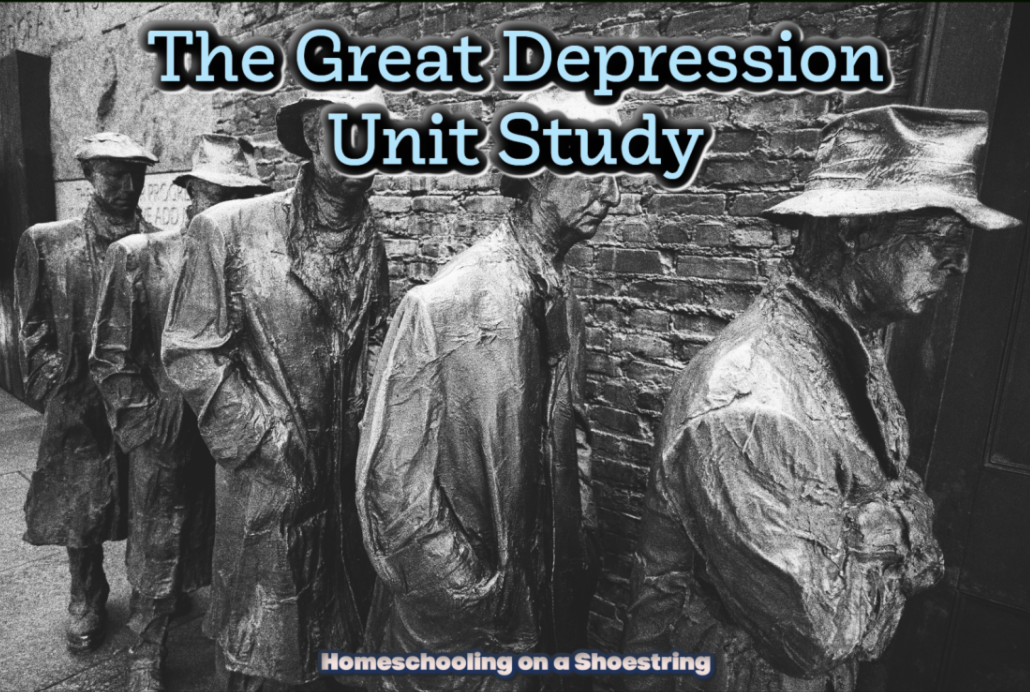
Great Depression Unit Study
The Great Depression began when the stock market crashed in October 1929 and lasted until the United States entered World War II. Banks closed, factories shut down, and by 1933 about one out of every four American workers had no job. On the Great Plains, years of drought turned farms into the Dust Bowl, and thousands of families packed up and headed west looking for work.
This Great Depression Unit Study covers the crash, life during hard times, the Dust Bowl, President Franklin D. Roosevelt and the New Deal, and the ways families learned to make do with very little. Those lessons in thrift fit right in with homeschooling on a shoestring, and the books, songs, photographs, and recipes from the 1930s make the era easy to bring home.
Learning Objectives
Many parents and teachers will need to create their own goals. You can compare the goals at these sites to create your own goals depending on how stringent your requirements need to be. All links have several suggested activities for different ages.
Suggested Curriculum Standards:
- World Book Scope Basic Course structure https://www.worldbook.com/typical-course-of-study.aspx
- Michigan Department of Education https://www.michigan.gov/mde/services/academic-standards
- Maine as an example of state level requirements https://www.maine.gov/doe/standards/ela/resources
- California state level requirements https://www.cde.ca.gov/be/st/ss/
- Ontario Canada K-8 Expectations https://www.dcp.edu.gov.on.ca/en/curriculum#elementary
- Abeka Scope and Sequence https://www.abeka.com/HomeSchool/ScopeAndSequence.aspx
- The series of books called “What your nth Grader needs to know” May also be helpful nth representing the grade your child is in. This series only Goes to grade 8
- Describe what happened when the stock market crashed in 1929 and why so many banks failed afterward.
- Learn how the Great Depression changed daily life for children and families in cities and on farms.
- Explain what caused the Dust Bowl and where it happened.
- Identify Herbert Hoover, Franklin D. Roosevelt, and Eleanor Roosevelt and their roles during the 1930s.
- Name several New Deal programs and tell what each one was meant to do.
- Find out how the Great Depression affected Michigan, from the auto factories to the CCC camps.
- Practice ways to save, reuse, and make do, the way families did during hard times.
Timeline
Add these dates to a timeline of the Great Depression:
- 1929: Stock prices tumble on Black Thursday, October 24, and crash on Black Tuesday, October 29.
- 1930: Banks begin failing across the country, and many families lose their savings.
- 1932: World War I veterans called the Bonus Army march on Washington. Franklin D. Roosevelt is elected president in November.
- 1933: Roosevelt takes office in March, closes the banks for a “bank holiday,” and gives his first radio fireside chat. Congress creates the Civilian Conservation Corps and other New Deal programs.
- 1935: A huge dust storm on April 14 becomes known as Black Sunday. The Works Progress Administration is created, and the Social Security Act is signed.
- 1936: Dorothea Lange takes her famous photograph of a mother in a California pea pickers’ camp, now known as Migrant Mother.
- 1937: The Flint sit-down strike ends in February when General Motors agrees to recognize the autoworkers’ union.
- 1939: John Steinbeck publishes The Grapes of Wrath, a novel about a family leaving Oklahoma for California.
- 1941: After the attack on Pearl Harbor, the United States enters World War II, and wartime factory jobs bring the Depression to an end.
Vocabulary
| depression | economy | stock market |
| crash | bank run | unemployment |
| breadline | soup kitchen | Hooverville |
| drought | Dust Bowl | migrant |
| sharecropper | tenant farmer | relief |
| New Deal | fireside chat | Social Security |
| Civilian Conservation Corps | Works Progress Administration | union |
| hobo | boxcar | thrift |
- WordWeb: Free downloadable dictionary software.
- Dictionary.com: Online definitions and pronunciation.
Book Resources
- Bud, Not Buddy by Christopher Paul Curtis: A ten-year-old boy runs away from a Flint foster home in 1936 to find his father in Grand Rapids. A Newbery Medal winner set right here in Michigan.
- Meet Kit by Valerie Tripp: The first Kit Kittredge book, about a girl in Cincinnati whose family takes in boarders after her father loses his business.
- Leah’s Pony by Elizabeth Friedrich: A picture book about a farm girl who sells her pony to help save her family’s farm.
- Potato: A Tale from the Great Depression by Kate Lied: A true family story about digging potatoes in Idaho to get through hard times.
- Children of the Great Depression by Russell Freedman: Nonfiction filled with photographs of what life was like for kids in the 1930s.
- Out of the Dust by Karen Hesse: A Newbery Medal novel in free verse about a girl on an Oklahoma farm during the Dust Bowl, for ages 10 and up.
- Children of the Dust Days by Karen Mueller Coombs: Nonfiction about growing up on the Plains during the dust storms.
- A Long Way from Chicago and A Year Down Yonder by Richard Peck: Funny stories about children sent to stay with their tough, clever grandmother in a small Illinois town.
- Esperanza Rising by Pam Muñoz Ryan: A girl from a wealthy family in Mexico starts over in a California farm workers’ camp.
- Roll of Thunder, Hear My Cry by Mildred D. Taylor: A Black family holds on to their Mississippi land in 1933. Best for middle school and up.
- Riding the Rails: Teenagers on the Move During the Great Depression by Errol Lincoln Uys: Real stories from young people who left home and hopped freight trains.
- Franklin Delano Roosevelt for Kids: His Life and Times with 21 Activities by Richard Panchyk: A biography with hands-on projects.
- Dear Mrs. Roosevelt: Letters from Children of the Great Depression edited by Robert Cohen: Real letters children wrote to the First Lady, for older students and parents.
- Hard Times: An Oral History of the Great Depression by Studs Terkel: Interviews with people from every walk of life, for high school students.
Poetry and Music
- Listen to “Brother, Can You Spare a Dime?” from 1932 and talk about who is singing and what he wants people to remember.
- Dust Bowl Ballads by Woody Guthrie (Smithsonian Folkways): Songs written by a singer who lived through the dust storms in Texas and Oklahoma.
- Song Stories: Woody Guthrie’s Dust Bowl Ballads (Library of Congress): The history behind the album.
- “Happy Days Are Here Again” was Roosevelt’s campaign song in 1932. Compare its cheerful sound to the songs about hard times.
- After reading Out of the Dust, write your own free verse poem about a day during a dust storm.
Videos
- Kit Kittredge: An American Girl (2008, G): A family film that shows boarders, hobos, and a family trying to keep its house.
- Annie (1982, PG): The orphan musical set in 1933, including a visit to President Roosevelt.
- The Dust Bowl (PBS): Ken Burns’s documentary, with survivors who were children during the dust storms. Preview it for younger viewers.
- Riding the Rails (1997): An American Experience documentary about teenagers who rode freight trains.
- The Grapes of Wrath (1940): The classic film of Steinbeck’s novel, for teens.
Families in the 1930s gathered around the radio each evening. Turn off the screens for a night, listen to a radio drama or a recording of a fireside chat together, and talk about how it feels to imagine the story instead of watching it.
Activities
- Family History Interview: Ask grandparents and older relatives what their parents and grandparents told them about the 1930s. Record the stories, then retell them in writing or as a short play.
- Make Do Week: For one week, try living like a Depression family. Plan simple meals, mend clothes instead of replacing them, turn off extra lights, and keep a list of everything you reused.
- Then and Now Prices: Look up what bread, milk, a car, and a movie ticket cost in 1933, and compare those prices to what your family pays today.
- Read a Photograph: Study Dorothea Lange’s Migrant Mother. List everything you see, then write what you think the people in the picture are thinking.
- Dust Bowl Map: Color southwest Kansas, southeast Colorado, northeast New Mexico, and the panhandles of Texas and Oklahoma on a map. Trace Route 66 west to California, the road many families took.
- Alphabet Agencies Chart: Make a chart of New Deal programs such as the CCC, WPA, TVA, FDIC, and Social Security, with what each one did and whether it still exists.
- New Deal Detectives: Use the Living New Deal map listed under Field Trips to find buildings, parks, or murals near you that were made during the 1930s.
- Hobo Signs: Learn about the chalk symbols hobos left for each other, then invent your own set of symbols and leave messages around the house.
- Bank Run Demonstration: Give each family member pennies to “deposit” in a pretend bank that keeps only a few on hand. Have everyone ask for their money back at once and talk about what happens.
- Older Students: Read about the Flint sit-down strike and write a short report on why autoworkers stayed inside the factories for 44 days.
Games
Use these ideas to turn key concepts from this unit into creative, engaging games your learners will love.
Game Board Blanks
Create your own themed games for this unit using printable templates and inspiration from the sites below:
- Games . . . Tools for Learning by Mark and Janice Vreeland
- Games for Learning ideas from Mary Peterson
- Board Game Templates – Tim’s Printables – free blank game boards
- JustFamilyFun – Board Game Paths
- Cardboard Cognition: Educational Board Games: An archived San Diego State University chart that helps you pick the right type of board or card game to make, with ideas for game boards and pieces.
- Monopoly: The board game was first sold by Parker Brothers in 1935, right in the middle of the Depression. Play a game and talk about why people may have enjoyed pretending to be rich.
- Penny Games: Children in the 1930s played marbles, jacks, hopscotch, and kick the can. Teach your children a few of these games that cost little or nothing.
- Ride the Rails Board Game: On a file folder, draw a railroad track from Chicago to California with stops along the way. Add spaces like “Dust storm! Lose a turn” and “Found work picking peaches. Move ahead 2.” Players roll a die and answer a question card to move.
Neverending Card Deck
Use the Neverending Card Deck card and box templates to make your own sets. You can flip the card template to print your custom design on the back. Free clipart works great for themed backs or matching your card box. These cards can be used in both card games and board games.
Alphabet Agencies Match Card Game
Make pairs of cards. One card in each pair has the name of a New Deal program, and the other has what it did. For example: CCC and “Young men planted trees and built parks”; WPA and “Built roads and schools and hired artists and writers”; TVA and “Built dams to bring electricity to the Tennessee Valley”; FDIC and “Protects the money people keep in banks”; Social Security and “Monthly checks for older Americans”; REA and “Brought electric lines to farms.” Lay all the cards face down and take turns turning over two at a time, like Memory. When you match a program to its job, keep the pair and say the full name of the program. The player with the most pairs wins.
The same cards can be used as question cards for the Ride the Rails board game.
GeoSafari Cards
Using the GeoSafari Instruction Guide, you can create a wide variety of custom cards for this unit. GeoSafari is especially great for independent learning and long car trips!
Donna Young shows you how to make GeoSafari Cards
DIY Card Ideas
- Timeline event ↔ date matching cards
- True or false review questions
- Vocabulary words ↔ real-life images
- Chapter-based quizzes or review sets
GeoSafari Card Ideas
- New Deal Programs: Match each program’s initials to what it did.
- Dust Bowl Map: Locate the states hit hardest by the dust storms.
- People of the 1930s: Match Franklin Roosevelt, Eleanor Roosevelt, Herbert Hoover, Dorothea Lange, and Woody Guthrie to what they are known for.
- Great Depression Timeline: Match each event to its year.
- Depression Vocabulary: Match each vocabulary word to its definition.
Recipes
Depression cooks stretched what they had and skipped what they could not afford. This chocolate cake has no eggs, milk, or butter and is mixed right in the pan, so there are fewer dishes to wash.
Wacky Cake
- 1 1/2 cups flour
- 1 cup sugar
- 1/4 cup cocoa powder
- 1 teaspoon baking soda
- 1/2 teaspoon salt
- 1 cup water
- 1/3 cup vegetable oil
- 1 tablespoon white vinegar
- 1 teaspoon vanilla
Heat the oven to 350°F. Stir the flour, sugar, cocoa, baking soda, and salt together in an ungreased 8-inch square pan. Make three holes in the dry mix. Pour the oil into one, the vinegar into another, and the vanilla into the last. Pour the water over everything and stir with a fork until smooth. Bake for 30 to 35 minutes, until a toothpick in the center comes out clean. Dust with powdered sugar if you have it.
Hoover Stew: Cook a box of macaroni, drain it, and stir in a can of tomatoes, a can of corn or beans, and sliced hot dogs. Heat until warm. Ask your children what other cheap ingredients could be added to make it go further.
Field Trips
- Michigan families can visit the Civilian Conservation Corps Museum at North Higgins Lake State Park, on the site of a 1930s CCC camp and tree nursery. Check the museum’s page for its open season.
- Search the Living New Deal Map for post office murals, park shelters, bridges, and schools built in your area during the New Deal, then go see one.
- Many state parks have stone and log buildings built by CCC workers. Ask a park ranger which ones near you date from the 1930s.
- Visit a local history museum or historical society and ask whether they have photographs or objects from the 1930s.
Art and Craft Ideas
- Feed Sack Fashion: Families sewed dresses and shirts from the printed cloth bags that flour and feed came in. Cut a paper doll from cardboard and dress it with scraps from old clothes, or sew a small quilt from worn-out shirts.
- Button Whirligig: Thread string through two holes of a large button, tie the ends, wind it up, and pull to make it spin. It was a favorite homemade toy.
- WPA-Style Poster: Look at posters from the 1930s and design your own using bold shapes and only two or three colors. Crayons, markers, or paint all work.
- Black and White Photo Essay: Like the photographers of the 1930s, take black and white photos with a phone or camera of everyday life in your home or town and write a caption for each one.
- Tin Can Stilts: Punch two holes near the top of two sturdy, clean cans, thread a long loop of rope through each, and walk on them while holding the ropes.
Information Web Resources
- Dorothea Lange’s Migrant Mother (Library of Congress): The story behind one of the best-known photographs of the Depression.
- Utterances of FDR (FDR Presidential Library): Recordings of Franklin Roosevelt’s speeches from the library’s audio collection.
- The Living New Deal: A searchable map of thousands of projects built by New Deal programs across the country.
Worksheets
Make your own worksheets with these worksheet creation tools:
- SchoolHouseTech https://www.schoolhousetech.com/ This company gives away two free software worksheet factories one for Basic math and one for wordsearch utility that will make wonderful complements to this unit when you include the clipart listed in the clipart section.
- Start Write – This program makes nice reports and handwriting worksheets for the unit. https://www.startwrite.com/
- TeachNology has several online worksheet makers and a ton of Rubric makers. Rubrics work great with Homeschool Tracker because they give you total points and you count up exactly how many points your child gets. https://www.teach-nology.com/worksheets/
- Online Crossword Puzzle Maker to use with your vocabulary words or locations or even dates from the timeline. https://www.happychild.org.uk/wks/english/ssm/crosswords01.htm
Lapbook Ideas
- Great Depression Timeline: A fold-out strip from the 1929 crash to 1941.
- Causes Flap Book: One flap each for the stock market crash, bank failures, and the drought.
- Alphabet Agencies Pocket: Cards for each New Deal program with its initials on the front.
- Dust Bowl Map: The states hit by the dust storms and the road west.
- Make Do Mini-Book: Ways families saved, reused, and stretched what they had.
- Roosevelt Shutter Fold: Franklin on one side and Eleanor on the other, with facts about each inside.
- Michigan in the 1930s: The Flint sit-down strike, CCC camps, and Bud, Not Buddy.
- Vocabulary Matchbook: Each vocabulary word outside and its definition inside.
Evaluation Ideas
Assemble a three ring binder and please include:
- A copy of this unit
- Course Description (Highschool Students)
- Write a summary about books read for the unit
- Write an essay on the various topics discussed
- Your Lapbook created for the unit (K-8 Students)
- Any worksheets or activity books created with SchoolhouseTech Software https://www.schoolhousetech.com/
- Your journal and its contents
- Your Log of activities from Homeschool Tracker https://www.homeschooltracker.com/free-homeschool-tracker-basic-edition Its Free!
- Your Timeline
Related Unit Studies from Homeschooling on a Shoestring
More Unit Studies
Looking for your next topic? The Unit Studies directory has free and low-cost activities, lesson plans, worksheets, study guides, books, recipes, lapbook ideas, and games for homeschooling on a shoestring: https://homeschoolingonashoestring.com/homeschooling/homeschooling-by-subject/unit-studies/
Last Updated on November 2, 2026 by Jodi