
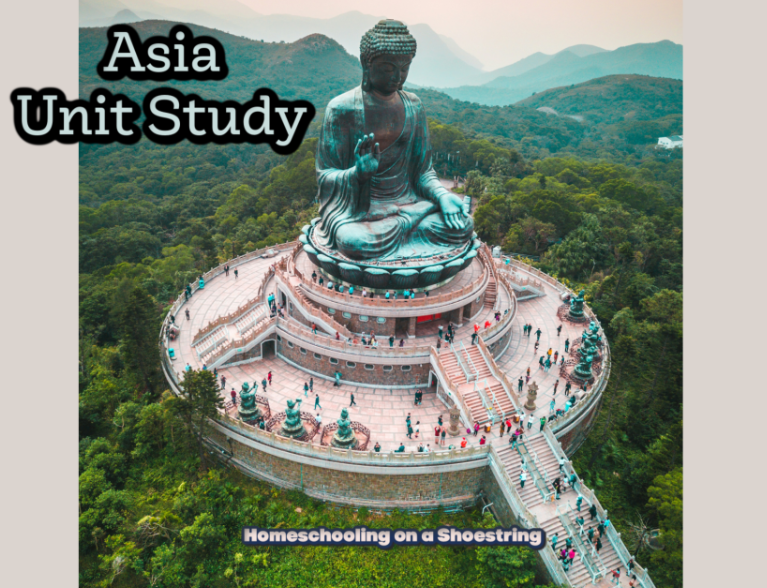
Asia Unit Study
Asia is the largest continent on Earth, and more than half of all the people in the world live there. It stretches from the deserts of the Middle East to the islands of Japan and Indonesia, and from the frozen north of Russia to the rain forests of Southeast Asia. Asia has the tallest mountain in the world, Mount Everest, and some of the oldest civilizations, along with the birthplaces of many of the world’s religions, writing systems, and inventions like paper, the compass, and silk.
This Asia Unit Study visits China, Japan, India, Israel, and other countries across the continent. Fold origami, build an abacus, make paper lanterns and a carp kite, write a haiku, cook chapatis and scrambled Chinese eggs, float an egg in Dead Sea salt water, read folktales from all over Asia, and play Asian Countries Rummy. Books, videos, crafts, recipes, lapbook ideas, and homemade games work for every age, from preschool to high school.
Learning Objectives
Many parents and teachers will need to create their own goals. You can compare the goals at these sites to create your own goals depending on how stringent your requirements need to be. All links have several suggested activities for different ages.
Suggested Curriculum Standards:
- World Book Scope Basic Course structure https://www.worldbook.com/typical-course-of-study.aspx
- Michigan Department of Education https://www.michigan.gov/mde/services/academic-standards
- Maine as an example of state level requirements https://www.maine.gov/doe/standards/ela/resources
- California state level requirements https://www.cde.ca.gov/be/st/ss/
- Ontario Canada K-8 Expectations https://www.dcp.edu.gov.on.ca/en/curriculum#elementary
- Abeka Scope and Sequence https://www.abeka.com/HomeSchool/ScopeAndSequence.aspx
- The series of books called “What your nth Grader needs to know” May also be helpful nth representing the grade your child is in. This series only Goes to grade 8
- Label the countries of Asia on a map, along with their capitals and major cities
- Locate important rivers, mountains, deserts, and seas, including the Himalayas, the Yangtze, the Ganges, the Gobi Desert, and the Dead Sea
- Recognize famous landmarks such as the Great Wall, the Taj Mahal, and Mount Fuji
- Describe the climates and ways of life in different parts of Asia
- Learn some words in Japanese, Hindi, Chinese, and Hebrew
- Compare folktales from Asia with familiar stories
- Appreciate the many cultures, foods, holidays, and beliefs found across Asia
Asia Facts
- Asia has 48 countries. China and India each have more than a billion people.
- Mount Everest, on the border of Nepal and China, is the tallest mountain in the world at 29,032 feet.
- The Dead Sea, between Israel and Jordan, is the lowest place on land, about 1,400 feet below sea level. Its water is so salty that people float on top of it.
- The Great Wall of China was built and rebuilt over about 2,000 years to protect China from invaders.
- The Taj Mahal in India was built by Emperor Shah Jahan in memory of his wife.
- The Chinese invented paper, the compass, gunpowder, printing, and the kite. Fortune cookies, though, were invented in the United States.
- Japan is made up of four main islands and thousands of small ones.
- Giant pandas live only in the bamboo forests of the mountains of central China.
- Rice is the main food for more than half of the people in Asia.
- Chinese is written in characters instead of letters, and traditionally from top to bottom.
Famous People of Asia
Choose one to research and write a short biography:
- Confucius, Chinese teacher and thinker
- Siddhartha Gautama, the Buddha
- Akbar the Great, emperor of India, and Birbal, his wise advisor
- Marco Polo, who traveled from Italy to China on the Silk Road
- Mahatma Gandhi, who led India to independence through peaceful protest
- Pearl S. Buck, American author who grew up in China
- Tenzing Norgay and Edmund Hillary, the first to climb Mount Everest
- Golda Meir, prime minister of Israel
- Mother Teresa, who cared for the poor in Kolkata, India
Timeline
Events to add to your timeline:
- About 2500 BC: Cities of the Indus Valley in what is now Pakistan
- About 1750 BC: Hammurabi writes his law code in Babylon
- About 500 BC: Confucius teaches in China and the Buddha teaches in India
- 221 BC: China is united under its first emperor, who begins joining walls into the Great Wall
- About 130 BC: The Silk Road links China with Persia and Rome
- About 105: Paper is invented in China
- 1271 to 1295: Marco Polo travels to China and back
- 1632 to 1653: The Taj Mahal is built
- 1947: India becomes independent
- 1948: Israel becomes a nation
- 1953: Tenzing Norgay and Edmund Hillary climb Mount Everest
Vocabulary
| abacus | continent | monsoon | pagoda |
| bamboo | dynasty | mosque | population |
| calligraphy | emperor | origami | rice paddy |
| chopsticks | haiku | oasis | sari |
| character | kimono | peninsula | synagogue |
| Silk Road | temple | steppe | tsunami |
- Copy each word and its definition onto a sheet of paper for your portfolio.
- Make flash cards with the word on the front, then have the kids hand write the definition in their own words on the back.
- Look up words with WordWeb, free downloadable software, or the online Dictionary.com.
Words to Learn
- Japanese: konnichiwa (hello), arigato (thank you), hai (yes), sensei (teacher), and ichi, ni, san (one, two, three)
- Chinese (Mandarin): ni hao (hello), xie xie (thank you), and yi, er, san (one, two, three)
- Hindi: namaste (hello), dhanyavaad (thank you), haan (yes), and nahin (no)
- Hebrew: shalom (hello, goodbye, and peace), todah (thank you), and achat, shtayim, shalosh (one, two, three)
Book Resources
Folktales
- Lon Po Po: A Red-Riding Hood Story from China by Ed Young
- Yeh-Shen: A Cinderella Story from China by Ai-Ling Louie
- The Seven Chinese Brothers by Margaret Mahy
- Tikki Tikki Tembo by Arlene Mosel
- Ming Lo Moves the Mountain by Arnold Lobel
- Foolish Rabbit’s Big Mistake by Rafe Martin
- The Empty Pot by Demi
- The Dragon’s Tale and Other Animal Fables of the Chinese Zodiac by Demi
- The Lost Horse by Ed Young
- Ten Suns: A Chinese Legend by Eric A. Kimmel
- The Rainbow People by Laurence Yep
- The Peacock’s Pride by Melissa Kajpust
- The Nightingale by Hans Christian Andersen
- Folktales from India by A. K. Ramanujan: Includes stories of Akbar and Birbal.
Picture Books
- The Story of Chopsticks by Ying Chang Compestine
- The Runaway Rice Cake by Ying Chang Compestine
- Moon Festival by Ching Yeung Russell
- Dragon Parade: A Chinese New Year Story by Steven A. Chin
- Mei Li by Thomas Handforth
- How My Parents Learned to Eat by Ina R. Friedman
- Grandfather’s Journey by Allen Say (and other books by Allen Say)
- No Dinner! The Story of the Old Woman and the Pumpkin by Jessica Souhami
- Tigers at Twilight (Magic Tree House) by Mary Pope Osborne
Chapter Books and Nonfiction
- Young Fu of the Upper Yangtze by Elizabeth Foreman Lewis
- The House of Sixty Fathers by Meindert DeJong
- Homesick: My Own Story by Jean Fritz
- China’s Long March: 6,000 Miles of Danger by Jean Fritz
- Li Lun, Lad of Courage by Carolyn Treffinger
- The Star Fisher and Child of the Owl by Laurence Yep
- Sadako and the Thousand Paper Cranes by Eleanor Coerr
- China: The People, and India: The Culture by Bobbie Kalman
- Look What Came From India by Miles Harvey
- The Great Games Book by Susan Adams (DK): Games from around the world, including Spillikins from China.
- Celebrations! by Barnabas and Anabel Kindersley (DK): Festivals around the world, including Chinese New Year.
Poetry and Music
- Write a haiku: three lines with 5, 7, and 5 syllables, usually about nature.
- Sing “Ichi, Ni, San” (one, two, three in Japanese) to the tune of “Three Blind Mice.”
- Listen to traditional music from China, Japan, and India, such as the erhu, koto, and sitar.
- Watch a performance of Bharatanatyam, a classical dance from India that tells stories with the hands, eyes, and face. Many cultural fairs have dancers.
Videos
- Big Bird in Japan (1988)
- Big Bird in China (1983)
- Mulan (Disney, 1998)
Activities
China
- Salt map: Make a map of China with blue yarn rivers, yellow tissue paper deserts, and brown paper mountains.
- Chinese characters: Practice writing a few characters from top to bottom with a thin brush and black paint.
- Chinese inventions: Have a wheelbarrow race, make and fly a kite, and try block printing with a carved potato to celebrate Chinese inventions.
- Pandas: Make a panda-shaped book and fill it with what you learn about pandas.
- Lantern Festival: Make paper lanterns and learn about the festival at the end of Chinese New Year.
- Compare folktales: Read Lon Po Po and Little Red Riding Hood, or Yeh-Shen and Cinderella, and make a chart of what is the same and different.
- Tangrams: Cut a square into the seven tangram pieces and make animals and shapes.
Japan
- Abacus: Thread beads or buttons onto string or pipe cleaners stretched across a shoebox lid, and learn to count on it.
- Japanese homes: Draw a picture of a Japanese home with futons, low tables, and paper screens. Make a “paper wall” by ironing tissue paper between sheets of wax paper.
- Children’s Day: On May 5, families fly carp kites called koinobori. The carp stands for strength and courage because it swims upstream. Make one from paper with crepe paper streamers.
- Hina Matsuri (Doll Festival): On March 3, families display dolls for their daughters. Set up your own doll display.
- Fukuwarai: Like pin the tail on the donkey, players are blindfolded and place the eyes, nose, and mouth on a face outline.
- Shadow tag: In the Japanese game kage-fumi, “it” tries to step on your shadow. Talk about what makes a shadow.
- Schools in Japan: Make a Venn diagram comparing Japanese and American schools.
- Bowing: Practice bowing as a greeting, the way people in Japan do instead of shaking hands.
India
- Map India and find the Ganges River, the Himalayas, and the Taj Mahal.
- Dress up: Wrap a long piece of fabric into a sari or a dhoti.
- Raksha Bandhan: At this festival, sisters tie bracelets on their brothers’ wrists, and brothers promise to protect them. Make a bracelet for a brother or sister and list what makes them special.
- Flag of India: Color the flag and learn about the wheel in the center, the Ashoka Chakra.
- Gandhi: Read about Gandhi and talk about how he changed India without violence.
- Akbar and Birbal: Read some of the wisdom stories of Birbal and act one out.
Israel
- Map Israel and find Jerusalem, the Sea of Galilee, the Jordan River, and the Dead Sea.
- Dead Sea float: Put an egg in a glass of fresh water, then stir in salt, a spoonful at a time, until the egg floats. The Dead Sea is almost ten times as salty as the ocean.
- Dreidel: Make a dreidel and learn to play the game children play during Hanukkah.
- Soccer: Soccer is the most popular sport in Israel. Learn the rules and play a game.
Writing Prompts
- You are traveling the Silk Road with Marco Polo. Write a letter home about what you see.
- Which country in Asia would you most like to visit, and why?
- Retell a folktale from Asia in your own words.
Recipes
Scrambled Chinese Eggs
- 2 tablespoons oil
- 1/2 onion, minced
- 6 to 8 eggs
- 2 teaspoons gluten-free soy sauce or liquid aminos
Heat the oil in a frying pan or wok and cook the onion until soft. Beat the eggs with the soy sauce, pour them in, and stir over medium heat until cooked. Serve with rice and stir-fried snow peas, bean sprouts, or bamboo shoots. Eggs have protein, and snow peas and bean sprouts add vitamin C and crunch.
Chapatis (Indian Flat Bread)
- 2 cups gluten-free all-purpose flour blend (one with xanthan gum)
- 1 tablespoon vegetable oil
- 1/2 teaspoon salt
- About 3/4 cup warm water
Mix the flour, oil, and salt in a large bowl. Add the water a little at a time to make a soft dough that isn’t sticky, and let it rest 10 minutes. Divide it into 8 balls. Roll each ball between two sheets of parchment paper into a thin circle about 5 inches across. Cook in a dry skillet over low to medium heat, turning several times, until it puffs and has light brown spots. Serve warm with butter, curry, or dal. Use a flour blend labeled certified gluten-free so it is safe for anyone with celiac. Gluten-free chapatis may not puff as much as wheat ones, but they taste just as good.
More Recipe Ideas
- Candy sushi: Lay a marshmallow cereal treat made with gluten-free crispy rice cereal, pressed flat (the rice), on a fruit roll-up (the seaweed), add a gummy worm (the fish), roll it up tight, and slice.
- Fortune cookies: Even though they were invented in America, they are fun to make with a gluten-free flour blend. Write fortunes, riddles, or jokes on small slips of paper to tuck inside.
- Stir-fry feast: Stir-fry broccoli, carrots, and celery with a splash of gluten-free soy sauce or liquid aminos and serve with sticky rice.
- Falafel: Mash canned chickpeas with onion, parsley, garlic, and cumin, add chickpea flour or gluten-free bread crumbs until it holds together, shape into small patties, and fry or bake until golden. Chickpeas are full of protein and fiber.
Field Trips
- Asian market: Look for foods, spices, and products from different countries in Asia.
- Chinese, Japanese, Indian, Thai, or Middle Eastern restaurant: Try something new.
- Japanese garden or botanical garden: Many have bonsai trees and koi ponds.
- Art museum: Look for Chinese pottery, Japanese prints, and Indian sculpture.
- Cultural festival: Look for Chinese New Year, Diwali, or Asian heritage festivals in your area.
Art and Craft Ideas
- Origami: Fold a cup, a cat, a crane, or a samurai helmet from newspaper.
- Paper fans: Draw a design on paper, accordion fold it, and staple or tape the bottom.
- Paper lanterns: Fold a sheet of construction paper in half the long way, cut slits from the fold, open it, and staple the ends together.
- Chinese New Year dragon: Make a long dragon from folded paper diamonds or a paper bag head and crepe paper body, and hold a dragon parade.
- Kimono: Trace a kimono shape on wrapping paper or decorate an old adult T-shirt.
- Daruma doll: Paint a face on a plastic egg and weight the bottom with clay so it rolls back up.
- Pagoda: Design a pagoda from boxes. Each story should be smaller than the one below it.
- Rangoli: Make a colorful floor design from India using colored rice, sand, or chalk.
- Flags: Make the flags of Japan, China, India, and Israel.
Information and General Resources
- Enchanted Learning: Asia: Maps and printables.
- CIA World Factbook: Maps and facts for every country.
- National Geographic Kids: Countries
- Wikipedia: Asia
Lapbook Ideas
- Map of Asia: Countries, capitals, rivers, and mountains.
- Country Flap Book: China, Japan, India, and Israel, with a flag, a word, a food, and a holiday for each.
- Landmarks Mini Book: The Great Wall, the Taj Mahal, Mount Fuji, Mount Everest, and the Dead Sea.
- Words to Learn Pocket: Hello and thank you in four languages.
- Folktale Comparison Chart: An Asian folktale and the story it reminds you of.
- Haiku Card: Your own haiku.
- Chinese Inventions Wheel
- Vocabulary Pocket: Flash cards for the vocabulary words.
Games
Use these ideas to turn key concepts from this unit into creative, engaging games your learners will love.
Game Board Blanks
Create your own themed games for this unit using printable templates and inspiration from the sites below:
- Games . . . Tools for Learning by Mark and Janice Vreeland
- Games for Learning ideas from Mary Peterson
- Board Game Templates – Tim’s Printables – free blank game boards
- JustFamilyFun – Board Game Paths
- Cardboard Cognition: Educational Board Games: An archived San Diego State University chart that helps you pick the right type of board or card game to make, with ideas for game boards and pieces.
More Game Ideas
- Spillikins: A Chinese game like pick-up sticks. Use bamboo skewers with the points cut off.
- Dreidel: Use beans, pennies, or raisins as game pieces.
- Fukuwarai and shadow tag: See the Japan activities above.
- The Eagle and the Chicks: A tag game played in China and Korea. One player is the eagle, one is the mother hen, and the chicks line up behind her holding onto each other’s waists while she protects them.
- Use the shape of a fan or lantern for any skill in a file folder game.
- Printable Board Games: Blank boards and parts for making your own games.
Neverending Card Deck
Use the Neverending Card Deck card and box templates to make your own sets. You can flip the card template to print your custom design on the back. Free clipart works great for themed backs or matching your card box. These cards can be used in both card games and board games.
Asia Card Game: Asian Countries Rummy
Make a deck of 40 cards from index cards or cut-up cereal boxes. Choose 10 countries in Asia and make 4 cards for each one: the country name, its flag, its capital, and a landmark or famous thing.
- China: Beijing. The Great Wall.
- Japan: Tokyo. Mount Fuji.
- India: New Delhi. The Taj Mahal.
- Israel: Jerusalem. The Dead Sea.
- Nepal: Kathmandu. Mount Everest.
- South Korea: Seoul. Kimchi.
- Thailand: Bangkok. Elephants.
- Vietnam: Hanoi. Rice paddies.
- Indonesia: Jakarta. Thousands of islands.
- Mongolia: Ulaanbaatar. The Gobi Desert.
How to play:
- Deal 7 cards to each player. Put the rest face down in a pile and turn the top card face up to start a discard pile.
- On your turn, draw one card from either pile, then discard one card.
- When you collect all 4 cards for one country, lay them down and find it on the map.
- The first player to lay down two complete countries wins.
These cards also work with your homemade file folder and board games. Players draw a card and name the country’s capital before they move.
GeoSafari Cards
Using the GeoSafari Instruction Guide, you can create a wide variety of custom cards for this unit. GeoSafari is especially great for independent learning and long car trips!
Donna Young shows you how to make GeoSafari Cards
DIY Card Ideas
- Timeline event ↔ date matching cards
- True or false review questions
- Vocabulary words ↔ real-life images
- Chapter-based quizzes or review sets
More GeoSafari Card Ideas
- Match countries to their capitals.
- Match landmarks to their countries.
- Label rivers and mountain ranges on a map card.
Worksheets
Make your own worksheets with these worksheet creation tools:
- SchoolHouseTech https://www.schoolhousetech.com/ This company gives away two free software worksheet factories one for Basic math and one for wordsearch utility that will make wonderful complements to this unit when you include the clipart listed in the clipart section.
- Start Write – This program makes nice reports and handwriting worksheets for the unit. https://www.startwrite.com/
- TeachNology has several online worksheet makers and a ton of Rubric makers. Rubrics work great with Homeschool Tracker because they give you total points and you count up exactly how many points your child gets. https://www.teach-nology.com/worksheets/
- Online Crossword Puzzle Maker to use with your vocabulary words or locations or even dates from the timeline. https://www.happychild.org.uk/wks/english/ssm/crosswords01.htm
- National Geographic MapMaker: Blank and filled-in maps.
- Lizard Point Asia Quiz: A customizable countries quiz.
Evaluation Ideas
Assemble a three ring binder and please include:
- A copy of this unit
- Course Description (Highschool Students)
- Write a summary about books read for the unit
- Write an essay on the various topics discussed
- Your Lapbook created for the unit (K-8 Students)
- Any worksheets or activity books created with SchoolhouseTech Software https://www.schoolhousetech.com/
- Your journal and its contents
- Your Log of activities from Homeschool Tracker https://www.homeschooltracker.com/free-homeschool-tracker-basic-edition Its Free!
- Your Timeline
- Give the student a blank map of Asia to label countries and landforms.
- Have the student present one country to the family with a food, a word, and a craft.
Related Unit Studies from Homeschooling on a Shoestring


More Unit Studies
Looking for your next topic? The Unit Studies directory has free and low-cost activities, lesson plans, worksheets, study guides, books, recipes, lapbook ideas, and games for homeschooling on a shoestring: https://homeschoolingonashoestring.com/homeschooling/homeschooling-by-subject/unit-studies/
Last Updated on November 2, 2026 by Jodi